
BLOG
How Is the Cost of System Development Determined? Work Volume, the Rate and the Breakdown
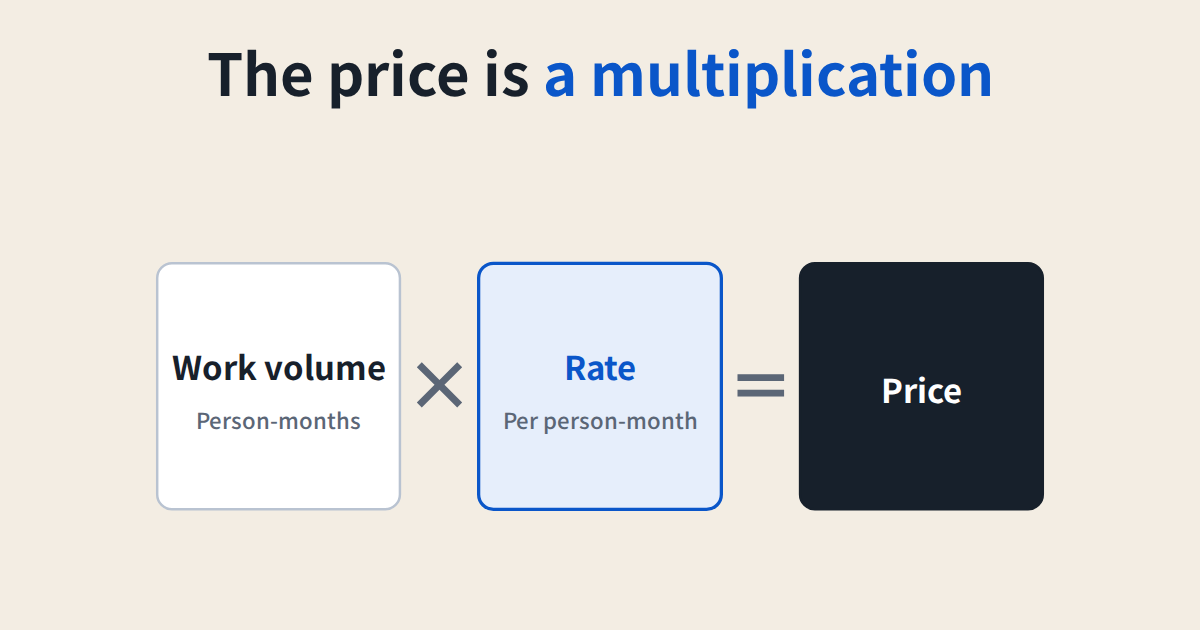
The cost of system development is set by multiplying how much work is needed (the work volume) by the rate for that work. The work produces nothing you can hold, so unless these two are visible, you cannot see what the money goes to.
Amounts differ widely between companies because both the expected work volume and the rate differ from one company to the next. Once you know which of the two differs, you can compare estimates.
In this article, the buyer means the company that commissions the system. It explains, from the buyer's side, the basic form of the price, how work volume is counted, how to think about the rate, and why the same request gets different prices.
If you want to see the basis of the price as effort per function, use our free estimate consultation.

About the author

wesionaryTEAM Editorial Team
The editorial team is made up of wesionaryTEAM's project managers and engineers. Drawing on what we learn every day on business system, AI adoption and digital transformation projects, we publish information people can use when making decisions, with cases and figures.
The price is work volume times rate
The price of system development is determined by two things.
- Work volume. How much labour and time it takes to build. It is also called effort.
- Rate. The amount charged for one person doing that work for one month.
Work volume is measured in person-months. One person working for one month is one person-month. Work that takes two people three months is six person-months. The amount per person-month is the person-month rate, and work volume times that rate is the price of development.

Even when an estimate says only "lump sum", this calculation is always behind it. If the amount does not make sense to you, asking whether it is the work volume or the rate that is large makes the discussion concrete.
Work volume is counted by adding up what is built
Counting work volume starts by breaking what is built into parts. Four kinds of parts are counted.

- Screens. Screens for input, for viewing lists, for settings.
- Forms. Things that are printed or exported, such as invoices and delivery notes.
- Functions. Processing behind the screens, such as calculation, approval flows and notifications.
- Links. Exchanging data with accounting software or existing systems.
For an inventory system, for example, the parts are listed as a screen for recording goods in, a list of stock by site, a monthly stocktaking form, and a link to the accounting software. The work needed for each is estimated and added up.
Another method is to estimate from the record of similar past projects. In practice the two are combined.
A reserve is normally added to the counted work. As development goes on, work that was not expected always appears. How much reserve is added depends on how clearly the system is defined. If what is to be built is vague, the expected work is vague too, and the reserve grows.
The rate varies by company and team
A person-month rate is not the engineer's salary. It is an amount that includes the cost of running the company.
Rates are not uniform. They vary with points such as these.
- The role and experience of the person. The person who leads the whole project and the person who builds to instructions have different rates.
- The company and the team. The size of the company, how it works, and how many companies are involved all change it.
- The type of development. Building from scratch and using an existing package differ.
There are public figures for reference. The Software Metrics Survey 2025 by the Japan Users Association of Information Systems (JUAS) derives a person-month rate of 1.27 million yen from the relation between total cost and work volume. Among projects where the outsourcing cost is known, the average was 0.96 million yen for development from scratch and 1.44 million yen for development using a package.

The figures are averages over the responding companies' projects. Actual rates can differ widely by company, and some are higher and some lower than these. Treat them as one point of reference.
Rates themselves keep rising. According to the Bank of Japan's Services Producer Price Index, the price of software development stood at 112.8 in September 2026 (preliminary), with 2020 as 100.
Writing code is only part of the work
Development work brings to mind someone writing code. That is only part of the work volume.
The same JUAS survey gives the share of work by phase. Rounded to the nearest 5%, requirements definition is 15%, design through integration testing is 60%, and system testing is 25%. Requirements definition is the step of writing down what will be built. System testing is the step of checking the finished system as a whole against how it will actually be used.

Deciding what to build and checking what was built take 40% of the whole. On top of this come managing progress, moving data from the old system, and preparing for use.
When an estimate looks cheap, some of this work may have been left out. When you compare amounts, it is essential to check which phases are included.
Why the same request gets different prices
When you consult several companies about the same thing, the amounts can differ widely. There are three reasons.

- The assumptions differ. Work volume changes with the number of screens, the number of users and the amount of data assumed.
- The scope differs. Some companies include testing, data migration and preparation for operation; others estimate them separately.
- The team and the rate differ. Who is assigned, and whether someone is assigned to manage progress, change both the rate and the work volume.
Both work volume and rate can differ widely by company. Comparing only the totals does not tell you which one differs. If the expected work volume differs, the companies have different sizes of system in mind. If the rate differs, the people and the team differ.
A low estimate is not bad in itself, and a high one is not a guarantee. We describe a case where the number of digits was no measure of the content in our article on taking over work started elsewhere. When the price becomes fixed is explained in Rough Estimates in System Development.
Four factors on the buyer's side that move the price
The price also changes with what the buyer decides.

- Scope. Building everything at once, or starting with the necessary part. A narrower scope means less work.
- Users and volume. More users and more data mean more design and testing work.
- Links to what exists. Whether to connect to the current system or accounting software, and whether to move past data, changes the work greatly.
- Timing. The more urgent, the more people are needed and the less slack there is.
When these four are known at the consultation, the estimator can set assumptions, and the basis of the amount becomes clear. How the schedule is set is explained in How Long Does System Development Take.
Three numbers to check on an estimate
Put in terms of what to check when an estimate arrives, there are three numbers.

- Work volume. How many person-months in total. With a breakdown by screen or function, you can see where the work is.
- Rate. How much per person-month. Some estimates give different rates by role.
- Phases included. Whether requirements definition, testing, data migration and progress management are in.
An estimate that states none of the three gives you no way to check the basis of the amount. If they are not written, ask. Whether you get an answer is itself a reason to choose or not choose a company.
How we arrive at the price
Before the contract we give a rough estimate for grasping the scale, and at the contract we present the estimate and fix the amount. Only when there are many other things you want to do, we estimate the difference after requirements definition.

When we estimate, we mainly submit three documents: the estimate, the proposal and the effort by function (detailed). The effort by function lists the work volume counted function by function, so you can check how much work each function takes. The assumptions and what is not included are also given in writing. You can view all three at any time on a screen dedicated to you in our project management tool, projectAI.
When something to add comes up during development, we go ahead only after you have confirmed its effort in projectAI. If you have another company's estimate, please compare on the same scope. We provide the effort-by-function list through our free estimate consultation.
FAQ
What is the market price of system development?
It depends on the size of what is built, so it cannot be shown as one amount. Even for the same request, the amount changes greatly with the assumptions and scope. Comparing the assumptions and scope of several estimates is more reliable than looking up a market price.
Will choosing a company with a low person-month rate cost less?
Not necessarily. The amount is work volume times rate, so a low rate can still mean a high amount if the work volume is large. Differences in rate also reflect differences in people and team. Check the expected work volume and the scope included as well.
How can we keep the cost down?
The basic way is to reduce the work volume. Separate the functions you must have from those that can wait, and narrow the first scope. With an estimate that shows the work volume per function, you can check how much the amount falls when a function is moved to later. Cutting testing or requirements definition can cost more in the end through rework.
Are there costs after development ends?
Yes. Usage fees for servers and the like, and maintenance costs for fixing defects and making improvements, continue while you use the system. In a 2014 JUAS survey, the yearly maintenance cost of in-house developed systems averaged 8.7% of the initial development cost. Check them together with the development amount when you receive an estimate.
Summary
The price of system development is work volume times rate. Both the expected work volume and the rate can differ widely by company. When you compare amounts, check the assumptions, the scope and the team behind them.
We submit a list of work volume counted function by function, so you can check the basis of the amount. Even if what you want to build is not yet settled, please use our free estimate consultation.
Related articles and pages
- How to Read a System Development Estimate: Four Places the Buyer Checks
- What Is an RFP? Its Role, Its Items, and Why Five Fields Are Enough to Start
- What System Maintenance Costs Cover: The Cost After Go-Live and What to Check Before the Contract
- What Is Contract Development? Contract Types and What to Decide Before You Order
- System development: contract development from requirements to operation
- Free estimate consultation
Sources
- Japan Users Association of Information Systems, "Software Metrics Survey 2025 Guidebook", April 2025 (Japanese)
- Bank of Japan, "Services Producer Price Index, September 2026 preliminary", October 2026 (Japanese)
- Japan Users Association of Information Systems, "Software Metrics Survey 2014, Maintenance Survey Report", June 2014 (Japanese)
Reviewed by

Ichiro NagataCEO and Representative Director
A former engineer at Yahoo! JAPAN. For more than 18 years at startups and large companies, he has worked on a wide range of projects, from new consumer and business ventures to the digital transformation of operations. Alongside hands-on development as an engineer, he has built and managed teams, designed businesses and tested hypotheses, gaining broad experience in launching and growing businesses. He has been through three business sales. Convinced that co-creation makes products better and lets ideas be tested in the market, he founded wesionaryTEAM to offer a co-creation platform.