
BLOG
How Long Does System Development Take? What Sets the Schedule and How to Shorten It
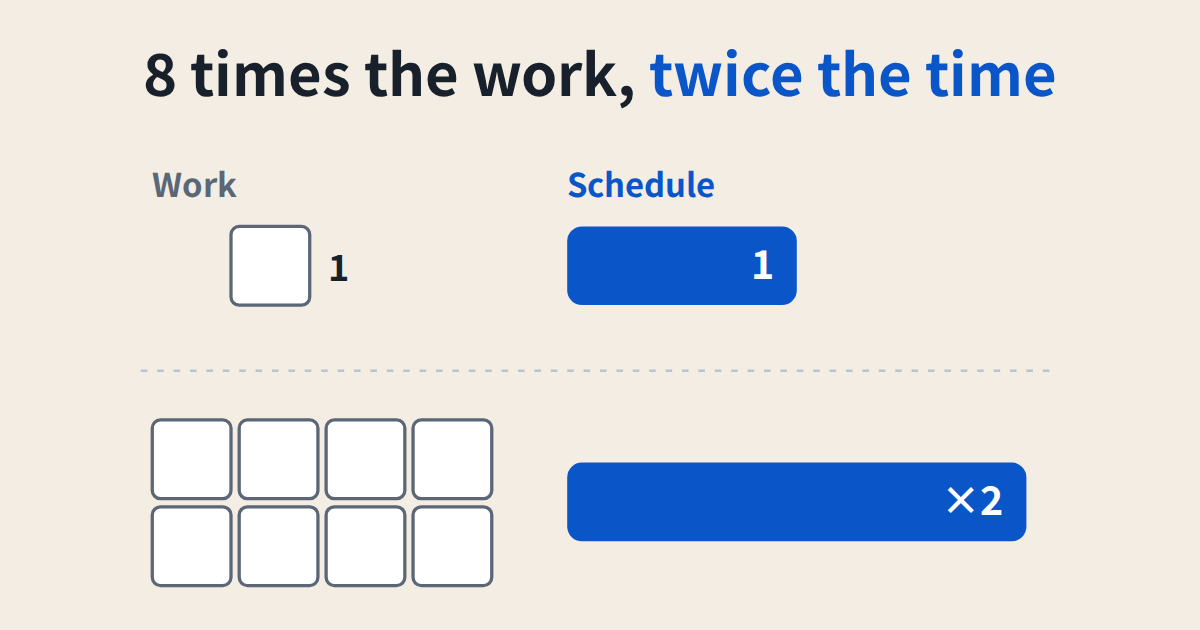
The schedule of system development is set mainly by the work volume. By the formula in a public survey, the standard schedule is about 9.7 months for 27 person-months of work and about 16 months for 125 person-months. A person-month is the work one person does in one month.
The schedule does not grow as fast as the work: even eight times the work takes only about twice as long. To shorten the schedule, start by narrowing what is built.
In this article, "the buyer" means the company that commissions the system. We cover what sets the schedule, how each phase uses time, what happens when it is cut too short, and how to shorten it. The survey and the model contract cited here are Japanese.
If the date you want to start using the system is fixed, start with the schedule in our free estimate consultation.

About the author

wesionaryTEAM Editorial Team
The editorial team is made up of wesionaryTEAM's project managers and engineers. Drawing on what we learn every day on business system, AI adoption and digital transformation projects, we publish information people can use when making decisions, with cases and figures.
The schedule can be estimated from the work volume
The Software Metrics Survey 2025 of the Japan Users Association of Information Systems (JUAS) puts the relation between work volume and schedule into a formula, from 232 actual projects. The standard schedule in months is 3.23 times the cube root of the work volume in person-months.
The report gives an example. For a project of 125 person-months, the cube root is 5, and multiplying by 3.23 gives 16.15 months as the standard schedule.

Applying the same formula, 8 person-months gives about 6.5 months, 27 gives about 9.7 and 64 gives about 12.9. Even when the work is eight times larger, the schedule is twice as long. In a larger project, the work can be divided and carried out in parallel.
According to the report, nine tenths of the difference in schedule between projects is explained by the work volume. To know the schedule, you first need to know the work volume. If the estimate states the work volume, you can also check the basis of the schedule.
The formula averages many actual projects. It does not guarantee the schedule of an individual project, which moves up or down with what is built and with the team.
Each phase uses time differently
System development goes through requirements definition, design, build and testing, in that order. Requirements definition is the phase in which what to build is decided and put into a document.
The same JUAS survey shows the share of the schedule by phase. Rounded to the nearest 5%, requirements definition takes 20%, design to integration testing 50%, and system testing 30%. The shares of effort, in the same order, are 15%, 60% and 25%.

Requirements definition takes a larger share of the schedule than of the effort. The report's view is that, compared with the other phases, it is not suited to dividing the work among people.
In other words, deciding does not shrink much when you add people. Design to integration testing is the opposite: the work is easy to divide, and its share of the schedule is smaller.
The 30% for system testing includes the period of support right after go-live. According to the report, this period is 11% of the whole, about twice its share of effort (5%). Its view is that, because what will happen cannot be specified in advance, time is needed to consider how to respond. The day you start using the system is not the end of the schedule.
The actual schedule runs about one tenth longer than planned
The same survey also compares the planned and the actual schedule. The planned schedule was 1.04 times the standard schedule given by the formula. The actual schedule was 1.08 times.

The report says it is safe to plan with about one tenth of slack over the standard schedule.
The tendency is stronger in small projects. In projects under 50 person-months, the actual schedule exceeded the standard schedule in 56% of cases. The report says it is desirable to plan with slack over the standard schedule.
When the date cannot move, work back from it and check with the development company a plan that includes slack. As points to note for keeping the planned schedule, the report lists three: sharing the awareness that the date comes first, making the requirements clear and keeping specification changes to a minimum, and setting a plan with more slack than the standard.
Projects that put the date first do keep it more often. In the same survey, the share that finished on or ahead of plan was 74.5% for projects that gave priority to the date and 61.6% for projects that gave priority to something else. If the date matters, it is worth saying so at the start. Why projects run late and how to prevent it is explained in Why System Development Is Delayed, and Four Things the Buyer Can Do.
Part of the schedule is the buyer's own work
The development company does not use the whole schedule. There are phases the buyer leads.
The Model Transaction and Contract for Information Systems, published by the Information-technology Promotion Agency, Japan (IPA) and the Ministry of Economy, Trade and Industry, treats requirements definition as work the buyer carries out with the development company's support. Before go-live there is also testing that the buyer does itself.

In the JUAS survey, requirements definition was 20% of the schedule and testing by the buyer (the user system test) was 16%. Together they are a little over a third of the schedule.
This part becomes longer or shorter with how the buyer acts. The schedule tends to stretch in three situations.
- Decisions. The person who decides what to build cannot attend the meetings.
- Reviews. Replies to questions and requests for approval come late.
- Data. The data and forms of the current system are slow to arrive.
Each of them stops the development company's work. The team is kept in place while it waits, so this can affect the cost as well as the schedule. On the buyer's side, write into the development schedule who checks what, and when. How the buyer tests before acceptance is explained in What Is an Acceptance Test (UAT).
Cutting it too short brings more defects after go-live
A shorter schedule is not always better.
The JUAS survey compares projects whose planned schedule was shorter than the standard with those at or above it. The average number of defects found right after go-live was 5.94 for plans at or above the standard and 11.2 for plans shorter than the standard, about 1.9 times.

The defects found in the buyer's own testing were 27.5 and 28.3, with no large difference. The difference appeared after the system came into use.
The report's view is that, with a relatively short plan, how the system will be used is not considered deeply enough and exceptions are not given enough attention. The time that was cut comes back as rework after you start using the system.
Three ways to shorten the schedule
To shorten the schedule without lowering quality, reduce the work volume and the waiting time, not the time for checking.

- Decide quickly. Answer questions and requests for review within the time set. The model contract also says it is important that the buyer's decisions on changes are made promptly.
- Start small. Build the needed part first. As the formula shows, less work means a shorter schedule.
- Hand over materials early. Give the screens, forms and data you use today at the first stage.
Starting small has the largest effect. Instead of building everything at once, build the part you will use first and start using it, then build the rest in the next stage. What you learn from using it can also go into the next stage.
When you want a shorter schedule, we do not recommend asking for the testing and review periods to be cut. As the figures in the previous section show, it comes back later as defects.
How we work
We run development in two-week sprints. A sprint is a unit in which we decide the functions to build in that round and build and test them within two weeks.

We do not wait until every function is ready: once a function has finished testing, we send an acceptance request through our project management tool, projectAI. Acceptance work does not pile up at the end, and early comments can be applied to the functions still being built, which keeps rework small.
You can check the status of each function in projectAI at any time. If the date you want to start using the system is fixed, please tell us in our free estimate consultation.
FAQ
How long does it take from the first consultation until building starts?
After the estimate and the contract, building starts once requirements definition has settled what to build. Requirements definition takes about a fifth of the schedule, so include this time when you count back from the date you want to start using the system.
The date we want to start is fixed. How can we make it?
Narrow the scope. Build first the part needed on that date and move the rest to a later stage. We do not recommend making the date by cutting the testing period.
How can we check whether the schedule on an estimate is reasonable?
Ask how many person-months the work is and what the schedule is based on. Also check when the buyer's own work falls and how much slack is included.
When does the schedule slip partway through?
When decisions or replies to review requests are late, and when what is to be built grows partway through. Deciding at the start who replies and by when, and until when additions are accepted, helps prevent it.
Summary
The schedule of system development is set mainly by the work volume. The actual schedule tends to run about one tenth longer than planned, and a little over a third of it is phases the buyer leads. To shorten it, reduce the scope and the waiting time, not the time for checking.
We work in two-week sprints and take acceptance function by function as each is ready. Even if only the date you want to start is settled, please use our free estimate consultation.
Related articles and pages
- The Phases and Flow of System Development: What the Buyer Does at Each Phase
- Agile vs Waterfall Development: Which Should the Buyer Choose?
- What System Maintenance Costs Cover: The Cost After Go-Live and What to Check Before the Contract
- What Is Contract Development? Contract Types and What to Decide Before You Order
- System development: contract development from requirements to operation
- Free estimate consultation
Sources
- Japan Users Association of Information Systems, "Software Metrics Survey 2025 Guidebook", April 2025 (Japanese)
- Information-technology Promotion Agency, Japan and Ministry of Economy, Trade and Industry, "Model Transaction and Contract for Information Systems, 2nd edition", December 2020, revised April 2025 (Japanese)
Reviewed by

Ichiro NagataCEO and Representative Director
A former engineer at Yahoo! JAPAN. For more than 18 years at startups and large companies, he has worked on a wide range of projects, from new consumer and business ventures to the digital transformation of operations. Alongside hands-on development as an engineer, he has built and managed teams, designed businesses and tested hypotheses, gaining broad experience in launching and growing businesses. He has been through three business sales. Convinced that co-creation makes products better and lets ideas be tested in the market, he founded wesionaryTEAM to offer a co-creation platform.