
BLOG
What Is an RFP? Its Role, Its Items, and Why Five Fields Are Enough to Start
When you set out to commission a system, you may be told to "prepare an RFP first". Look it up and the list of items is long, and many people stop before they start writing.
An RFP, or request for proposal, is the document in which the buyer tells development companies what it wants built and on what conditions, and asks for proposals and estimates. It is not a document you can send only after every field is filled. For a first consultation, five fields are enough. For a field you cannot fill in, write "undecided" and fill it in during the consultation.
In this article, "the buyer" means the company that commissions the system. We cover what an RFP is for, the items of a formal RFP, the five-field minimum, how to handle fields you cannot fill in, and what to ask the development company to return. The model contract cited here is a Japanese one.

About the author

wesionaryTEAM Editorial Team
The editorial team is made up of wesionaryTEAM's project managers and engineers. Drawing on what we learn every day on business system, AI adoption and digital transformation projects, we publish information people can use when making decisions, with cases and figures.
An RFP tells the vendor what you want built
RFP stands for request for proposal. It is the document with which the buyer tells development companies what it wants built and under what conditions, and asks for a proposal and an estimate.
The Model Transaction and Contract for Information Systems, published by the Information-technology Promotion Agency, Japan (IPA) and the Ministry of Economy, Trade and Industry, is a template contract. It provides that the contract is concluded on the basis of the RFP from the buyer and the proposal and estimate from the development company. The RFP is the document from which the contract starts.

When you consult several companies, handing over the same document lets you compare proposals and estimates on the same conditions. If you explain by word of mouth, what gets across differs from company to company, and the assumptions behind the estimates do not line up.
Writing also has the effect of aligning views inside your company. When you put on one page what the trouble is and what you want solved first, you may find that each unit thought differently. Reading it through internally before sending it to development companies reduces gaps later.
A formal RFP has seven items
The model contract gives the following seven as the basic items of an RFP.

- System overview. The background, the basic policy and the intended effect.
- Proposal procedure. The briefing schedule, the contact point and how to submit a proposal.
- Requested matters. The requirements of what you want built. This is the core of the RFP.
- Development team and environment. The division of roles and the place of work.
- Guarantee requirements. What you ask for on performance and security.
- Contract matters. The form of contract, the ownership of rights, and the conditions of acceptance and payment.
- Other. Definitions of terms and the like.
The core, "requested matters", is to state not only what the system does (functional requirements) but also conditions such as speed and operation (non-functional requirements). An annex of the model contract divides the seven items further and lists about 40 individual items.
For a company with no information systems unit, writing all of this is heavy work. If you put off consulting because many fields cannot be filled, the trouble stays as it is.
The model contract was drawn up for the development of critical infrastructure and core enterprise systems. The number of items matches that scale. For a small development, there is no need to fill in every item from the start.
You can send it before everything is decided
The model contract divides RFPs into two kinds: one issued at the stage of setting the direction and the plan for the system, and one issued after requirements definition. Requirements definition is the phase in which what to build is put into a document.

Of the first kind, the model contract says that there may be undecided matters. The RFP you send for a first consultation is this kind.
Of the kind issued after requirements definition, it says that what you want built must be stated clearly, because a requirement that is not expressed is not realised in the system. Writing in detail can wait until that stage.
For a first consultation, five fields are enough
So what should you write first? From here on, this is not an official list but the minimum we recommend from the position of a company that receives consultations.

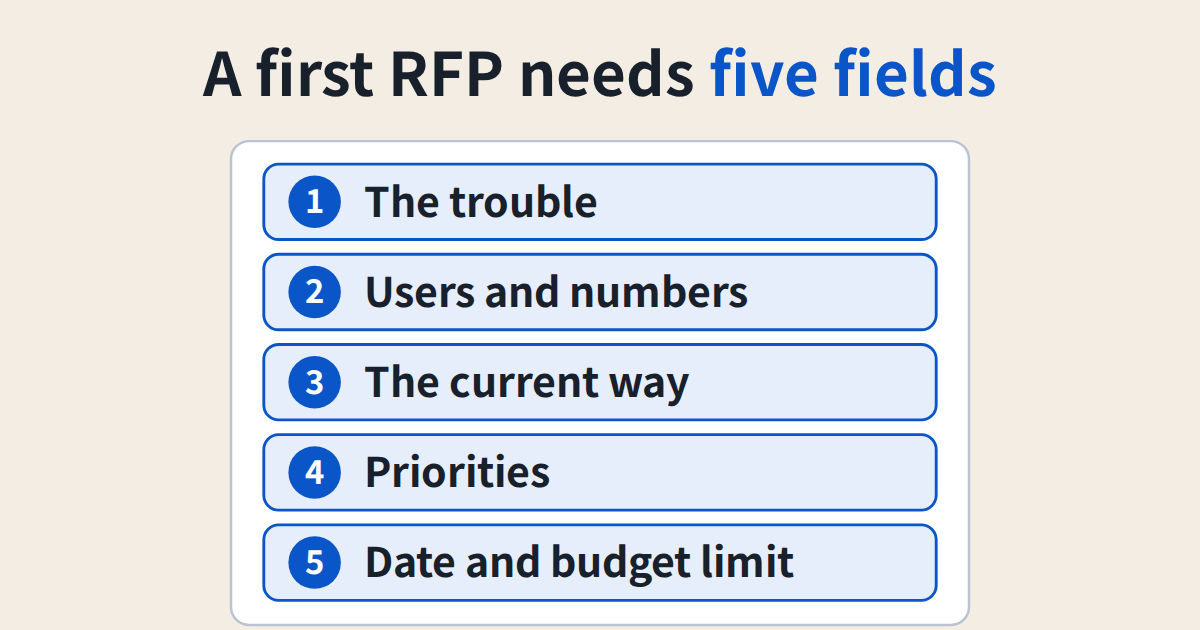
- The trouble. Before the functions you want, write what is not working now.
- Users and numbers. Only your own staff, or your customers too? About how many?
- The current way. Excel sheets, paper forms, the system in use. Attach the real ones.
- Priorities. What you must have, and what can wait.
- Date and budget limit. When you want to start using it. The amount, if a limit is set.
If preparing it in writing is hard, telling these five in the consultation call works just as well. If you do write it, one to three lines per field is enough. It fits on one page. There is no need to polish the wording, and bullet points are fine.
Here is a filled-in example, using stock control (for illustration).
- The trouble. Stock counts do not match the books.
- Users and numbers. Eight people in the warehouse and the office.
- The current way. Excel and paper slips (the real ones attached).
- Priorities. Recording goods in and out first; totals can wait.
- Date and budget limit. We want to use it from next April. The limit is undecided.
For the current way, showing the real thing gets across better than a written explanation. Attach the sheets and forms you use today as they are.
When you write, you do not need to decide the solution. Rather than "we want a smartphone app", write "we want to record stock on the spot inside the warehouse". The development company can then compare several ways and propose one.
For a field you cannot fill in, write "undecided"
It does not matter if you cannot fill in some of the five fields. Do not leave them blank. Write "undecided".

A blank and "undecided" mean different things to the reader. A blank does not tell whether it was forgotten or not decided. With "undecided" written, the development company can choose to fill it with an assumption or to ask and confirm.
The model contract also says that, in making a proposal, the development company must ask in writing about any unclear point so that no doubt remains. Questions coming back are a sign that the RFP is doing its job.
The budget limit is a field that is hard to write. If it is not decided, "undecided" is fine. If it is decided, writing it brings proposals on what can be done within it.
Ask the development company to return three things
An RFP is not finished when it is sent. So that you can compare the proposals and estimates that come back, add at the end of the RFP a request to write and return the following three.

- What the amount assumes. The number of users, what the buyer provides and so on.
- What is not included. Data migration, upkeep after go-live, usage fees for servers and the like.
- When the amount is fixed. At the contract, or after design.
Because a minimum RFP carries little information, the development company fills more of it with assumptions. Each company assumes differently, so unless the assumptions are written, the estimates cannot be compared.
Also add the deadline for the reply and a contact for questions. When the person who takes questions is set, the development company can confirm unclear points more easily, and the quality of the proposals rises.
How we work
To consult us, you do not need an RFP or a document of requirements. Send one line on what you want to build, and in an online call your PM asks questions and sorts out the content. A PM, or project manager, is the person responsible for running the whole development.

Points that are not decided can stay as they are. The five fields in this article are also what we ask in the call. If you bring them written, the talk moves that much faster.
When you go on to an estimate, we prepare a screen dedicated to you in our project management tool, projectAI, and keep what was discussed in the call there. When we estimate, we mainly submit three documents, the estimate, the proposal and the effort by function (detailed), and you can view all of them on that screen at any time. When something to add comes up during development, we go ahead only after you have confirmed its effort in projectAI. On the amount, we give a rough estimate before the contract, and present and fix it at the time of the contract. Only when there are many further things you want to do, we estimate the difference after requirements definition.
FAQ
How many companies should we send the RFP to?
There is no set number. Narrow it to as many as you can read side by side on the same conditions. When you send it, state the deadline for submission and a contact who takes questions. The RFP items listed in the model contract also include the submission deadline and the contact point.
May we have a development company help us write the RFP?
You may. But if you will also ask that company for a proposal, decide the purpose, the priorities and the criteria for comparing proposals yourselves. Keep advice on how to write it separate from the decision on what to build.
What is the difference between an RFP, an RFI and an RFQ?
An RFI is a request for information, to learn about candidate companies and technologies. An RFP asks for a proposal that solves the trouble you describe. An RFQ is a request for a quotation, to compare price and delivery once what to build is decided. The one used for a first consultation is the RFP in this article.
Should we put the budget in the RFP?
If an upper limit is set, we recommend writing it. Once they know the limit, development companies can propose what fits within it and which functions to move to later. If it is not set, write "undecided" and decide after seeing a rough estimate.
May we decline after receiving proposals and estimates?
Yes. An RFP is a document for choosing which company to commission. When you decline, tell them your decision early and add a short reason for not choosing them; it helps them next time. With us, you are welcome to stop at the estimate.
Summary
An RFP is the document that tells development companies what you want built and under what conditions. A formal RFP has many items, but for a first consultation five are enough: the trouble, the users, the current way, the priorities, and the date and budget. Write "undecided" in a field you cannot fill in, and ask for the assumptions, the scope and the time the amount is fixed to be returned.
To consult us, you do not need to prepare documents. Even if what you want to build is not yet settled, please use our free estimate consultation.
Related articles and pages
- What Is Contract Development? Contracts, Process, Pitfalls
- Insourcing vs. Outsourcing Development: How to Decide
- Taking Over a Software Project from Another Vendor: A Real Restart
- PoC vs MVP: The Difference in Purpose, Timeline and Process
- System development: contract development from requirements to operation
- Free estimate consultation
Sources
- Information-technology Promotion Agency, Japan and Ministry of Economy, Trade and Industry, "Model Transaction and Contract for Information Systems, 2nd edition", December 2020, revised April 2025 (Japanese)
- Referred to in the figure notes: article 4; annex 2
Reviewed by

Ichiro NagataCEO and Representative Director
A former engineer at Yahoo! JAPAN. For more than 18 years at startups and large companies, he has worked on a wide range of projects, from new consumer and business ventures to the digital transformation of operations. Alongside hands-on development as an engineer, he has built and managed teams, designed businesses and tested hypotheses, gaining broad experience in launching and growing businesses. He has been through three business sales. Convinced that co-creation makes products better and lets ideas be tested in the market, he founded wesionaryTEAM to offer a co-creation platform.