
BLOG
What System Maintenance Costs Cover: The Cost After Go-Live and What to Check Before the Contract
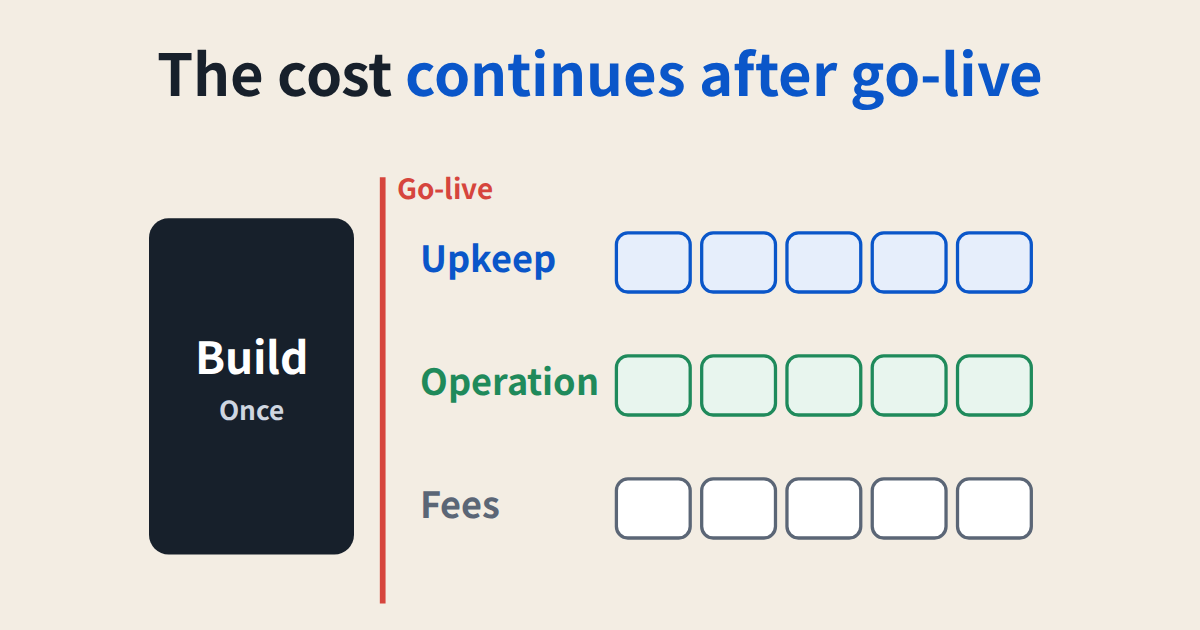
The maintenance cost of a system is the cost of fixing it and keeping it in step with changes in the business and environment after go-live. In a survey by the Japan Users Association of Information Systems (JUAS), the yearly maintenance cost of in-house developed systems averaged 8.7% of the initial development cost.
The cost after go-live is easier to understand when split into three: maintenance, operation and usage fees. Once you know what work you are paying for, you can ask what is inside an estimate.
In this article, "the buyer" means the company that commissions the system. We cover the difference between maintenance and operation, the work maintenance includes, what sets the cost, and what to check before the development contract. The model contract cited here is a Japanese one.
The scope of maintenance and how its cost is set can be discussed in our free estimate consultation.

About the author

wesionaryTEAM Editorial Team
The editorial team is made up of wesionaryTEAM's project managers and engineers. Drawing on what we learn every day on business system, AI adoption and digital transformation projects, we publish information people can use when making decisions, with cases and figures.
Operation and maintenance are different work
They are often named together, but operation and maintenance are different work.
The Model Transaction and Contract for Information Systems, published by the Information-technology Promotion Agency, Japan (IPA) and the Ministry of Economy, Trade and Industry, is a template contract. It describes operation as the phase of running the system so that work proceeds smoothly, including starting and stopping it, monitoring, and file housekeeping. It describes maintenance as the process of keeping the current system fit for the work and the environment.

In short, operation keeps today's system running, and maintenance changes the system itself. When an estimate has a single line for "operation and maintenance", ask which work is included and how far.
The form of the contract is not single either. The model contract says that outsourced maintenance and operation can be a quasi-mandate contract or a fixed-price contract depending on the content. In a quasi-mandate contract you pay for work being carried out, and in a fixed-price contract for the completion of a deliverable. The development company's responsibility differs with the form.
Maintenance includes more than fixing
The word maintenance brings fixing defects to mind. Actual maintenance includes other work as well.
The model contract comes with a sample specification for outsourcing application maintenance. The sample lists the cases the development company receives and the work it carries out as follows.

- Answering questions. Questions received are looked into and answered.
- Handling trouble. The cause of a failure is investigated and the program is fixed.
- Improvement. Changes that keep the system usable when its environment changes, and changes that improve performance.
- Preventive maintenance. A failure that has not yet surfaced is found and fixed before it happens.
- Improvement proposals and regular reports. Usage is analysed and proposals are made, and the status of the work is reported regularly.
This is a sample, and the actual scope differs by contract. The model contract itself notes that maintenance and operation take many forms and that no single template can cover them. That is exactly why you need to check what your own contract includes.
There are survey figures on how maintenance work divides up. In the maintenance survey of the JUAS Software Metrics Survey 2014 (231 systems), answering inquiries took 31.4% of maintenance work on average, improvements 26.2% and fixing defects 15.6%. Fixing is one part of maintenance work.
Usage fees come on top of the work
Maintenance and operation are paid for people's work. Separately, there is a cost for the things you use. This article calls it usage fees.
These are the costs of infrastructure such as servers, of outside services, and of other companies' software. They change with how much you use and with the terms of each contract.

When you use another company's product, pay attention to its end date too. The model contract notes that the maintenance period of a packaged product can be affected by generation changes and the end of support of the operating system and hardware it depends on, and says it is desirable to look into the migration and its cost at the end of support in advance.
Usage fees are paid through the development company in some cases and directly to the provider in others. Check which it will be, and whether they are in the estimate.
The cost continues because everything around the system keeps changing
Why does a finished system keep costing money? Because even if the system does not change, what surrounds it does.

- The work changes. The model contract says that when the content or procedures of a business change, the system is also changed to a greater or lesser degree.
- The environment changes. The sample specification lists, as maintenance work, changes that keep the system usable when its operating environment changes.
- New weak points are found. The model contract says that even for software delivered with full care, the possibility that a new vulnerability is found from the day after delivery cannot be ruled out. A vulnerability is a security weakness that an attack can use.
If you stop maintenance, the system stays fitted to the work and the environment of that moment, and gradually stops fitting. Maintenance cost is the cost of keeping it fit.
It cannot be left entirely to the vendor either. The model contract says the buyer's participation is indispensable in the maintenance and operation stage as well. When you are going to change your work, tell the development company early.
There are survey figures on the size of the cost as well. In the same 2014 JUAS survey, for systems developed in-house, the maintenance cost per year after go-live averaged 8.7% of the initial development cost. The cost of additional development after go-live averaged 14.7%. Over five years, including the initial development cost, the total comes to more than double. It is a 2014 survey, and an average over systems whose median initial development cost was 160 million yen. Check your own amount with an estimate.
Scope, hours and speed of response set the cost
The amount for maintenance is set by what is handled, when, and how fast. In the sample specification, these are written in the schedule of the contract.

- Scope. Which systems are covered and which work is included. A base workload is also set.
- Hours. The days and times when the work is done. If you ask for nights and holidays too, the staffing changes.
- Speed of response. Targets such as the time from receiving a report to the first response.
The targets the sample lists are the share of cases, within the agreed time, for the first response to an incident report, the first answer to a question, and the delivery of an improvement. Note that what is measured is the time to the first response, not the time until it is fixed.
Agreeing such levels in numbers is called a service level agreement (SLA). The model contract says attention should be paid to whether the required level is achievable and whether the cost of measuring it is reasonable. A higher level costs more. Choose a level that matches the impact when your work stops.
Check four points before the development contract
Check the maintenance terms before you sign the development contract. Once development is over, your options are narrower. The model contract also asks for development that considers the balance of maintenance and operation costs and looks at the return over the whole period the system is used.

- Source code. The text the program is built from. The model contract says that to have it disclosed or handed over, one way is to name the source code in the deliverables.
- Design documents. The model contract asks the buyer, with a future rebuild in view, to make sure maintenance work is reflected in the design documents.
- Copyright. The model contract says that even a buyer who does not hold the copyright can outsource maintenance to another company. It depends on the terms, however, so check your own contract.
- The maintenance estimate. Ask for a rough figure of the cost after go-live together with the development estimate.
With all four in place, the option of asking another company to maintain the system stays open. What to check when taking over a system built by another vendor is covered in our article on taking over a project.
How we work
We manage defects and failures after go-live in our project management tool, projectAI, too. Defects you find can be registered from projectAI. Failures after go-live are recorded as incidents and followed through cause and countermeasure.

As during development, fixes and improvements in maintenance go ahead only after you have confirmed their effort in projectAI. Quality is managed in line with international standards, and you can check the status of defects at any time. Please use our free estimate consultation even if you are only concerned about the cost after go-live.
FAQ
What happens if we do not sign a maintenance contract?
When a defect or a change in the environment occurs, you ask for help each time. Someone who can handle it is not always found at once, and it takes time because the work starts with investigation. For a system whose stoppage would cause trouble, it is safer to settle the contact in advance.
We hear maintenance usually costs 15% of the development cost. Is that true?
There is no fixed ratio. In the 2014 JUAS survey, the yearly maintenance cost of in-house developed systems averaged 8.7% of the initial development cost. It changes greatly with the scope and hours covered, so check what is included rather than the ratio.
Can a company other than the developer maintain the system?
Yes. The premise is that you hold the source code and the design documents. Check at the time of the development contract that they are in the deliverables.
Are defects after delivery fixed under the maintenance cost?
For a defect that differs from what the contract says, you can ask the development company to fix it within the period set in the contract. Maintenance is a separate contract for keeping up with changes after go-live. Which one applies depends on the terms of the contract.
Summary
The cost after go-live splits into maintenance, operation and usage fees. Maintenance is the work of keeping the system fit for the work and the environment, and its amount is set by scope, hours and speed of response. Check the terms before you sign the development contract.
We record defects, incidents and improvements after go-live in projectAI too, and go ahead after the effort is confirmed. Even if you want to talk about the cost after go-live as well, please use our free estimate consultation.
Related articles and pages
- How to Read a System Development Estimate: Four Places the Buyer Checks
- Rough Estimates in System Development: When the Price Is Fixed, and Why It Changes
- What Are Person-Months and the Person-Month Rate? Reading Them on an Estimate
- What Is a Quasi-Mandate Contract? When to Use It in System Development and How It Differs from Fixed-Price
- System development: contract development from requirements to operation
- Free estimate consultation
Sources
- Japan Users Association of Information Systems, "Software Metrics Survey 2014, Maintenance Survey Report", June 2014 (Japanese)
- Information-technology Promotion Agency, Japan and Ministry of Economy, Trade and Industry, "Model Transaction and Contract for Information Systems, 2nd edition", December 2020, revised April 2025 (Japanese)
Reviewed by

Ichiro NagataCEO and Representative Director
A former engineer at Yahoo! JAPAN. For more than 18 years at startups and large companies, he has worked on a wide range of projects, from new consumer and business ventures to the digital transformation of operations. Alongside hands-on development as an engineer, he has built and managed teams, designed businesses and tested hypotheses, gaining broad experience in launching and growing businesses. He has been through three business sales. Convinced that co-creation makes products better and lets ideas be tested in the market, he founded wesionaryTEAM to offer a co-creation platform.