
SYSTEM DEVELOPMENT
System Development & Contract Development Services
With an extensive track record in contract development and a systematized methodology, we guide you to success from requirements definition through operations and maintenance, as a co-creation partner that goes beyond the role of a system development company.
PROBLEMS
Do You Have Any of These System Development Challenges or Concerns?
You are thinking about requesting development, but the requirements definition is unclear and you are not sure how to proceed
Your system performs poorly, and getting work done takes too much time
You want to keep costs down, but you worry about whether quality can be maintained
You are anxious about replacing your current system and whether the migration will go smoothly
You are short on in-house IT staff and worry about whether you can carry out system operations properly
You are not confident about choosing technologies or a development environment, and you have been slow to adopt the latest technology
3 Reasons We Can Solve Your System Development Concerns and Challenges
Requirements Definition and Agile Development from the Early Stages
Even if your requirements definition is still unclear, we carry it out in stages through close communication with you early in the project. By adopting agile development methods and repeating development and feedback one small feature at a time, we can keep the project moving while changing requirements flexibly.
01
Performance Optimization and Improved Usability
We analyze the performance of your current system and identify bottlenecks. We then optimize it, improving operational efficiency. We also interview users about their behavior and provide UI/UX design that is intuitive to use. This makes the system easier to use while also improving its performance.
02
Smooth Introduction of a New System Through Technology Selection and Operations Support
We select the technology best suited to your business and draw up a plan that minimizes the risks of the migration work. If your in-house IT staff is short-handed, we also provide full support that includes operations and maintenance, achieving a smooth replacement and sustainable operations.
03
POINTS
5 Key Points for Leading System Development to Success
Clear Requirements Definition and Goal Setting
A successful system development project starts with clear requirements definition and goal setting. It is important that the whole team shares the specific features and expected outcomes so that the direction of development does not drift. This helps prevent the problem of “that is not what we expected” at delivery. Carrying out requirements definition thoroughly at the early stage keeps later problems to a minimum.
Appropriate Technology Selection and Architecture Design
To lead a system development project to success, appropriate technology selection and architecture design are essential. Choosing technology that fits the scale and purpose of the system improves development efficiency and scalability. Furthermore, designing an architecture with future expansion in mind lets us build a flexible and stable system. Technology selection calls for a balance between the latest technology and proven technology.
Regular Communication and Feedback
Regular communication with customers and the development team is essential to keeping a project on track. By reporting issues and progress to customers frequently during development and gathering their feedback, we can make corrections at an early stage. We work to prevent problems caused by a lack of communication and to keep the project running smoothly.
Adopting an Agile Development Process
Adopting an agile development process is effective for making a system development project succeed. By developing in repeated short sprints, we add features little by little and respond flexibly to customer requests. We can also respond immediately to changes in requirements midway through development, resulting in a highly adaptable system. This lets us maintain quality while also increasing the speed of development.
Strengthening the Post-Release Maintenance and Operations Framework
In system development, release is not the end; maintenance and operations after release become an important phase. To support stable operations, prompt troubleshooting and regular maintenance are necessary. Strengthening the maintenance support structure and keeping the system running smoothly after it goes live is the key to sustaining the success of system development over the long term. It is also essential to focus on security updates and version management.
FLOW
Our System Development Process in Detail
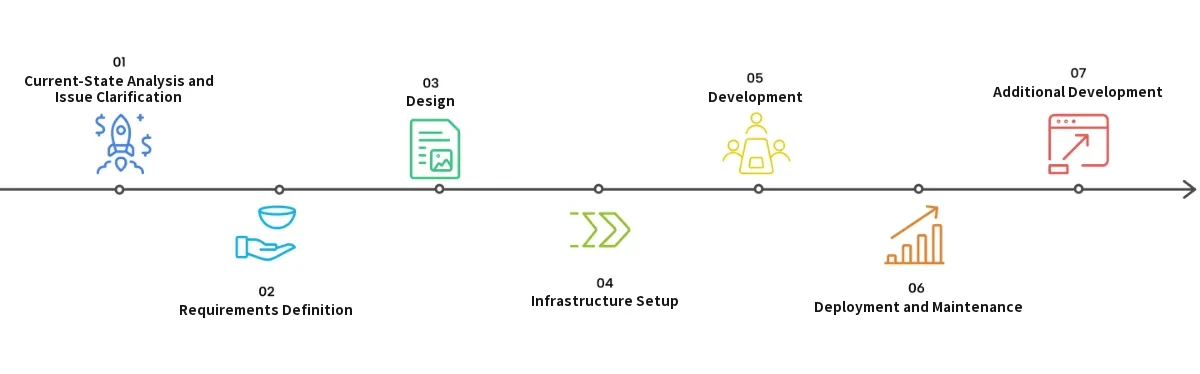
STEP 1
Current-State Analysis and
Issue Clarification
After the contract is signed, we aim to get your product off the ground quickly and keep the project running smoothly. First, we confirm the team members, project goals, scope, division of roles, working rules, and risks together with you, and lay a solid foundation.
Depending on the scale and difficulty of the product, we aim to complete the following tasks early.
First-Half Tasks
Creating a Document List
We identify the documents essential to carrying out the project.
Defining the Team Structure
We clarify the team members involved in the project and their roles.
Creating Milestones
We set the schedule for each stage’s deliverables and for UAT (user acceptance testing), making progress visible.
Sorting Out Unclear Points
We review the essential materials and features and sort out the parts that are not yet clear.
Creating a Customer Request List
We compile your requests and needs and come to understand them through interviews.
Kickoff Meeting
We hold a kickoff meeting where everyone shares the goals and roles.
Second-Half Tasks
Creating a Simplified Business Workflow
We concisely organize the business workflows that underpin the product.
Creating a Sitemap
We create a sitemap showing the overall page structure and make the navigation clear.
Defining Data Items
We design the required data structure and establish the basic framework of the system.
Creating a Feature List
We list the features the product needs by size and decide their priorities.
Creating a Development Plan for Each Feature
We plan sprints for each feature so that development progress is easy to follow and manage.
Management and Progress Checks
Using project management tools, we manage and share task progress and issues.
For launching projects, we have standardized the WBS (Work Breakdown Structure) and its related formats. Every task proceeds according to the standard WBS so that it is carried out without omissions and with a consistent level of quality. This standardization lets us get projects off to a strong, fast start.
STEP 2
Requirements Definition
Accurate and clear requirements definition is extremely important to the success of a project. By carrying out the requirements definition process in stages, we deliver a solution that accurately reflects your needs. Through the process below, we firm up the direction of the project and move smoothly into development.
First-Half Tasks
Customer Needs Interviews
We interview you in detail about your challenges and needs and clarify the development goals.
Visualizing Business Processes
We review the current business workflows and clarify what to optimize and which parts the system will cover.
Creating a Requirements List
We identify features and specifications and create a requirements list that shows the big picture.
Finalizing the Scope
We clarify the scope of development and also define items outside the project scope and any limitations.
Confirming Technical Requirements
We confirm requirements related to technology and system configuration and clarify technical constraints and risks.
Second-Half Tasks
Deciding Feature Priorities
We evaluate features in terms of importance and feasibility and decide the development priorities.
Defining Data Requirements
We define the data items and data structure and design where the data comes from and how it is processed.
Confirming Non-Functional Requirements
We define non-functional requirements such as performance, security, and scalability.
Creating a Prototype
We create a prototype that users can actually try, and collect their feedback.
Creating and Agreeing on the Requirements Definition Document
We prepare the requirements definition document, obtain your agreement, and establish the foundation for the project.
STEP 3
Design
In system development, the design phase is an important step that determines the quality and success of the entire project. By carrying out design in stages, we reflect your needs while moving smoothly into the development process. We proceed with design along the steps below, supporting you in building a highly reliable system.
First-Half Tasks
Overall Design Based on Requirements Definition
Based on the requirements definition, we clarify the design of the whole system and the role of each part.
Architecture Design
We design the technology stack, the server and network configuration, and the data flows.
Database Design
We define data items and tables and design the optimal database structure.
UI/UX Design
We design the UI/UX from the user’s perspective, aiming for intuitive operation.
Confirming the Feature List and Scope
Within the scope of the project, we organize features by priority and reflect them in the design.
Second-Half Tasks
Detailed Design
We carry out the detailed design of each feature and prepare documents for development.
Data Flow Design
We design the flow of data in detail to ensure reliable integration between systems.
API Design
We design the API specifications for integration with other systems and the front end.
Security Design
We carry out security design that takes data encryption and access management into account.
Reviewing and Agreeing on the Design Documents
We compile and share the design documents, then review and agree on them together.
STEP 4
Infrastructure Setup
In system development, building a stable infrastructure environment is extremely important for ensuring the reliability and scalability of the service. We set up infrastructure in stages and provide the optimal environment for your needs. Based on the process below, we achieve smooth and efficient infrastructure setup.
First-Half Tasks
Infrastructure Design Based on Requirements Definition
Based on the system requirements, we design the optimal infrastructure configuration.
Selecting the Server Environment
We select the optimal environment according to system load and scalability.
Network Design
We design the network configuration and optimize communication flows and security.
Confirming Security Requirements
We strengthen the system’s security measures and minimize risk.
Creating the Infrastructure Setup Schedule
We plan the server and network settings and manage progress rigorously.
Second-Half Tasks
Cloud/On-Premises Environment Setup
We set up and configure servers and network equipment.
Configuring the Database Server
We design and configure the database server and optimize its performance and availability.
Designing and Implementing Load Balancing and Redundancy
To improve system availability, we implement load balancing and redundancy.
Creating a Backup and Recovery Plan
To protect data, we put automatic backups and a disaster recovery plan in place.
Infrastructure Testing and Final Check
We verify that the infrastructure operates correctly, run load tests, and carry out optimization.
STEP 5
Development
In system development, the coding phase is an important step in which the design is turned into concrete programs and features are realized. While ensuring an optimal development environment and code quality, we carry out coding efficiently and smoothly.
Through the process below, we steadily advance system development and deliver a high-quality product.
First-Half Tasks
Setting Up the Development Environment
Before coding, we prepare a unified development environment to improve efficiency.
Confirming Coding Standards
We unify coding standards to make the code easier to maintain.
Creating the Initial Modules
We create the initial modules to align the direction of development.
Dividing and Assigning the Code
We assign each feature to a responsible developer, module by module, to promote parallel development.
Setting Up Version Control
We manage the history of code changes in a version control system and maintain consistency.
Second-Half Tasks
Coding Each Feature
Each developer in charge implements the front end and back end based on the detailed design.
Running Unit Tests
We run unit tests after coding to find bugs early.
Conducting Code Reviews
The team conducts code reviews to improve quality and ensure consistency.
Implementing Error Handling and Exception Handling
We implement appropriate handling for when errors or exceptions occur.
Final Integration and Verification
We integrate all modules and verify that the whole system works correctly.
STEP 6
Deployment and Maintenance
For a system’s production deployment, we plan and carry out everything from the final checks before release to the migration work, keeping the impact on your business to a minimum. After deployment, we set up a maintenance and operations framework that keeps the system running stably, and we provide ongoing support that covers monitoring, incident response, and security updates.
First-Half Tasks
Pre-Deployment Testing and Final Check
We run final tests before going live and check for problems.
Creating the Deployment Plan
We draw up the deployment plan and clarify the schedule and the people responsible.
Deploying the System to the Production Environment
We deploy the tested system to the production environment at a time that has little impact on your business.
System Go-Live and Initial Support
We confirm that the system runs normally in the production environment and provide initial support.
Second-Half Tasks
Regular Maintenance and Monitoring
To keep the system running stably, we carry out regular maintenance and monitoring.
Security Patches and Updates
We apply the latest security measures to keep the system secure.
Incident Response and Troubleshooting
When a system failure occurs, we restore service quickly, analyze the cause, and draw up measures to prevent recurrence.
Support for Users and Operations
We help users operate the system and handle problems, and we also propose ways to optimize operations.
STEP 7
Additional Development
In response to new needs and changes in your business that emerge after release, we continuously add and improve features. While maintaining consistency with the existing system, we draw up development plans that weigh priority and cost-effectiveness, and we evolve the system in step with the growth of your business.
Requirements Definition for Additional Features
To address your new needs, we consider additional features for the system. Through interviews, we clarify the new requirements and confirm that they fit with the existing system.
Scope Adjustment and Estimation
We determine the development scope for the additional features and estimate the effort and cost. We adjust the development schedule and run the project so that it does not disrupt your other work.
Implementation and Testing of Additional Features
We implement the features newly covered by the requirements definition and integrate them into the existing system. After integration, we run unit tests and integration tests to confirm that the features work correctly and to ensure quality.
Release and Rollout Support for Additional Features
After developing the new features, we release them to the production environment. As initial support after release, we update the user manuals and hold briefing sessions for users, supporting a smooth rollout.
INDUSTRIES
System Development Track Record by Industry
Core Business System Development for Institutional Food Service
As project manager of a co-creation project involving multiple companies, we are taking part in the development of a large-scale core business system for institutional food service. We are advancing data integration across work that spans ordering and order management, menu planning, and ingredient management, along with standardization and automation.
Ordering and Order Management System Development for Construction
We developed a cloud-based ordering and order management system that unifies a multi-tier chain of transactions involving craftspeople, general contractors, manufacturers, trading companies, and shipping companies. It addresses on-site problems such as ordering methods scattered across LINE, phone, and fax, mistakes in material part numbers, and the effort of coordinating deliveries to the site.
Booking System Development for Ryokan and Bathing Facilities
We developed a system that completes the entire process on LINE, from accepting day-use bathing bookings to payment, cancellation, and check-in with a QR code. With multilingual support, it also handles bookings from international visitors to Japan.
Ordering and Order Management System Development for E-commerce and Wholesale Sectors
We have a track record of migrating e-commerce operations that had run on Shopify to a custom-built in-house system, and of developing an ordering and order management platform specialized for the wholesale of furniture and interior goods. We also go as far as automatic integration with warehouses, other online marketplaces, and advertising.
System Development for the Medical and Health Fields
We developed a system for large medical institutions that covers everything from sharing and reviewing medical case images to creating and approving reports. We also have a track record with a health and productivity management platform that visualizes employee health data through LINE integration.
Case Studies: Life Pilot, a Platform Supporting Health and Productivity Management
Recruitment and Matching System Development
We design and develop matching systems tailored to the characteristics of each industry, such as job matching specialized for occupations like taxi drivers and security staff, and admissions matching that connects universities with prospective students.
Case Studies: MEETSCUL, a Matching Platform Connecting Regions and Companies
Replacement, Maintenance, and Operations of Existing Systems
We also handle taking over the maintenance and operations of systems built by other companies, improving performance and quality, and migrating to a new environment when support for the current one expires. Rather than assuming a rebuild is needed, we start by evaluating the current state.
Frequently Asked QuestionsFAQ
What should we prepare before requesting system development?
First, it is important to organize your business challenges and requirements and clarify which features you need. It also helps to decide your budget and a rough timeline in advance so that things go smoothly.
We are not sure which technologies we should use. Can you advise us?
Yes, absolutely. We recommend the most suitable technologies after considering the nature of your work, future scalability, cost, and other factors.
How long does development take?
It depends on the content and scale of development. A small-scale system can take a few months, while a large-scale system can take six months or more. We will tell you the specific timeline after we have heard about your needs.
How much does system development cost?
It depends on the scale and features of the system. We provide an estimate that matches the scale of development, so please feel free to talk to us first.
Can you accommodate changes to requirements during development?
Yes, we can. We also flexibly readjust the schedule and cost when requirements change.
What happens with maintenance and operations after system development?
We also provide maintenance and operations support after development. Please leave regular maintenance and troubleshooting to us.
Can you integrate a new system with our existing systems?
Yes, we can. We review the specifications of your existing systems and connect the new system to them through data integration and APIs.
What security measures do you take for the system?
Security is our top priority. We incorporate encryption, authentication features, and multilayered security measures to keep your data safe.
Which is better, a cloud environment or an on-premises environment?
Each has its advantages. The cloud has the edge in scalability and cost, while an on-premises environment is better suited to cases that require a high level of security. We will make a recommendation based on your specific requirements.
We have no one in-house who knows much about system operations. What should we do?
It is not a problem even if this is your first time handling system operations. We prepare operations manuals and provide training support, so you can rest assured.
What types of agreements are used in contract development?
We support both quasi-mandate (time-and-materials style) agreements and fixed-scope (contract-for-work) agreements. For example, we propose a quasi-mandate agreement, which allows flexible progress, when requirements are not yet fully settled, and a fixed-scope agreement when the scope and deliverables are clear, guiding you to the agreement type best suited to the nature of your project.
What is the difference between contract development and fixed-scope (contract-for-work) development?
Fixed-scope development is one of the agreement types used in contract development, so the two terms are not opposites. Contract development is the general term for entrusting development to an outside company. If the contract is a fixed-scope (contract-for-work) agreement, it is called “fixed-scope development,” and if it is a quasi-mandate (time-and-materials style) agreement, it is called “contract development under a quasi-mandate agreement.” Under a fixed-scope agreement, the fee is paid for the completed deliverable, and the development company is responsible for completing it and is liable for any nonconformity with the contract. Under a quasi-mandate agreement, the fee is paid for the performance of the work, and completion itself is not promised. A fixed-scope agreement fits when what to build has been decided, and a quasi-mandate agreement fits when you are still exploring requirements. It is also common to divide the work by phase, using a quasi-mandate agreement for requirements definition and a fixed-scope agreement for development.
Related: What Is Contract Development? Agreement Types and What to Decide Before Placing an Order
What are the key points to consider when choosing a system development company?
Beyond technical capability, the important things are a setup that lets the company work alongside you from requirements definition through operations, a framework for quality management, and transparency about progress and costs. We have obtained ISO 9001 (quality) and ISMS (information security) certifications, and in a survey by a third-party organization we were also selected as an outstanding company in the System Development category.
Do you support development that uses AI?
Yes. We have a track record of system development that incorporates generative AI and LLMs (such as AI-based automatic generation, data analysis, and automatic translation), and we also use AI in production in our own development processes. You can also consult us about everything from a PoC (proof of concept) for AI adoption through production implementation.
Do you also handle development or replacement of core business systems?
Yes, we do. We have a track record of taking part, as project manager, in large-scale core business system development for institutional food service, and we also handle taking over the maintenance and operations of systems built by other companies and migrating to a new environment when support for the current one expires. Rather than assuming a rebuild is needed, we start by evaluating your current system.
Can we request development of just one specific business system, such as an ordering and order management system or a booking system?
Yes, you can. We have a track record of developing systems focused on specific business functions, such as a cloud-based ordering and order management system for the construction industry, an ordering and order management platform for wholesale, and a LINE booking system for day-use bathing at ryokan. We start by working with you to sort out the scope of the business functions to be covered.
We are looking for a development company that knows our industry well. Do you have industry knowledge?
We have a track record of development in a wide range of industries, including institutional food service, construction, ryokan and bathing facilities, e-commerce and wholesale, healthcare, health and productivity management, recruitment, education, tourism, and fitness. Rather than relying on industry knowledge alone, we emphasize interviewing you about how the work is actually done and turning that into requirements, so even in an industry that is new to us, we begin with on-site research.
Which is better, building from scratch or adopting an off-the-shelf package?
If your business processes are standard, a package is the better fit; if a process is a source of competitive advantage, or off-the-shelf products cannot meet your requirements, building from scratch is the better fit. We have cases where we built from scratch to meet requirements that commercial packages could not handle, and cases where we recommended using an existing product. We do not steer you toward either one; we make our recommendation after organizing your requirements.
Can you hand over the developed system so that we can handle its operations and modifications ourselves?
Yes. We provide in-house development support that includes explaining the design intent and the code, preparing procedures for day-to-day operations, and helping you set up your own development structure. Our goal is not to keep winning further development work, but to put your team in a position to run on its own.
Can you provide ongoing development with a dedicated team (lab-type development)?
Yes, we can. We have development centers in Japan and Nepal and can support ongoing development by a team made up of dedicated members. When we work alongside you from a stage where requirements are not yet fully settled, we mainly propose a quasi-mandate (time-and-materials style) agreement.
What is the difference between contract development and SES (on-site staffing at the client)?
With contract development, we take on the completion of the system or the development work itself, and our own team carries out the development within our own organization. SES is an arrangement in which engineers work under the direction of the client, and the focus is on supplying labor rather than deliverables. We have summarized the types of agreements (fixed-scope or quasi-mandate) and what to decide before placing an order in an explanatory article.
Related: What Is Contract Development? Agreement Types and What to Decide Before Placing an Order
Can we try things on a small scale first instead of jumping straight into full-scale development?
Yes. For new business ventures and new work processes, we recommend validating your hypotheses with a PoC (proof of concept) or an MVP (minimum viable product) before moving on to full-scale development. Together we narrow down the hypotheses you want to test, design only the features that are needed, and release in a short time, so that you can decide on your next investment based on the results.
Should we choose in-house development or outsourcing?
A realistic approach is to divide by area: keep in-house the areas that are directly tied to your business’s competitiveness, and outsource standard areas and development during the launch period. Fully in-house development, including the development itself, is hard to sustain on your own, so we also help clients start with outsourcing and move to in-house development in stages. We have summarized the criteria for deciding in an explanatory article.
Related: Should System Development Be In-House or Outsourced?
FREE ESTIMATE
Free Estimates: Learn What to Build and the Cost Range on the First Call
Your requirements do not need to be settled. Tell us in a sentence what you want to build, and your project manager will sort it out with you.
CASE STUDIES
Related Case Studies
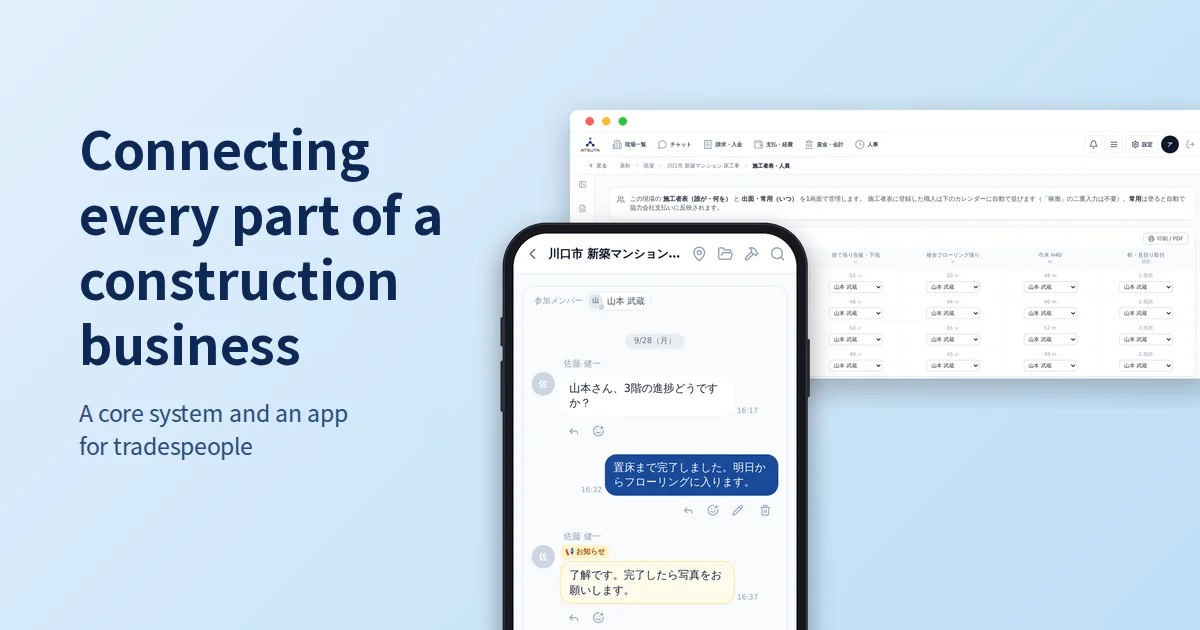
A Core Business System and Craftsperson App That Connect Every Operation of a Construction Company
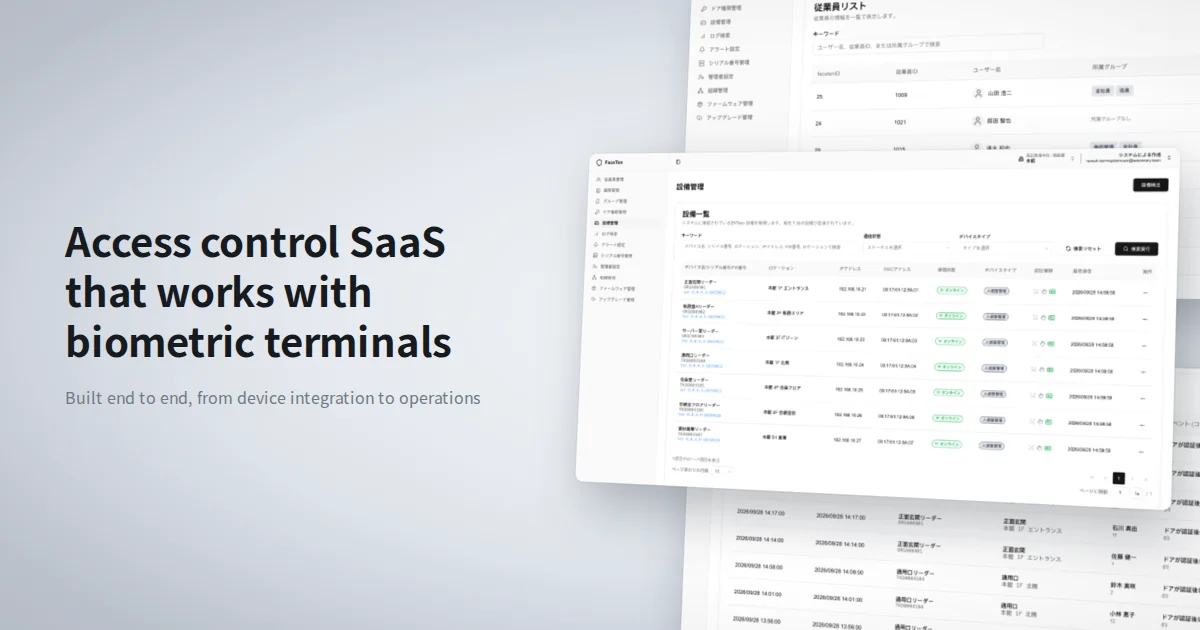
A Multi-Site SaaS Entry and Exit Management System Integrated with Biometric Terminals
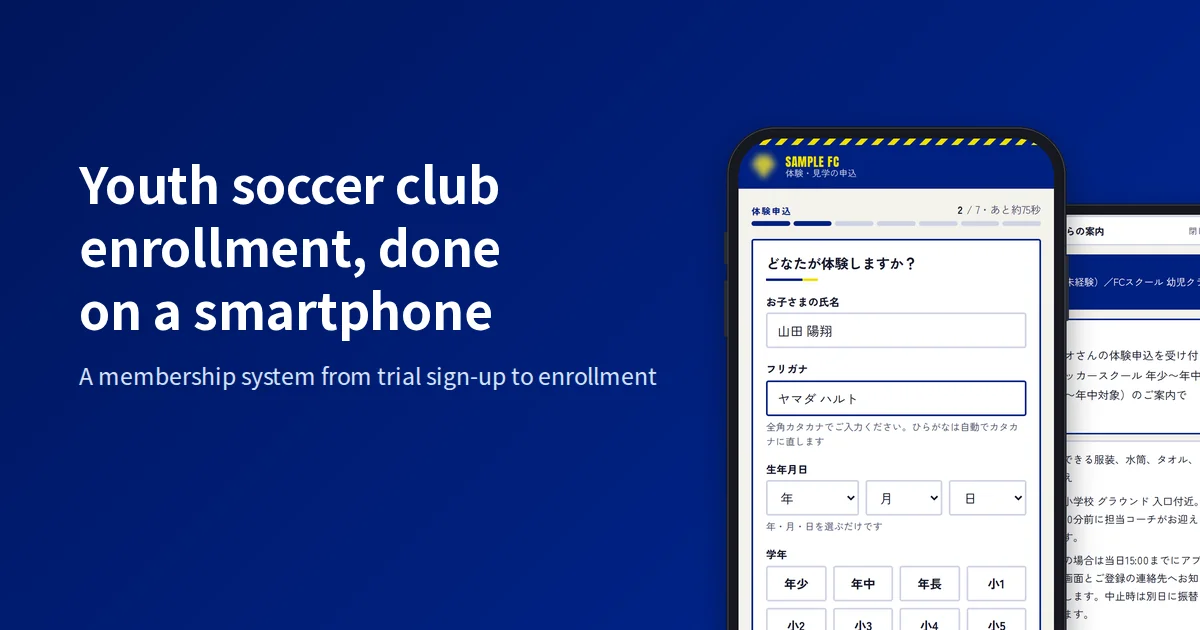
A Membership Management System That Lets a Youth Soccer Club Complete Enrollment on a Smartphone
A Full Replacement of side bizz, a Sales Outsourcing Matching Service
Taking Over Maintenance and Operations of GraceBank, an Egg Freezing and Storage Service
J-Client+: A Business System That Consolidates Email Communication with Manufacturers