
BLOG
What Are Person-Months and the Person-Month Rate? Reading Them on an Estimate
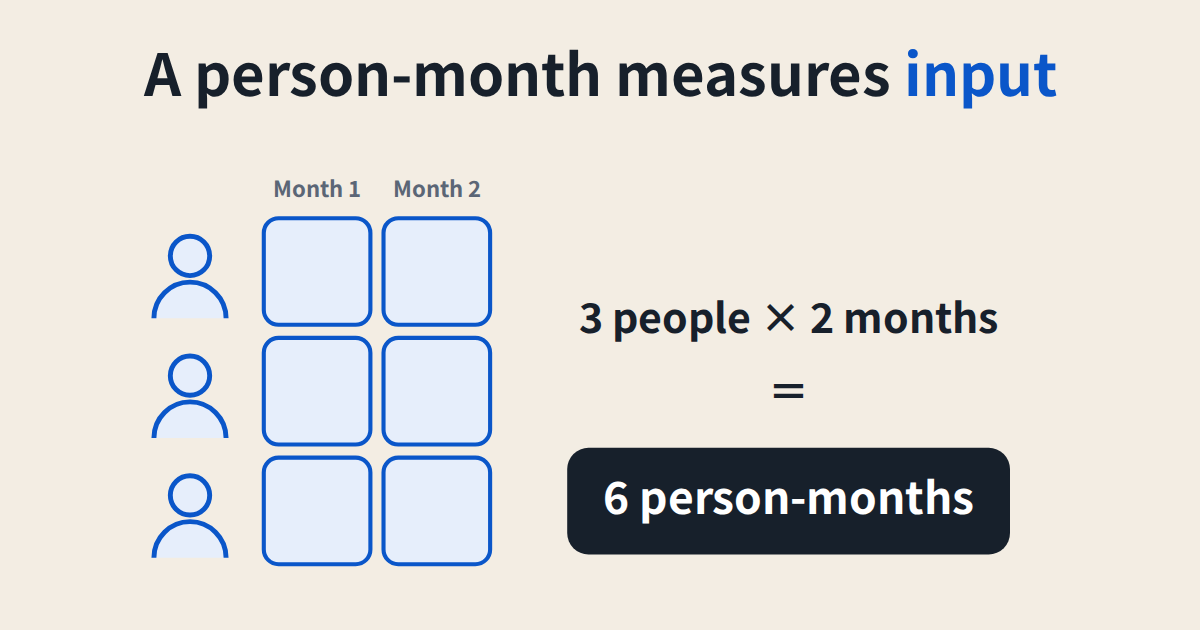
A person-month is a unit that counts the work one person does in one month as 1, and the person-month rate is the amount charged for one person-month. On a system development estimate, person-months multiplied by the rate form the base of the amount.
Both describe the work put in and its price. They do not describe how much is produced or how good it is, so on an estimate you need to check what the person-months consist of.
In this article, "the buyer" means the company that commissions the system. We cover what a person-month means, how it relates to the schedule, the rates that appear in a public survey, the limits of counting in person-months, and how to read them on an estimate. The survey and the law cited here are Japanese.
If you want an estimate that shows what the person-months consist of, use our free estimate consultation.

About the author

wesionaryTEAM Editorial Team
The editorial team is made up of wesionaryTEAM's project managers and engineers. Drawing on what we learn every day on business system, AI adoption and digital transformation projects, we publish information people can use when making decisions, with cases and figures.
A person-month is people multiplied by time
Person-months are counted by multiplying the number of people by the number of months. Three people working two months is 3 × 2, six person-months. The amount of work is also called effort.
The same six person-months can take several shapes. One person for six months, two people for three months, and three people for two months are all six person-months on paper.
The person-months on an estimate are the sum of the work of everyone involved. It includes not only the people who write programs but also those who design, those who test, and the person who manages the whole. People who join part-way, or take part only for some of the period, are counted by their months.

When work is counted by the day, the unit is the person-day: the work one person does in one day. How many days make one person-month differs by company, so on an estimate written in person-days, check how many days it treats as one person-month.
The amount of an estimate is basically these person-months multiplied by the person-month rate. If the person-months double, the amount roughly doubles.
Adding people does not shorten the schedule in proportion
On paper, six person-months of work is finished in one month by six people. In practice it is not.
Some work can be divided and some cannot. Work that can only proceed in sequence does not get faster with more people. More people also means more work between people, such as meetings and handovers.
The Software Metrics Survey 2025 of the Japan Users Association of Information Systems (JUAS) expresses the relation between effort and schedule as a formula drawn from actual projects. The standard schedule is 3.23 times the cube root of the effort, in months. A project of 125 person-months comes to about 16 months.

By this formula, when the effort grows about 16 times, from 8 to 125 person-months, the standard schedule grows only 2.5 times, from about 6.5 to about 16 months. Put the other way, halving the schedule is not achieved by doubling the people.
Comparing the person-months and the period on an estimate tells you how many people the plan assumes. If a plan puts many people into an extremely short period, ask why.
The same survey also shows how often the actual schedule exceeded this standard: 49% overall, 56% for small projects under 50 person-months, and 29% for large projects of 500 person-months or more. The survey considers that large projects have more work that can be shared out, so the share of work that can be shortened by adding people affects the schedule. It can be read as saying that the smaller the project, the less room there is to shorten it by adding people.
Person-month rates in a public survey
There are public figures that can serve as a guide to the person-month rate, from the same JUAS survey. Each figure divides something different.
- 1.27 million yen. Derived from the relation between total development cost and effort across 195 projects.
- 0.96 million yen. The average for 99 projects built from scratch where the outsourcing cost is known.
- 1.44 million yen. The average for 39 projects using an existing software package where the outsourcing cost is known.

Two cautions when reading them. First, the analysis behind the 1.27 million yen covers projects whose rate was between 0.5 and 4 million yen. The range analysed alone spans a factor of eight. Second, all of them are averages. In the same survey, the average for small projects built from scratch (under 10 person-months, six projects) was 1.85 million yen.
Actual rates can differ greatly by company, by team structure and by the kind of development. Use the survey figures as a prompt for asking about the rate on the estimate you received, not as a standard for deciding whether it is high or low.
A person-month shows what was put in
Person-months have a limit. They show the amount put in, not the amount or quality of what comes out.
Six person-months put in do not always produce the same thing. It changes with the experience of the people assigned, the difficulty of what is built, and how the work is run. An estimate with more person-months is not necessarily one that builds something better.

For this reason, several estimates cannot be compared by the number of person-months alone. What you compare is what those person-months build and which phases they include. Person-months mean something only together with the scope.
An estimate with few person-months can have two reasons. It may be low because experienced people take the work, or low because necessary work was not counted. The number alone cannot tell them apart, so ask which work was counted.
The contract type changes what a person-month means
The meaning of a person-month also changes with the form of the contract. System development contracts in Japan fall into two broad kinds: fixed-price (ukeoi) and quasi-mandate.
A fixed-price contract promises the completion of the work and pays for its result. On a fixed-price estimate, person-months are the basis for calculating the amount. Whether the person-months actually spent are more or fewer than estimated, what you pay is the agreed amount.
A quasi-mandate contract pays for work being carried out. When a quasi-mandate contract is set up to pay by the amount worked, the person-month becomes the unit that is billed. If the work grows, the payment grows.

When person-months are written on an estimate, check whether they are the basis of a calculation or the unit billed. If they are the unit billed, also check the monthly cap and how the work is reported. A report that shows how many people worked on what, and how much, lets you check the basis of the payment.
How to read person-months on an estimate
When you receive an estimate, check the following four points about person-months.

- Person-months by phase. Not only the total, but how many person-months go to which phase.
- Period and head count. Dividing the person-months by the period gives the average number of people planned. Twelve person-months over four months is three people on average.
- How the rate is split. One rate for the whole, or different rates by role.
- The contract type. Whether person-months are the basis of a calculation or the unit billed.
If these are not written, ask the development company. Asking what those person-months will do shows you more of the estimate than asking for fewer of them. When estimates from several companies differ greatly in person-months, the scope or the phases they took to be included may differ.
How we work
We give a rough estimate before the contract so that you can grasp the scale, and we present and fix the estimate amount at the time of the contract. Only when there are many further things you want to do, we estimate the difference after requirements definition.
When we estimate, we mainly submit three documents: the estimate, the proposal and the effort by function (detailed). The effort by function lists the effort counted function by function, so you can check which functions the total person-months are built up from. You can view all three at any time on a screen dedicated to you in our project management tool, projectAI.

When something to add comes up during development, we go ahead only after you have confirmed its effort in projectAI. What is decided stays on record and can be checked later. If you have another company's estimate, please compare on the same scope. You can check the effort per function in the documents we provide through our free estimate consultation.
FAQ
What is the going rate per person-month?
In public data, the 2025 JUAS survey shows values from 0.96 million to 1.44 million yen, depending on what was averaged. Rates also vary with the experience and role of the people assigned, so read the rate on an estimate together with the breakdown of person-months.
How many days is one person-month?
There is no fixed number of days or hours; it differs by company. If you receive an estimate written in person-days or hours, ask how many days and hours it counts as one person-month.
Can the delivery date be brought forward by adding people?
Not in proportion to the people added. Some work cannot be divided, and more people means more meetings and handovers. If you want it sooner, also discuss narrowing the scope.
How can we tell whether the person-months on an estimate are too many?
Ask for the person-months by phase and by function. Once you know what was counted and built up, you can ask about only the functions that seem high. One estimate alone cannot tell you, so when you compare with other companies, align the assumptions and scope.
Summary
A person-month is a unit of work, people multiplied by time, and the person-month rate is the amount for one person-month. Person-months show the amount put in, not the amount or quality of what comes out. On an estimate, check the person-months by phase, the period and head count, how the rate is split, and the contract type.
We submit a list of effort counted function by function, so you can check what the person-months consist of. Even if you already have another company's estimate in hand, please use our free estimate consultation.
Related articles and pages
- How to Read a System Development Estimate: Four Places the Buyer Checks
- Rough Estimates in System Development: When the Price Is Fixed, and Why It Changes
- What Is an RFP? Its Role, Its Items, and Why Five Fields Are Enough to Start
- What Is a Quasi-Mandate Contract? When to Use It in System Development and How It Differs from Fixed-Price
- System development: contract development from requirements to operation
- Free estimate consultation
Sources
- Japan Users Association of Information Systems, "Software Metrics Survey 2025 Guidebook", April 2025 (Japanese)
- e-Gov Laws and Regulations Search, "Civil Code (Act No. 89 of 1896)" (Japanese)
Reviewed by

Ichiro NagataCEO and Representative Director
A former engineer at Yahoo! JAPAN. For more than 18 years at startups and large companies, he has worked on a wide range of projects, from new consumer and business ventures to the digital transformation of operations. Alongside hands-on development as an engineer, he has built and managed teams, designed businesses and tested hypotheses, gaining broad experience in launching and growing businesses. He has been through three business sales. Convinced that co-creation makes products better and lets ideas be tested in the market, he founded wesionaryTEAM to offer a co-creation platform.