
BLOG
How to Read a System Development Estimate: Four Places the Buyer Checks
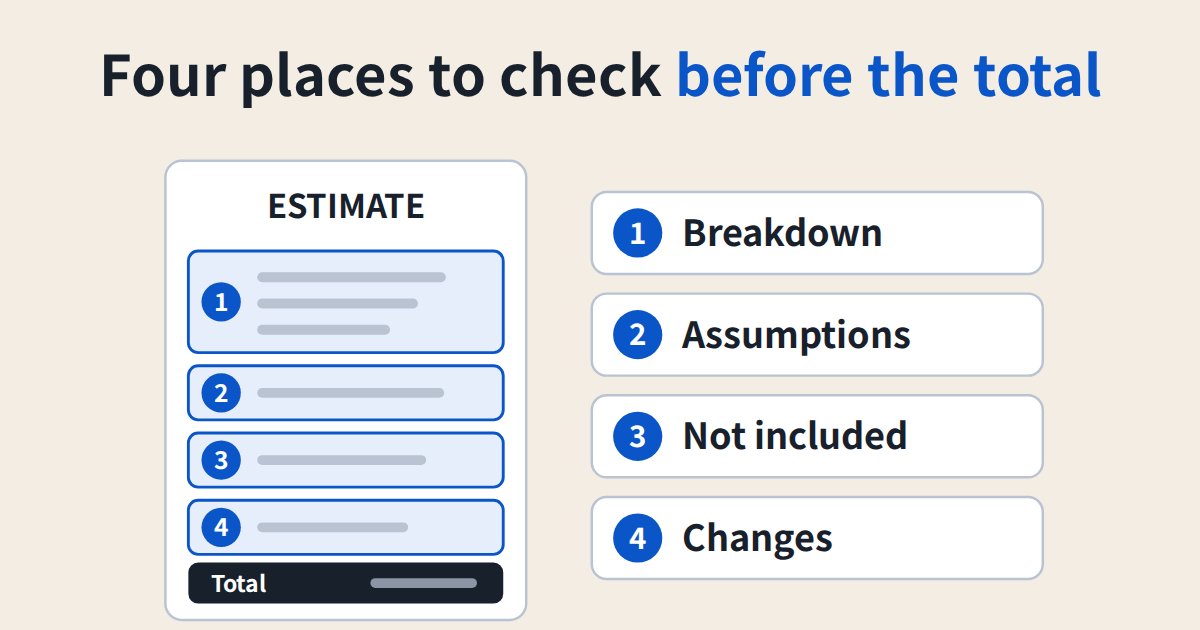
Even when you receive an estimate from a development company, it is hard to judge whether the amount is reasonable. Comparing only the totals tells you neither whether it is high or low nor whether it will grow later.
The first thing to look at on an estimate is not the total. It is four places: the breakdown, the assumptions, what is not included, and how changes are handled. If these four are written, you can check the basis of the amount.
In this article, "the buyer" means the company that commissions the system. We cover how to read the four places, how to compare several estimates, and what to ask the development company. The model contract cited here is a Japanese one.

About the author

wesionaryTEAM Editorial Team
The editorial team is made up of wesionaryTEAM's project managers and engineers. Drawing on what we learn every day on business system, AI adoption and digital transformation projects, we publish information people can use when making decisions, with cases and figures.
The estimate becomes the base of the contract
An estimate is not just a document that tells you the amount. It is the base on which the content of the contract is decided.
The Model Transaction and Contract for Information Systems, published by the Information-technology Promotion Agency, Japan (IPA) and the Ministry of Economy, Trade and Industry, is a template contract. It provides that the contract is concluded by deciding the scope of work, the period, the division of roles, the amount and so on, based on the request for proposal (RFP) from the buyer and the proposal and estimate from the development company. A request for proposal is a document that tells the development company what you want built and under what conditions.

What is not written on the estimate rarely enters the contract either. If you sign with a vague estimate, you cannot check later what was included in the amount. Reading the estimate is also reading the content of the contract in advance.
1. See whether the breakdown is split by phase
The first place to look at is the breakdown. With an estimate of a single line such as "system development, one lot", you cannot tell how much each piece of work costs.
If the breakdown is split by phase, you can notice a missing phase. Phases are the stages of work: requirements definition, design, build and testing. Requirements definition is the phase in which what to build is put into a document.

There are figures to use as a guide. According to the Software Metrics Survey 2025 of the Japan Users Association of Information Systems (JUAS), the share of effort by phase, rounded to the nearest 5%, was 15% for requirements definition, 60% from design to integration testing, and 25% for system testing.
If the estimate you received has no line for requirements definition or testing, or an extremely small one, ask why. It may assume that the buyer does that work. The management line is the work needed to run the project, such as checking progress and holding meetings. The work does not disappear when the line is missing, so check where it is included.
2. The assumptions show what the amount presumes
The amount of an estimate rests on assumptions: the number of screens, the number of users, the systems to connect to, what the buyer provides. If an assumption changes, the amount changes.
The model contract has "estimate conditions" written in the development plan. This is where the conditions the estimate presumes and the roles of the buyer and the development company are written. It also says that the following three points are to be explained at the proposal and estimate stage, before the contract.

- The project structure. Whether there are major subcontractors or offshore work.
- The ownership of rights. Which side holds the copyright and other rights in the programs that are built.
- Other companies' software. Whether another company's product is used at the core.
An estimate without written assumptions leaves room to be told later "that was not included". If they are not written, ask for them in writing.
3. Check first what is not included
An estimate states what is included. What is harder to check is what is not written.
Besides development itself, there is work needed before go-live. The example development plan in the model contract lists, in addition to design, production and inspection, the phases of data migration, operation training, and acceptance by the buyer. Acceptance means that the buyer checks and receives what was delivered.

- Data migration. The work of moving the data of the current system to the new one.
- Training and manuals. Explaining to the people who will use it, and writing the manuals.
- Operation and upkeep after go-live. The work of keeping it running and responding to defects.
- Usage fees. The monthly cost of servers and outside services.
Check whether these are in the estimate or estimated separately. Being separate is not a problem in itself. Signing without knowing the total is. Also ask, before the contract, for a rough figure of the monthly cost after go-live.
4. See how the amount is decided when something changes
Wanting to change what is built during development is not unusual. In the JUAS Software Metrics Survey 2020, the share of projects with large or serious changes was 2.5% where the initial requirements were "very clear" and 69.8% where they were "very vague".
The model contract notes that conflicts over additional charges and delivery dates often arise around specification changes. For that reason it provides that a change must always be proposed in writing and handled through a set procedure.

In the procedure, the cost of the change, the work schedule and the effect on the delivery date and the amount are put in writing, and the change becomes final only when the responsible persons of both sides approve it. The idea is that nothing is changed by a spoken promise.
On the estimate and the contract, check two points: how the amount is calculated when something changes, and who approves it. If these are settled, surprises over additional cost become fewer. On the buyer's side too, decide who may request a change and who approves it.
Compare several estimates on the same conditions
If you compare only the totals of estimates from several companies, you will misjudge. Each company includes a different scope and different assumptions.

Before comparing, align the following four points.
- The scope. Do they cover the same functions and screens?
- The assumptions. Are the number of users and what the buyer provides the same?
- What is not included. Are data migration and upkeep in or out?
- When the amount is fixed. At the contract, or after design?
If a gap remains after aligning them, ask each company the reason. A low estimate may have a narrow scope or optimistic assumptions. A high estimate may include work the other companies left out.
Five questions to ask the development company
When you receive an estimate, ask the following five questions. Whether the answers come back in writing is also material for choosing a company.

- Can you give the breakdown by phase?
- What does this amount assume?
- What is not included in this amount?
- If something changes on the way, how is the amount decided?
- When is the amount fixed?
With an estimate that cannot answer these five, there is no way to check the basis of the amount. Asking is not rude. It is a check the buyer should make.
How we work
When we estimate, we submit three main documents.
- The estimate. The amount and its assumptions.
- The proposal. What will be built, and how we will proceed.
- Effort by function (detailed). A list of the work volume (effort) needed for each function.

You can view all three at any time on a screen dedicated to you, in our project management tool, projectAI. Because the effort for each function is visible, you can check where the amount comes from.
We give a rough estimate before the contract so that you can grasp the scale, and we present and fix the estimate amount at the time of the contract. Only when there are many further things you want to do, we estimate the difference after requirements definition.
When something to add comes up during development, we go ahead only after you have confirmed its effort in projectAI. The record of that confirmation stays, and you can look back at it at any time.
If you already have an estimate from another company, please compare on the same scope. We welcome comparison. The same person remains your contact from consultation to operation.
FAQ
Two estimates differ by nearly double. Which one is right?
Both can be right on their own assumptions. Line up the scope, the assumptions, what is not included and when the amount is fixed, and most of the gap is explained by these four. For a gap that still has no explanation, ask each company the reason. Whether they can answer is material for your decision.
It feels expensive. May we ask for a discount?
If you ask only for a lower amount, phases such as testing and management get cut, and that can come back later as defects and delay. When you want it lower, move the scope, not the amount: drop functions that can wait, build in stages, or take on more of the work yourself. If the effort for each function is shown, you can check how much the amount falls when a function is removed.
What are the "management" and "contingency" lines paying for?
Management is the work needed to run the project: checking progress, holding meetings, checking quality. Deleting the line does not remove the work; it only moves into other lines. Contingency is an allowance for what is not yet decided. Ask what the contingency is for, and how it is treated if it is not used.
After the contract, can we be charged more than the estimate?
It depends on the form of the contract. Under a fixed-price contract, which promises completion, the amount for the agreed scope does not change. What changes it is an addition or change outside that scope. Under a quasi-mandate contract, where you pay for the work carried out, more work means a higher amount. Before the contract, check which form it is and who approves a change in writing.
Does asking for an estimate cost money?
It depends on the company and the stage. Some companies give a consultation and a rough estimate free of charge and charge for a detailed estimate that involves requirements definition. Ask in advance how far it is free. Our estimate consultation is free.
Summary
On an estimate, look at four places before the total: the breakdown, the assumptions, what is not included, and how changes are handled. Compare several estimates only after aligning the scope and the assumptions. Ask about anything that is not written, in writing, before the contract.
We write the factors that set the amount on the estimate and hand it to you. Even if you already have another company's estimate in hand, please use our free estimate consultation.
Related articles and pages
- Can a System Another Vendor Started Be Taken Over? A Real Restart After an Order One Digit Higher
- What Is Contract Development? Contracts, Process, Pitfalls
- Fixed-Price (Ukeoi) Development: Pros, Cons, vs Quasi-Mandate
- Insourcing vs. Outsourcing Development: How to Decide
- System development: contract development from requirements to operation
- Free estimate consultation
Sources
- Information-technology Promotion Agency, Japan and Ministry of Economy, Trade and Industry, "Model Transaction and Contract for Information Systems, 2nd edition", December 2020, revised April 2025 (Japanese)
- Japan Users Association of Information Systems, "Software Metrics Survey 2025 Guidebook", April 2025 (Japanese)
- Japan Users Association of Information Systems, "Software Metrics Survey 2020, System Development and Maintenance Report", April 2020 (Japanese)
Reviewed by

Ichiro NagataCEO and Representative Director
A former engineer at Yahoo! JAPAN. For more than 18 years at startups and large companies, he has worked on a wide range of projects, from new consumer and business ventures to the digital transformation of operations. Alongside hands-on development as an engineer, he has built and managed teams, designed businesses and tested hypotheses, gaining broad experience in launching and growing businesses. He has been through three business sales. Convinced that co-creation makes products better and lets ideas be tested in the market, he founded wesionaryTEAM to offer a co-creation platform.