
BLOG
The Phases and Flow of System Development: What the Buyer Does at Each Phase
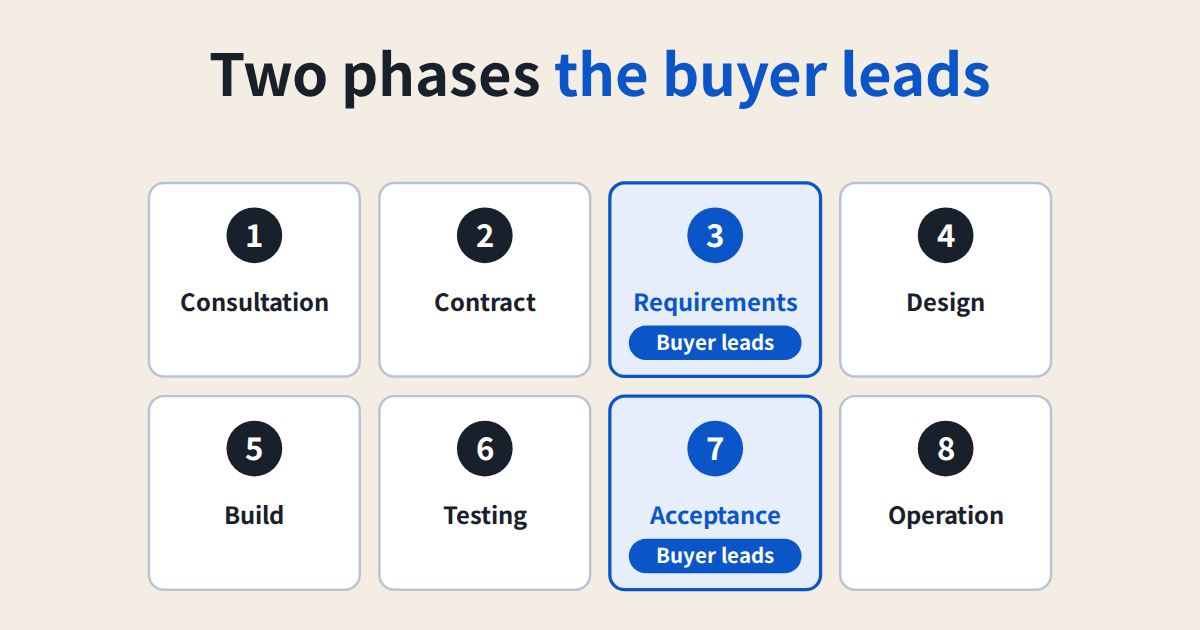
System development moves through eight phases: consultation and estimate, contract, requirements definition, design, build, testing, acceptance and operation.
The phases are the order in which the development company does its work, and also the order in which the commissioning side makes decisions. The buyer has something to do in every phase, and requirements definition and acceptance are phases the buyer leads.
In this article, the buyer means the company that commissions the system. It covers the flow from consultation to operation, what the buyer does at each phase, which phases take time, and why projects run late and how to prevent it.

About the author

wesionaryTEAM Editorial Team
The editorial team is made up of wesionaryTEAM's project managers and engineers. Drawing on what we learn every day on business system, AI adoption and digital transformation projects, we publish information people can use when making decisions, with cases and figures.
The whole flow has eight phases
Names differ by company, but development generally goes in this order.
- Consultation and estimate. You explain the trouble and check the outline of what will be built and the expected amount.
- Contract. The scope, the amount and the way of working are agreed in writing.
- Requirements definition. What will be built is written down.
- Design. The parts users see, such as screens and forms, are decided, and then the internal structure.
- Build. The programs are made according to the design.
- Testing. The development company checks that what was built works as designed.
- Acceptance. The buyer checks the finished system against the real work.
- Operation. Questions and defects after go-live are handled, and improvement continues.
Design has two steps. External design decides what users see, such as screens and forms. Internal design decides how to build it. The buyer mainly reviews the external design.
Testing has steps as well. An integration test checks the parts joined together, a system test checks the whole, and an acceptance test is the buyer's own check. If the acceptance test finds no problem, the buyer formally accepts the deliverables.
Design and testing are paired. What was decided in requirements definition is checked at acceptance, what was decided in external design is checked in the system test, and what was decided in internal design is checked in the integration test. Checking goes in the reverse order of deciding.

Inside the buyer there are three roles
The buyer is the company that commissions the system. But more than one person acts inside that company. Japan's model contract for information systems, compiled by the Information-technology Promotion Agency (IPA) and the Ministry of Economy, Trade and Industry, divides the roles inside the commissioning company into three: management, the business department and the IT department.

Many companies have no IT department. In that case one person is named as the contact and does the coordinating. The owner sometimes acts as the contact. What matters is that none of the three roles is left empty.
What the buyer does at each phase
Few phases can in fact be left entirely to the development company. Who inside the buyer does what at each phase is generally as follows. In a smaller company one person covers more than one role.

- At consultation and estimate, the contact person explains the trouble, the users, the hoped-for timing and the upper limit of the budget. For points not yet decided, saying so is enough.
- At contract, management checks and decides the scope and amount, the procedure for changing the specification, and the handling of defects after delivery.
- In requirements definition, the business department explains today's work and decides what is essential and what can wait. Management approves the resulting document.
- In design, the business department looks at the proposed screens and forms and checks that they can be used in the real work.
- During the build, the contact person receives progress reports and gathers answers inside the company to the questions that come up.
- In testing, the contact person receives the development company's report of what was checked.
- At acceptance, the business department operates the system along the real flow of work and checks that it behaves as decided.
- In operation, the contact person takes questions from inside the company and reports the improvements wanted.
Of these, requirements definition and acceptance are led by the buyer. The same model contract treats requirements definition as work the buyer does with the development company's support: the business department defines the business requirements, the IT department defines the functions the system needs, and management approves. What is built depends on the buyer's own work, and only the buyer can settle it.
For acceptance too, the same document describes a phase in which the development company supports the buyer's review and testing. The buyer does the checking, with the business department at the centre. Whether people from the shop floor can give time to these two phases largely decides the result.
What each phase leaves in your hands
Each time a phase ends, a document is left with the buyer. That document is the starting point of the next phase and the reference if a misunderstanding arises later.

- At consultation, estimate and contract: the estimate and the contract.
- In requirements definition: the requirements document describing what will be built.
- In design: the design documents for screens and forms.
- In testing and acceptance: the record of what was checked and the results.
- At the start of operation: a user guide and the agreed contact for questions.
If the work moves to the next phase without a document, check what was actually decided. Progress is more reliably judged by whether these documents have been approved than by reports of work done.
The phases that take time are deciding and checking
Only part of the development period is spent making programs. The Software Metrics Survey 2025 by the Japan Users Association of Information Systems (JUAS) gives the share of the schedule by phase. Rounded to the nearest 5%, requirements definition takes 20%, design through integration testing 50%, and system testing 30%.

Deciding and checking take half the schedule. The same survey explains that requirements definition does not lend itself to being split among people, so its share of the schedule is larger than its share of the work. It is a phase that adding people does little to shorten.
The shares are averages over the responding companies' projects and vary with the size of the project and the way of working. Even so, the point holds generally: a schedule estimated from build time alone falls short.
Why projects run late
The larger the project, the more likely it is to run late. According to the JUAS Corporate IT Trends Survey 2026, the share of projects delivered later than planned was 9.6% for projects under 10 person-months and 47.8% for those of 500 person-months or more. A person-month is the amount of work one person does in one month.

The same survey asked for the causes. The answers included insufficient consideration at planning, 52.5%; current work and systems being more complex than assumed, 48.8%; a lack of skills among the company's own staff, 46.5%; and frequent specification changes, 42.4% (multiple answers).
All three concern the period before development starts and the phases just after. Problems at the deciding stage, more than problems during the build, lead to later delay.
What the buyer can do to keep to schedule
Many of the causes of delay can be reduced by how the commissioning side acts.

- Set the three roles. Decide at the start who is the contact, who takes part from the shop floor, and who makes the final decision.
- Answer on time. When answers to the development company's questions and requests for confirmation are late, the later phases are late by the same amount.
- Make changes by procedure. Rather than mentioning an idea when it occurs to you, check the impact and cost and then decide.
- Start small. Starting with the necessary part and adding the rest later lowers the risk of delay.
Requirements definition and acceptance need time from people in the business department. It is safer to discuss the timing at the first planning stage so that it does not fall in a busy season. When you receive the schedule from the development company, marking the periods when your own company must act makes preparation easier.
There are two ways to move through the phases
Broadly, there are two ways of moving through the phases.

- In order (waterfall). The phases proceed from requirements definition onward, planned on the premise of not going back. It suits development where what is built is settled and the date cannot move.
- In cycles (agile). Building and checking are repeated in short periods. It suits development where you want to decide as you use the system.
Neither is better in itself; the choice depends on how much of what is to be built is already decided. The relation to the form of contract is explained in our article What Is Contract Development?.
How we work
We run development in two-week sprints. A sprint is a unit in which we decide the functions to build in that round and build and test them within two weeks. Because we re-plan every two weeks, a change in priorities is reflected quickly.

We make the status of development visible in our own project management tool, projectAI. On a screen dedicated to you, you can check at any time whether each function is being built, being tested or waiting for your acceptance.
We send acceptance requests through projectAI function by function as each one finishes testing, and submit the test specification for each function. Early comments are applied to the functions still being built to keep rework small.
FAQ
How long does development take?
It depends on the size of what is built. The JUAS Software Metrics Survey 2025 gives a formula for the standard schedule from the work volume: about 9.7 months for 27 person-months and about 16 months for 125 person-months. A person-month is the work of one person for one month. Also check that the schedule includes requirements definition and acceptance.
How much time does the buyer need to set aside?
There is no fixed amount, but it is not small. In the same survey, requirements definition, which the buyer leads, took 20% of the whole schedule, and the buyer-side system test took 16%. Decide in advance who attends meetings and by when questions are answered.
When do we pay?
It is set in the contract. The model contract fixes the amount and the payment method of each phase within the contract for that phase. Some contracts split payment into the start, the middle and after acceptance, so check the estimate and the contract.
Can everything be left to the development company?
The building can be left to them, but deciding what to build and checking what is finished can only be done by the buyer. Before you start, decide who is the contact, who takes part from the front line, and who makes the final decisions.
Summary
System development moves through eight phases from consultation to operation. The buyer has something to do in every phase and leads requirements definition and acceptance. Many causes of delay lie in the deciding stage.
We work in two-week sprints and keep the status of development visible in projectAI at any time. Even if what you want to build is not yet settled, please use our free estimate consultation.
Related articles and pages
- What Is Contract Development? Contract Types and What to Decide Before You Order
- What Is a Quasi-Mandate Contract? When to Use It in System Development and How It Differs from Fixed-Price
- Should You Insource or Outsource System Development?
- Can a System Another Vendor Started Be Taken Over? A Real Restart After an Order One Digit Higher
- System development: contract development from requirements to operation
- Free estimate consultation
Sources
- Japan Users Association of Information Systems, "Software Metrics Survey 2025 Guidebook", April 2025 (Japanese)
- Japan Users Association of Information Systems, "Corporate IT Trends Survey Report 2026", April 2026 (Japanese)
- Information-technology Promotion Agency, Japan and Ministry of Economy, Trade and Industry, "Model Transaction and Contract for Information Systems, 2nd edition", December 2020, revised April 2025 (Japanese)
Reviewed by

Ichiro NagataCEO and Representative Director
A former engineer at Yahoo! JAPAN. For more than 18 years at startups and large companies, he has worked on a wide range of projects, from new consumer and business ventures to the digital transformation of operations. Alongside hands-on development as an engineer, he has built and managed teams, designed businesses and tested hypotheses, gaining broad experience in launching and growing businesses. He has been through three business sales. Convinced that co-creation makes products better and lets ideas be tested in the market, he founded wesionaryTEAM to offer a co-creation platform.