
BLOG
Rough Estimates in System Development: When the Price Is Fixed, and Why It Changes
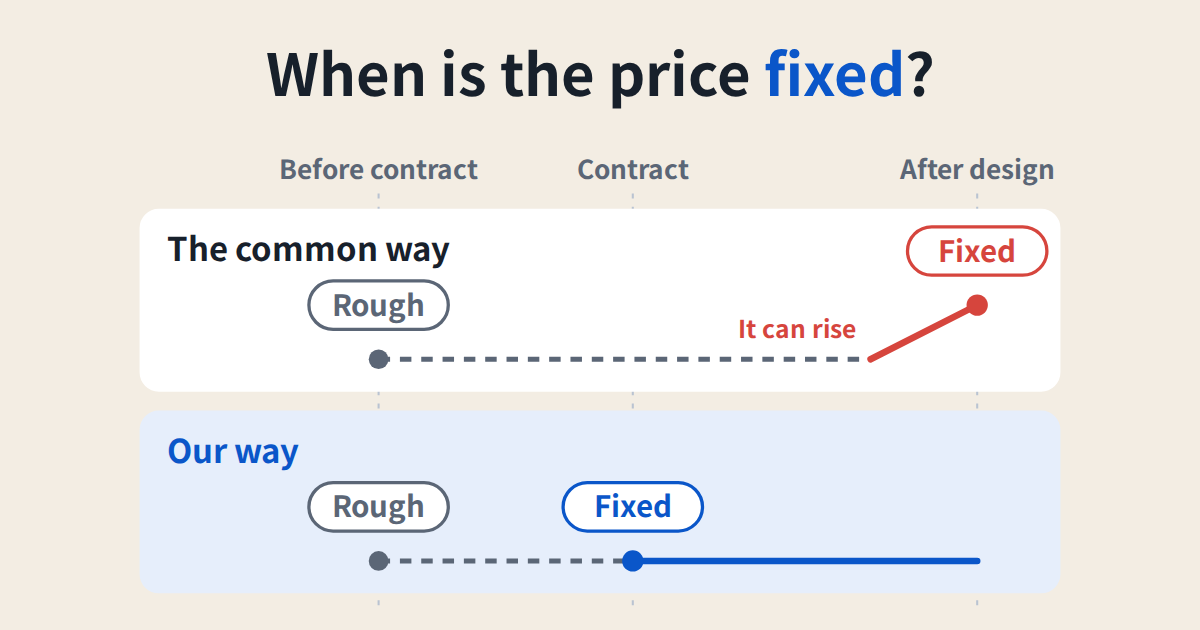
When you ask about building a system, the first number you hear is a rough estimate. As the talks go on, the number changes, and many buyers are left wondering what the first one meant.
A rough estimate is a number given before the details of the system are decided. In the common approach, the price becomes final only after the design is finished. Some companies fix the price at the time of contract instead, and we are one of them.
In this article, the buyer means the company that commissions the system. It sets the common approach beside ours and explains, from the buyer's side, why a rough estimate changes later, why a very low one deserves caution, what to bring to the first consultation, and what to check when a rough estimate arrives.

About the author

wesionaryTEAM Editorial Team
The editorial team is made up of wesionaryTEAM's project managers and engineers. Drawing on what we learn every day on business system, AI adoption and digital transformation projects, we publish information people can use when making decisions, with cases and figures.
In the common approach, the price is final after design
Japan's model contract for information systems, compiled by the Information-technology Promotion Agency (IPA) and the Ministry of Economy, Trade and Industry, divides estimates into four stages: a trial estimate at the concept stage, a preliminary estimate at the planning stage, a rough estimate at the requirements stage, and a final estimate after design.
Requirements definition is the step of writing down what will be built. External design is the step of deciding what users see, such as screens and printed forms.

The model contract states that estimates up to requirements definition are not final estimates, and that a final estimate becomes possible after the external design is approved. It also adopts contracts per phase and re-estimation: an estimate made at a vague stage is made again once things are clear.
Take an inventory system. The purpose, to see the stock at each site at once, is settled at the first consultation. The number of items, the number of screens for recording goods in and out, and whether to connect to the accounting software are not. A rough estimate puts provisional assumptions on these open points.
Three reasons a rough estimate changes later
There are three main reasons the amount moves.
- The details are not decided. At the rough stage, the number of screens, the fields on each form and the connections to other systems are open. The model contract also warns that requirements about operation and data migration can appear during design.
- Today's work and systems turn out more complex than assumed. Exceptions on the shop floor and the fine rules of a long-used system are found only once someone looks.
- The specification changes along the way. As the system takes shape, people want to add features or change what they see.
The Corporate IT Trends Survey 2026 by the Japan Users Association of Information Systems (JUAS) asked why projects went over budget. The most common answers were current work and systems being more complex than assumed, 51.4%; insufficient consideration at planning, 51.0%; and frequent specification changes, 48.6% (multiple answers).
Specification changes depend heavily on how clear the first requirements are. In the JUAS Software Metrics Survey 2020, large or critical changes occurred in 2.5% of projects whose requirements were very clear, and in 69.8% of those whose requirements were very vague.

The survey covers mainly large companies, which should be kept in mind. Even so, the link between vague requirements and later changes is plain.
A very low rough estimate deserves caution
It is often said that the range of an estimate narrows as the stages go on. That is not always so. A rough estimate can be set too low, and the amount can rise sharply at the design stage.
Where the price becomes final after design, the buyer moves forward relying on the rough figure. If the amount rises sharply once design is done, time and money have already been spent. The buyer has to decide whether to accept the higher amount at a point where turning back is hard.
The larger the project, the higher this risk. In the same Corporate IT Trends Survey 2026, the share of projects that went over budget was 6.0% for projects under 10 person-months and 42.2% for those of 500 person-months or more. A person-month is the amount of work one person does in one month.

When you collect rough estimates from several companies, the lowest figure does not always end up the cheapest. A rough estimate that is too low tends to look like this.
- Few assumptions are written down. If you cannot tell what the amount assumes, you are more likely to hear later that something is not included.
- Many items are left out. Check whether data migration, testing and preparation for operation are estimated separately.
- There is no clear answer when you ask when the price becomes final and what would raise it.
Along with the amount, ask when that amount becomes final and in what cases it rises.
We fix the price at the time of contract
Our estimating goes in this order.

- Before the contract, we give a rough estimate. It is a figure for grasping the scale. The project manager in charge listens in the first call and tells you the scope and a sense of the cost.
- At the contract, we present the estimate and fix the amount. We do not work in a way where the price stays open until design is finished.
- Only when there are many other things you want to do, we estimate the difference after requirements definition. Depending on the project, once the additional requests are gathered in requirements definition, we present only the added part.
With the amount settled at contract, the buyer can get the budget approved internally in one go, without the worry of not knowing the total until design ends.
When we estimate, we mainly submit three documents: the estimate, the proposal, and the effort by function (detailed), a list of the work volume (effort) for each function. You can view all three at any time on a screen dedicated to you, in our project management tool, projectAI. When something to add comes up during development, we go ahead only after you have confirmed its effort in projectAI, and the record can be looked back at any time. The person who explained the estimate stays your contact and reports progress after development begins.
What to bring to the first consultation to firm up the rough estimate
The more that is known at the consultation, the firmer the rough estimate. These five things help, as far as you know them.

- What the trouble is. Before the features you want, tell us what is not working today.
- Who will use it, and how many. Whether only staff use it or customers too changes what is built.
- How it is done now. Showing the spreadsheet, the paper form or the current system is the quickest way.
- What is essential and what can wait. Priorities allow an estimate with a bounded scope.
- The timing you hope for and the upper limit of the budget. With a limit, we can first discuss what fits within it.
You do not need all of them. Saying that a point is undecided is enough for the estimator to set an assumption.
Four things to check when you receive a rough estimate
When you look at a rough estimate, check the assumptions behind the number and what happens next, more than the number itself.

- When the price becomes final. At contract, or after design. It differs by company.
- In what cases it rises. Ask the conditions and how the increase would be estimated.
- Whether the assumptions are written. Check what the amount assumes, such as the number of screens and users.
- Whether exclusions are written. Check whether data migration, operation and maintenance, and server fees are included.
Comparing companies on these four points shows where the difference in price comes from. We describe a case of reviewing an estimate for work started elsewhere in our article on taking over a project.
FAQ
How far apart are the rough and final amounts?
There is no set ratio. You may see figures such as "a rough estimate is within 30 to 50%", but we found none with a stated source. What decides the size of the gap is how clear the first requirements are and how many changes come later. In projects whose first requirements were very vague, large changes occurred in about seven in ten (JUAS, 2020 edition).
May we get our internal budget approved on the rough amount?
You can, but write down the assumptions and when the amount becomes final. If the company fixes the price after design, tell your organisation in advance that a second approval will be needed at that point. If the company fixes the price at the contract, one budget approval is enough.
The rough estimate is over our budget. How should we discuss it?
Tell them your upper limit as it is. Once they know it, the development company can propose narrowing the scope or building in stages. If the effort for each function is shown, you can decide while checking how much the amount falls when a function is moved to later.
Can we get a rough estimate when much is still undecided?
Yes. What is undecided is set down as an assumption, and the rough estimate states those assumptions. Some companies charge for a detailed estimate that involves requirements definition, so ask first how far it is free. At our company, the first call and the estimate after the requirements are worked out are both free of charge.
May we ask only for a rough estimate and not commission the work?
Yes. A rough estimate is material for deciding whether to commission. With us, you are welcome to stop at the estimate, and we will not follow up with sales contact afterwards. Please also use it to compare with other companies' estimates.
Summary
A rough estimate is a number for grasping the scale, given before the details are decided. When the price becomes final differs by company, and where it is fixed after design, a rough estimate that is too low can rise sharply later.
We fix the price at the time of contract. Even if what you want to build is not yet settled, please use our free estimate consultation. In the first call we tell you the scope and a sense of the cost.
Related articles and pages
- Can a System Another Vendor Started Be Taken Over? A Real Restart After an Order One Digit Higher
- What Is Contract Development? Contract Types and What to Decide Before You Order
- What Is a Quasi-Mandate Contract? When to Use It in System Development and How It Differs from Fixed-Price
- What Is Fixed-Price (Ukeoi) Development? Pros, Cons and How It Differs from Quasi-Mandate Contracts
- System development: contract development from requirements to operation
- Free estimate consultation
Sources
- Information-technology Promotion Agency, Japan and Ministry of Economy, Trade and Industry, "Model Transaction and Contract for Information Systems, 2nd edition", December 2020, revised April 2025 (Japanese)
- Japan Users Association of Information Systems, "Corporate IT Trends Survey Report 2026", April 2026 (Japanese)
- Japan Users Association of Information Systems, "Software Metrics Survey 2020: System Development and Maintenance Report", April 2020 (Japanese)
Reviewed by

Ichiro NagataCEO and Representative Director
A former engineer at Yahoo! JAPAN. For more than 18 years at startups and large companies, he has worked on a wide range of projects, from new consumer and business ventures to the digital transformation of operations. Alongside hands-on development as an engineer, he has built and managed teams, designed businesses and tested hypotheses, gaining broad experience in launching and growing businesses. He has been through three business sales. Convinced that co-creation makes products better and lets ideas be tested in the market, he founded wesionaryTEAM to offer a co-creation platform.