
BLOG
Why System Development Is Delayed, and Four Things the Buyer Can Do
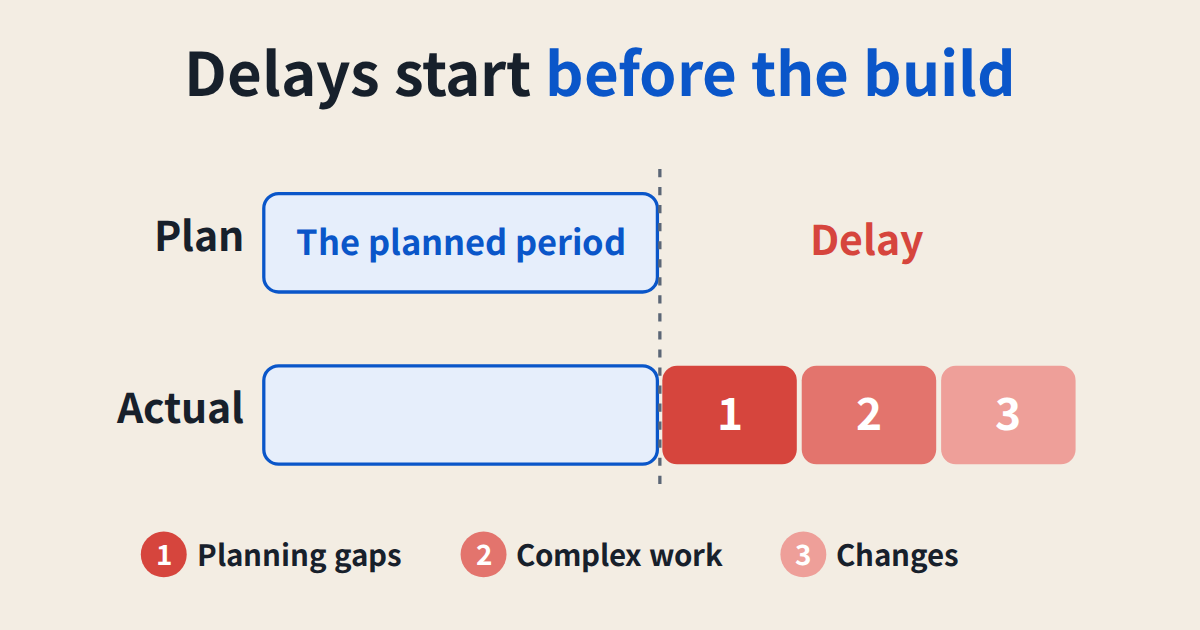
The causes of delay in system development gather in the stage before the build. In a survey by the Japan Users Association of Information Systems (JUAS), the top factors behind late schedules were "gaps in planning" and "current work and systems more complex than expected", and the phase that most affected the schedule was requirements definition.
The stage before the build is the one in which the commissioning side is deeply involved. Much of the delay can be reduced by how that side works.
In this article, "the buyer" means the company that commissions the system. We cover how often delays happen, what causes them, what the buyer can do, and what to ask the development company. The surveys and the model contract cited here are Japanese.
If your project has a fixed date, bring it to our free estimate consultation.

About the author

wesionaryTEAM Editorial Team
The editorial team is made up of wesionaryTEAM's project managers and engineers. Drawing on what we learn every day on business system, AI adoption and digital transformation projects, we publish information people can use when making decisions, with cases and figures.
The larger the project, the more delays
JUAS surveys every year whether companies' system development finished as planned. Its IT trends report 2026 shows, by project size, the share of projects whose schedule was "later than planned".
Size is divided by person-months. A person-month is a unit for the amount of work one person does in one month.

- Under 10 person-months. 9.6% were late.
- 10 to under 50. 16.2%.
- 50 to under 100. 25.4%.
- 100 to under 500. 38.8%.
- 500 or more. 47.8%.
At the smallest size about one in ten is late, and at the largest nearly half. A larger project has more people involved and more to decide.
The gap is also clear in the share that answered "finished as planned": 47.5% under 10 person-months and 19.5% at 500 or more. Most of the rest answered "finished more or less as planned".
The causes gather where things are decided
The same survey asked the companies that reported a late schedule for the causes, with multiple answers allowed.

In order of frequency, the answers were "gaps in planning" 52.5%, "current work and systems more complex than expected" 48.8%, "lack of skill in own staff" 46.5%, and "frequent specification changes" 42.4%. Own staff here means the staff of the responding company, that is, the buyer.
The causes on the development company's side were "lack of skill at the vendor" at 37.0% and "too few people on the project" at 29.3%. The top four arise in scenes where the buyer takes part: making the plan, conveying the current work, and deciding the specifications.
"Gaps in planning", "current work and systems more complex than expected" and "frequent specification changes" were also at the top of the answers on quality and on budget. The survey treats these three as causes common to quality, budget and schedule.
The phase with the most effect is requirements definition
The survey also asked which phases affected the worsening. For the schedule, "requirements definition" was named most often at 69.0%, followed by "design, implementation and testing" at 51.7%.
Requirements definition is the phase in which what to build is decided and put into a document. A phase before the build is named more often than the phases of the build. Compared with the previous year's survey, the answers naming requirements definition for the schedule rose by 8.6 points.

The Model Transaction and Contract for Information Systems, a template contract published by the Information-technology Promotion Agency, Japan (IPA) and the Ministry of Economy, Trade and Industry, positions the upstream phases including requirements definition as the stage for which the buyer should bear responsibility. The phase that affects delay most is also the phase the buyer leads.
Vague requirements come back as changes
When requirements definition is vague, specification changes increase later. A change brings rework and repeated checking, and lengthens the schedule.
The JUAS Software Metrics Survey 2020 looked at the relation between the clarity of the first requirements and how changes occurred. The share of projects with large or serious changes was 2.5% where the requirements were "very clear", 15.1% where "fairly clear", 33.8% where "somewhat vague", and 69.8% where "very vague".

From "somewhat vague" to "very vague" the share more than doubles. Taking time to decide at the start reduces delay later.
Making things clear does not mean producing thick documents. It means showing the development company today's workflow, the screens and forms in use and how exceptions are handled, and agreeing in a document on what to build.
Handle changes and undecided matters in writing
Even so, things you want to change will come up during development, and sometimes you go on without having decided everything. The problem is settling them by word of mouth.
The model contract provides that, for what is undecided, the content and the date it will be decided are confirmed in writing. A specification change becomes final only after its cost, its schedule and its effect on the delivery date are put in writing, discussed, and approved by the responsible persons of both sides.

Handled in writing, each change shows how the date moves. A spoken change adds work without moving the date, so it surfaces as a delay near the end.
The same goes for what is undecided. If you share with the development company when it will be decided, the company can reorder its work and prepare. How to check an estimate is explained in How to Read a System Development Estimate.
Four things the buyer can do
Many of the causes of delay can be reduced by how the buyer acts. Matching what can be done to the top causes in the survey gives the following.

- Set the roles and who decides first. If it is not settled who answers and who approves, every check takes days. Set a deadline for replies as well.
- Show today's work and its exceptions. Conveying early the sheets and forms in use, and how month-end and cancellations are handled, reduces the complexity discovered later.
- Use the change procedure. Put what you want to change in writing, and decide after checking the effect on the date and the cost.
- Start small, in stages. The smaller the project, the fewer the delays, so build the part you need first and add the rest later.
The model contract has the work each of the buyer and the development company is to do put in a document, and makes the side that delays its own part responsible for it. A delay in the buyer's work is also part of the delay in development. Set time aside inside your company for answering questions, providing materials and giving approvals. How to proceed in small steps is explained in Agile vs Waterfall Development.
Ask the development company how progress is reported
A delay cannot always be avoided, but it can be known early. Known early, there are moves to make, such as revising the scope or changing the order.
The model contract provides for regular meetings at which the development company submits a progress report. In the meeting, the two sides check whether anything is late and, if so, the reason and the response. What was decided, what stays under review, and its schedule and owner are also confirmed there.

Before the contract, ask the development company the following three questions.
- How often do you report progress, and on what basis?
- When something is likely to be late, when and from whom do we hear it?
- When something is late, how do you show the reason and the response?
With a report that only says "it is going well", a delay stays invisible until the end. Check whether plan and actual will be shown side by side.
How we work
We manage projects in line with the international standard for project management. We manage the schedule in detail in our project management tool, projectAI, and you can check the following four at any time on a screen dedicated to you.
- Milestones. The dates of key points such as the end of requirements definition and go-live.
- Sprint plan. The functions to build in each two-week round.
- Development status. For each function, whether it is being built, has been tested, or is waiting for your reply.
- Gantt chart. A schedule that lines up the plan for each phase as horizontal bars.

Our answers to the three questions in the previous section are as follows.
- Progress reports. At a weekly meeting, we report plan against actual while looking at the projectAI screen. Between meetings, you can check the screen at any time.
- When a delay looks likely. Your assigned project manager tells you as soon as we know, without waiting for the weekly meeting.
- When the project is late. We write the reason, the functions and dates affected, and proposed countermeasures in projectAI, and decide with you which to take.
When something to add comes up during development, we go ahead only after you have confirmed its effort in projectAI, so you can decide after checking the effect on the date. Please use our free estimate consultation even while you are only unsure about the date.
FAQ
What should we do first when told the project is likely to be late?
Ask for the reason and for how far each function has got, in writing. Then decide whether to narrow the scope or move the date.
May we shorten the testing period to keep the date?
We do not recommend it. Cutting testing means defects are found after you start using the system, and you have to stop work to deal with them. If the date cannot move, review the scope instead.
Who bears the cost when the project is late?
It depends on the cause and the contract. Under the Civil Code, if the delay is caused on the development company's side, the buyer can claim damages (Article 415). It is different when the buyer's own share of the work was late, so confirm the division of work and the change procedure in writing before the contract.
Can we cancel the contract when the development company's delay means we will miss the date?
It depends on the contract and the Civil Code. The Civil Code allows cancellation when the other party does not perform, the buyer demands performance within a reasonable period, and there is no performance within that period (Article 541). If the buyer's own work caused the delay, the situation changes, so check the division of work and what happened in the records first.
Summary
Delays in system development grow with project size, and their causes gather where things are decided, such as planning and requirements definition. The buyer can reduce them in four ways: set the roles, show today's work, use the change procedure, and start small. Check progress as plan against actual.
We manage projects in line with the international standard and report plan against actual at a weekly meeting. When a delay looks likely, your assigned project manager tells you as soon as we know. Even if you are uneasy about your date, please use our free estimate consultation.
Related articles and pages
- The Phases and Flow of System Development: What the Buyer Does at Each Phase
- The Kinds of Testing in System Development: Unit, Integration, System and Acceptance
- What Is an Acceptance Test (UAT)? How the Buyer Runs It, and Formal Acceptance
- What Is Contract Development? Contract Types and What to Decide Before You Order
- System development: contract development from requirements to operation
- Free estimate consultation
Sources
- Japan Users Association of Information Systems, "Corporate IT Trends Survey Report 2026", April 2026 (Japanese)
- Japan Users Association of Information Systems, "Software Metrics Survey 2020, System Development and Maintenance Report", April 2020 (Japanese)
- Information-technology Promotion Agency, Japan and Ministry of Economy, Trade and Industry, "Model Transaction and Contract for Information Systems, 2nd edition", December 2020, revised April 2025 (Japanese)
- Referred to in the figure notes: articles 12, 36 and 37
- e-Gov Laws and Regulations Search, "Civil Code (Act No. 89 of 1896)" (Japanese)
Reviewed by

Ichiro NagataCEO and Representative Director
A former engineer at Yahoo! JAPAN. For more than 18 years at startups and large companies, he has worked on a wide range of projects, from new consumer and business ventures to the digital transformation of operations. Alongside hands-on development as an engineer, he has built and managed teams, designed businesses and tested hypotheses, gaining broad experience in launching and growing businesses. He has been through three business sales. Convinced that co-creation makes products better and lets ideas be tested in the market, he founded wesionaryTEAM to offer a co-creation platform.