
BLOG
What Is an Acceptance Test (UAT)? How the Buyer Runs It, and Formal Acceptance
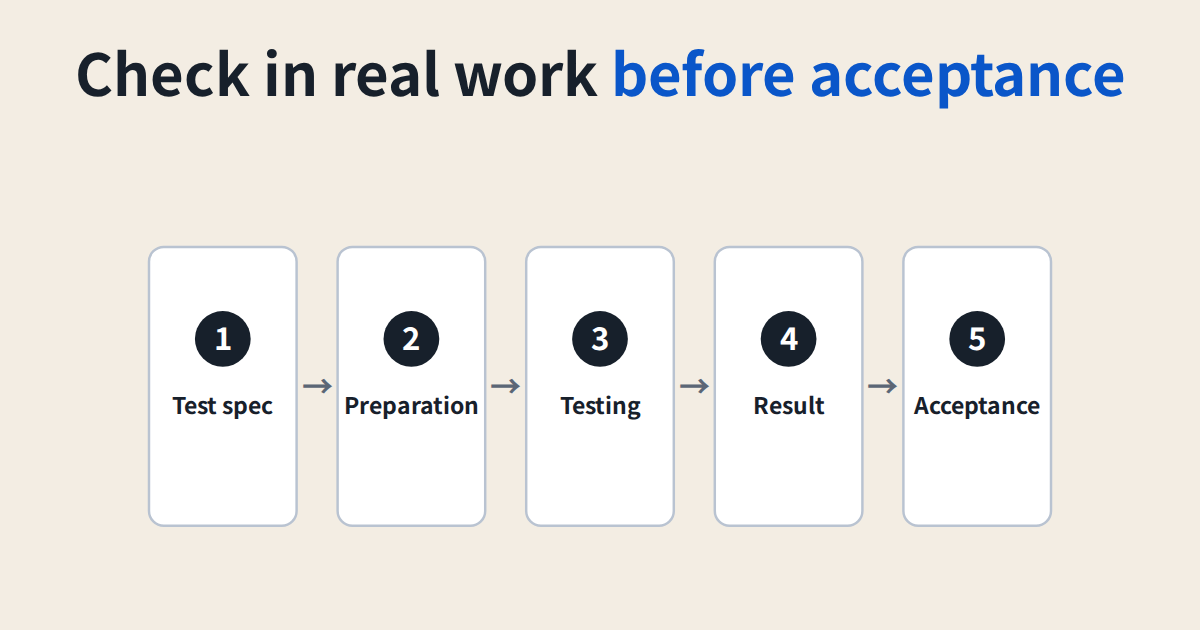
An acceptance test is the test in which the buyer runs the delivered system through their own work and checks whether it can be accepted. It is also called UAT, for user acceptance testing. Its purpose differs from the tests the development company runs, and only the buyer can do it.
The result of the acceptance test leads directly to formal acceptance. Under the model contract, if the buyer does not report a failure in writing within the agreed inspection period, the system is deemed to have passed. How much is prepared in advance, and how much of the users' time can be set aside, decides how far you can check.
In this article, the buyer means the company that commissions the system. It covers how to prepare for the acceptance test, the scenes to check, how to handle problems found, and how the test relates to formal acceptance.

About the author

wesionaryTEAM Editorial Team
The editorial team is made up of wesionaryTEAM's project managers and engineers. Drawing on what we learn every day on business system, AI adoption and digital transformation projects, we publish information people can use when making decisions, with cases and figures.
The acceptance test has a different purpose from the vendor's tests
Before delivery, the development company runs its own tests: an integration test that checks the parts joined together, and a system test that checks the whole. What they look at is whether the system works as designed.
The acceptance test looks at whether the system works as decided and whether it can be used in the real work. Japan's model contract for information systems, compiled by the Information-technology Promotion Agency (IPA) and the Ministry of Economy, Trade and Industry, provides that the buyer inspects whether the delivered software matches the specification.

Even when the vendor's tests are thorough, the acceptance test cannot be skipped. The fine rules and exceptions of the work are known only to the people who do it.
The checking is done by the people who use the system
Inside the buyer there are three roles. The same model contract divides them into management, which decides the budget and direction, the business department, which uses the system at work, and the IT department, which is the contact for the development company. A company without an IT department names one person as the contact.

In the acceptance test the work is generally divided as follows.
- The business department operates the system, checks it and records the results.
- The contact person draws up the plan and tells the development company about the problems found.
- Management looks at the results and approves the pass or fail.
The development company supports this checking. You can ask it to set up the environment and explain how to operate the system, but the buyer decides whether it passes.
Preparation is finished before the test begins
If you start preparing once the test has begun, you will run out of time. The model contract provides that the buyer, in consultation with the development company, draws up the test specification that is the standard for the inspection. Four things are written in it.

- Test items. What to check.
- Test data. What data to use.
- Test method. How to operate, and what result counts as a pass.
- Test period. From when to when.
The development company reviews the finished test specification against the system specification. Agreeing in advance on how to check prevents the later misunderstanding of being told that something is out of scope.
Reserve the time of the people who will check as well. The acceptance test runs alongside ordinary work, so assigning in advance who checks which scene and when makes it easier to finish within the period. Using data close to the real thing matters too. With a small sample you will not notice slowness or errors in totals.
What you check are scenes of real work
Problems are found more readily by going through the flow of work than by trying functions one at a time. Typical scenes to check are these six.

- Daily work. Go through from start to finish, such as from order to invoice.
- Month-end and year-end. Closing and carry-over, done only occasionally.
- Exceptions. Cancellation, correction and sending back: flows that differ from the usual.
- Permissions. Check that nothing is visible to people who must not see it.
- Forms and data. Look at the content of the output and at the data moved from the old system.
- Links. Exchanges with other systems, such as accounting software.
Do not stop at the everyday operations. The trouble comes when a problem is first noticed after go-live, at month-end or in an exception. Taking the scenes from the flow of work decided in requirements definition leaves fewer gaps.
Problems found are sorted into two kinds
Finding problems in the acceptance test is not unusual. In the Software Metrics Survey 2025 by the Japan Users Association of Information Systems (JUAS), the defects found in the user-side system test averaged 27.5 to 28.3 per project. These are averages over the responding companies' projects.
Record each problem with a screenshot: what you did, what happened, and what should have happened. Then sort it into one of two kinds.

- It does not work as decided. Under the model contract, the development company fixes it free of charge and the buyer inspects again.
- It was never decided. It is treated as an additional request, through the procedure for changing the specification.
The line between them is whether it is written in the agreed documents. This is where having approved the requirements and design documents pays off.
When many fixes are requested, put them in order. Things that stop the work come first; changes to appearance or wording come later. Listing everything with the same weight delays the important fixes. In the re-test, go through not only the fixed points but the operations around them once more.
If you do not reply within the period, it is a pass
The result of the acceptance test leads to formal acceptance, the procedure of acknowledging that the deliverables have been received. The model contract sets it out as follows.

- If it passes, you hand the inspection certificate to the development company. Acceptance is then complete.
- If it fails, you give specific reasons in writing and ask for the fix.
- If you raise no objection in writing with reasons within the inspection period, it is deemed to have passed.
The third needs care. The model contract explains that the purpose of this provision is to prevent acceptance being drawn out for the buyer's own reasons. Being too busy to check is not a reason. The length of the inspection period and the procedure differ from contract to contract, so check your own.
Defects found after acceptance also have a time limit
Defects are sometimes found after acceptance. A deliverable that does not match the content of the contract is called a non-conformity, and the model contract provides that the buyer can ask for it to be fixed.

There is a time limit, however. By when you must report it to have it fixed is set in the contract. Where the contract is silent, for fixed-price (ukeoi) contracts the Japanese Civil Code requires notice within one year of learning of the non-conformity.
The time limit and the range of defects covered differ by contract. For an individual case, check the contract and consult a specialist if needed.
How we work
We do not wait until every function is finished; we ask you to accept each function as it is done. Once a function's specification, build and testing are complete, we send you an acceptance request through our project management tool, projectAI. You check that function on a screen dedicated to you and send us your comments.
We write and submit the test specification for each function, and you can see every test case in projectAI. Before accepting, you can see which function was checked and how.

We do not only fix the function an early comment is about; we spread it to the functions still being built. Compared with checking everything together at the end, this keeps later rework small.
Approvals of specifications, acceptance requests, your comments and our responses, and confirmations of added effort all stay on record in projectAI, and you can look back at them at any time. The same person is your contact from consultation to operation.
FAQ
Can the development company write the inspection specification, the document with the test steps?
You can ask for help in writing it. The model contract also has the buyer write the inspection specification after consulting the development company. But the buyer decides what counts as a pass. A practical split is that the buyer writes the scenes of work and the results that count as a pass, and the development company tidies up the detailed steps. If the development company submits the specification of its own tests, read that too before accepting.
May we use our real business data in the acceptance test?
If it contains personal information such as customers' names and contact details, or information about business partners, do not use it as it is. Use data with names and the like replaced, or data made to resemble the real thing. Check whether you may use it against your own information-handling rules and your contract with the development company.
If it fails, who pays for the fix?
Under the model contract, if the reasons for failure are accepted, the development company fixes it free of charge within an agreed deadline, and the buyer inspects it again. The model contract sets no limit on the number of times. Where the agreed specification can be read in two ways, it is handled as a change rather than a fix, discussing cost and schedule.
How long does an acceptance test take?
It depends on the size of the system and the number of scenes to check. In the JUAS Software Metrics Survey 2025, the buyer-side system test took 16% of the whole development period. Set aside the users' working time in advance.
If I find a defect after acceptance, will it be fixed?
Within the period set in the contract, you can ask for a fix. Under the model contract, that period is counted from the completion of acceptance. The period and the range covered differ by contract, so check yours.
Summary
An acceptance test is the buyer's check of the delivered system against real work. Decide in advance how to check, go through the scenes of work, and give the result in writing within the inspection period.
We ask you to accept each function as it is done, and spread early comments to other functions to keep rework small. If you are at the stage of commissioning development, please use our free estimate consultation.
Related articles and pages
- Can a System Another Vendor Started Be Taken Over? A Real Restart After an Order One Digit Higher
- What Is Fixed-Price (Ukeoi) Development? Pros, Cons and How It Differs from Quasi-Mandate Contracts
- What Is Contract Development? Contract Types and What to Decide Before You Order
- Is Your Code Safe With a Development Company That Uses AI? Our Rules and How We Check Them
- System development: contract development from requirements to operation
- Free estimate consultation
Sources
- Information-technology Promotion Agency, Japan and Ministry of Economy, Trade and Industry, "Model Transaction and Contract for Information Systems, 2nd edition", December 2020, revised April 2025 (Japanese)
- Referred to in the figure notes: articles 27, 28 and 29
- Japan Users Association of Information Systems, "Software Metrics Survey 2025 Guidebook", April 2025 (Japanese)
- e-Gov Laws and Regulations Search, "Civil Code (Act No. 89 of 1896)" (Japanese)
Reviewed by

Ichiro NagataCEO and Representative Director
A former engineer at Yahoo! JAPAN. For more than 18 years at startups and large companies, he has worked on a wide range of projects, from new consumer and business ventures to the digital transformation of operations. Alongside hands-on development as an engineer, he has built and managed teams, designed businesses and tested hypotheses, gaining broad experience in launching and growing businesses. He has been through three business sales. Convinced that co-creation makes products better and lets ideas be tested in the market, he founded wesionaryTEAM to offer a co-creation platform.