
BLOG
Agile vs Waterfall Development: Which Should the Buyer Choose?
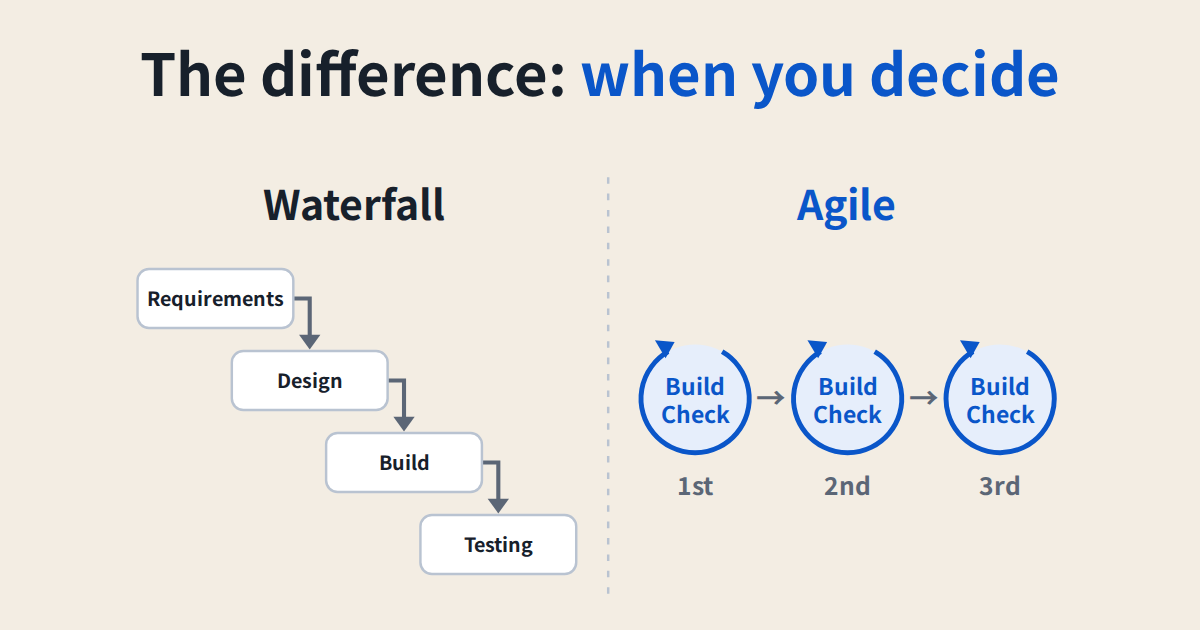
Waterfall development decides what to build first and then goes through the phases in order; agile development repeats a short cycle of building and checking. The main difference is when what to build is decided.
The difference is not only in how the system is built. It reaches the form of the contract and the buyer's role. Choose not by which is better but by how much of what you want to build is already decided.
In this article, "the buyer" means the company that commissions the system. We cover the difference between the two approaches, the projects each one suits, what the buyer does in agile development, and what to check before the contract. The contract and labour rules described here are those of Japan.
In our free estimate consultation, we sort out with you how much of what you want to build is already decided.

About the author

wesionaryTEAM Editorial Team
The editorial team is made up of wesionaryTEAM's project managers and engineers. Drawing on what we learn every day on business system, AI adoption and digital transformation projects, we publish information people can use when making decisions, with cases and figures.
The difference is when things are decided
The biggest difference between the two approaches is when you decide what to build.
In waterfall development, the requirements and specifications of the whole system are decided first, and building starts after that. In agile development, only the goal and the priorities are decided at the start, and the detailed specifications are decided while building. The Information-technology Promotion Agency, Japan (IPA) describes agile development as a method that can respond flexibly to added or changed functions and to changed priorities.
A different time to decide means changes are handled differently. When everything is decided first, a later change is handled as a procedure that revises what was decided. When things are decided while building, a change is taken in by choosing again what to build in the next cycle.

The word agile spread from the Manifesto for Agile Software Development, published in 2001. The manifesto says it values responding to change over following a plan, and customer collaboration over contract negotiation.
Compared side by side, five points differ
For the buyer, the difference shows in the following five points.

- What is built. Waterfall decides it first; agile decides it while building.
- Changes. Waterfall handles them through a procedure; agile expects them.
- Payment. In waterfall the basic form is payment for the completion of the agreed deliverable; in agile it is payment for the work carried out.
- The buyer's part. In waterfall you check at milestones; in agile you join every review.
- Contract. The IPA model contract for waterfall concludes a contract for each phase; the agile edition has a quasi-mandate contract as its premise.
A quasi-mandate contract is a contract in which you pay for work being carried out, not for a promise of completion. A contract that promises the completion of a deliverable is called a fixed-price (ukeoi) contract. The IPA explains that its agile model contract takes quasi-mandate as the premise because paying for the completion of a deliverable specified in advance does not fit an approach that decides while building.
The five differences are not separate. Because the time to decide what to build differs, the handling of changes differs, the form of the contract differs, and the buyer's role differs. Choosing only the approach, and leaving the contract and your role as they were, does not work.
Which one suits depends on how much is decided
Neither is better than the other. Which one suits depends on how much of what you want to build is already decided.

- Waterfall suits a project where what to build is settled and the date and budget are also set. Turning your current work into a system as it is falls here.
- Agile suits a project you want to decide as you use it, or one where priorities may change on the way. Launching a new service falls here.
When in doubt, separate the parts that are decided from the parts that are not. If most of it is decided, go in order. If the undecided parts are the centre, consider the repeating approach.
There is also a guide for size. As a point to check before the contract, the IPA agile model contract asks whether the project is of a size that one team (about 10 people at most) can keep handling.
In agile, the buyer's role grows
Agile development is not a method in which the development company builds flexibly as long as you leave it to them. The IPA explains that, for the buyer to gain the benefits, active and positive involvement in deciding the direction and content of the product is needed, and that this comes with a corresponding burden.

The buyer mainly does three things.
- Decide what to build. Choose what to build next against the goal.
- Set the priorities. On the premise that not everything can be built, separate what comes first from what waits.
- Check the result every cycle. Look at what is finished in each short period and decide the next step. Set time aside for this in advance.
Someone inside the buyer has to take this role: a person who knows the work well and can decide on the spot what to build first. If that person is busy and reviews stall, the development company cannot decide what to build next, and the benefits of agile are lost.
Take care with the contract and how you give direction
In agile development, the buyer and the development company's staff work closely, like one team. Here, care is needed in how you give direction.
Japan's Ministry of Health, Labour and Welfare has published its view on agile development as a set of questions and answers. The judgment is made by substance, not by the name of the contract. If the buyer directly instructs the development company's staff on the allocation or order of work or on working hours, it may be judged to be worker dispatch, so-called disguised contracting.

On the other hand, technical discussion on an equal footing, advice and proposals are regarded as no problem. The same goes for both sides joining meetings and chat. It is enough to agree that the assignment of work goes through the development company's manager. For an individual case, please check with a specialist.
Check seven points before the contract
The IPA agile model contract comes with a list of items that the buyer and the development company check together before the contract. It is there to find differences in understanding before starting.

- Purpose and goal. Is at least the near-term goal clear?
- Product vision. Is it shared with the stakeholders?
- Understanding of agile. Do the people involved understand its values and process?
- What is built. Does it suit agile development, and is it a size one team can build?
- Initial plan. Are the criteria for completion and quality, and the first scope, agreed?
- Understanding of the contract. Do you understand that it is a quasi-mandate contract?
- Team. Are there people to take each necessary role?
If many items cannot be answered, you are not ready to start with agile. Starting by settling the purpose and the scope moves faster in the end. How the buyer tests before acceptance is explained in What Is an Acceptance Test (UAT).
How we work
We run development in two-week sprints. A sprint is a unit in which we decide the functions to build in that round and build and test them within two weeks. The way we work is agile, but the scope and the price are fixed at the time of the contract, when we present the estimate. Within that scope, we decide with you every two weeks which functions to build first.

We do not wait until every function is ready: once a function has finished testing, we send an acceptance request through our project management tool, projectAI. Early comments are applied to the functions still being built, which keeps rework small. We report progress at a weekly meeting, and you can check the sprint plan and the status of each function in projectAI at any time.
When something outside the scope comes up that you want to add, we go ahead only after you have confirmed its effort in projectAI. Please use our free estimate consultation even if you are not sure which approach suits you.
FAQ
Is agile development faster and cheaper?
Not necessarily. Agile development is a method that makes it easier to respond to change, not a method that reduces cost or time. If what to build is settled, going in order produces less waste.
Can the amount not be decided in agile development?
If you decide the period and the team, the upper limit of the total can be decided. What cannot be decided is how far that amount will take you. By building from the highest priority, you get the most value within a limited amount.
Is there a way to combine the two?
Yes. For example, requirements definition settles the scope and priorities, and the development after it is divided into short periods that repeat. Separating the parts you want built with certainty from the parts you want to decide while using the system shows how to combine them.
Can a buyer without technical knowledge do agile development?
Technical knowledge is not needed. What is needed is a person who knows the work and can decide what to build first. Whether that person can stay involved decides the outcome.
Summary
Waterfall development decides first and goes in order; agile development decides while building. The difference reaches the form of the contract and the buyer's role. Which to choose depends on how much of what you want to build is already decided.
We fix the scope and the price at the contract and work in two-week sprints, taking acceptance function by function as each is done. Even if what you want to build is not yet settled, please use our free estimate consultation.
Related articles and pages
- The Phases and Flow of System Development: What the Buyer Does at Each Phase
- The Kinds of Testing in System Development: Unit, Integration, System and Acceptance
- Why System Development Is Delayed, and Four Things the Buyer Can Do
- What Is a Quasi-Mandate Contract? When to Use It in System Development and How It Differs from Fixed-Price
- System development: contract development from requirements to operation
- Free estimate consultation
Sources
- Information-technology Promotion Agency, Japan, "Model Transaction and Contract for Information Systems, Agile Development Edition", 31 March 2020, updated 11 September 2026 (Japanese)
- Referred to in the figure notes: pre-contract checklist
- Information-technology Promotion Agency, Japan and Ministry of Economy, Trade and Industry, "Model Transaction and Contract for Information Systems, 2nd edition", December 2020, revised April 2025 (Japanese)
- Ministry of Health, Labour and Welfare, "Questions and Answers on the Criteria for Distinguishing Worker Dispatch from Contracted Work (Notice No. 37), 3rd collection" (Japanese)
- "Manifesto for Agile Software Development", 2001
Reviewed by

Ichiro NagataCEO and Representative Director
A former engineer at Yahoo! JAPAN. For more than 18 years at startups and large companies, he has worked on a wide range of projects, from new consumer and business ventures to the digital transformation of operations. Alongside hands-on development as an engineer, he has built and managed teams, designed businesses and tested hypotheses, gaining broad experience in launching and growing businesses. He has been through three business sales. Convinced that co-creation makes products better and lets ideas be tested in the market, he founded wesionaryTEAM to offer a co-creation platform.