
BLOG
How to Run Requirements Definition: What the Buyer Decides and What Goes in the Document
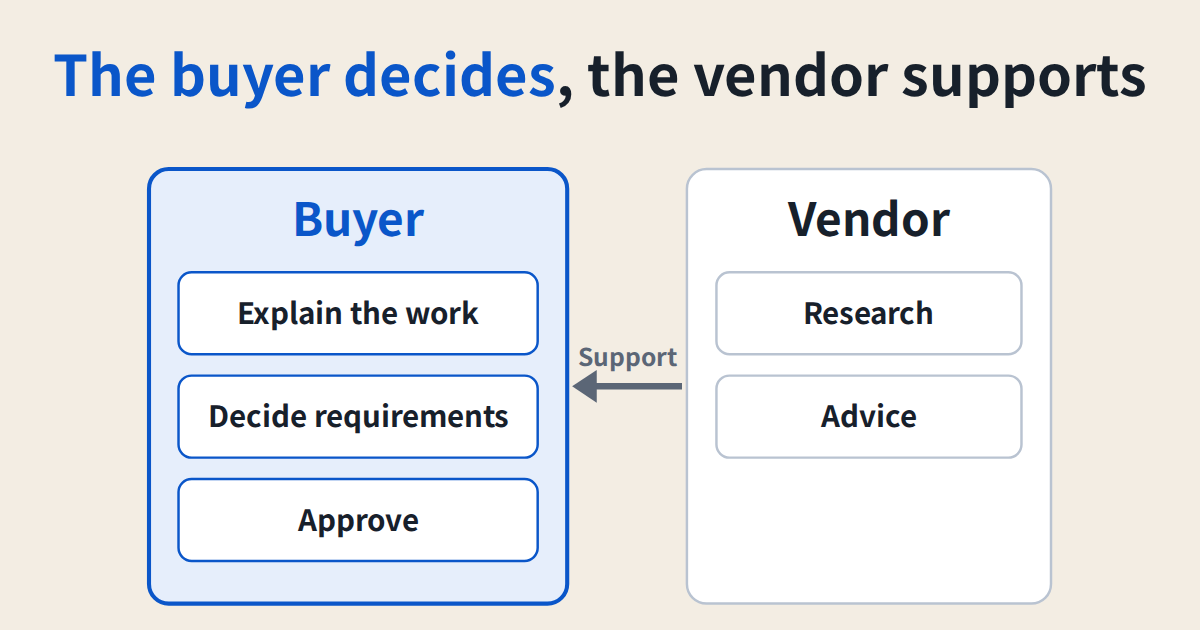
Requirements definition is the phase in which what to build is decided and written down. The deciding is done by the side that commissions the development; the development company supports it as a specialist.
What is decided in requirements definition becomes the standard for the design, the build and the testing that follow. If it is vague, the result is a system different from the one you had in mind.
In this article, "the buyer" means the company that commissions the system. We cover what the buyer decides in requirements definition, what goes in the requirements document, how to handle what cannot be decided, and how the document is finalised. The model contract cited here is a Japanese one.
How much of requirements definition you do on your side can also be discussed in our free estimate consultation.

About the author

wesionaryTEAM Editorial Team
The editorial team is made up of wesionaryTEAM's project managers and engineers. Drawing on what we learn every day on business system, AI adoption and digital transformation projects, we publish information people can use when making decisions, with cases and figures.
Requirements definition puts what will be built into a document
Requirements definition is the phase in which you decide what kind of system to build and put it into a document. That document is called the requirements document.
The Model Transaction and Contract for Information Systems, published by the Information-technology Promotion Agency, Japan (IPA) and the Ministry of Economy, Trade and Industry, is a template contract. It describes requirements definition as the work of setting out the required specifications of the system the buyer intends to build, and as work that depends heavily on the buyer's own business.

Design and build proceed from the requirements document. The model contract states that a requirement that is not expressed is not realised in the system. A wish that exists only in your head is not built.
What is decided in requirements definition also connects to the acceptance at the end. In the acceptance test, you check whether the finished system meets what was decided in requirements definition. What you write first becomes the standard you check against last.
The buyer decides, the vendor supports
The model contract presumes a form in which the buyer carries out requirements definition and the development company supports it. The reason is that the buyer is the one who knows the work.
Inside the buyer, the roles are divided too. In the model contract's explanation, the business units set out the business needs, the information systems unit defines the functions and other requirements of the system, and management approves.

The development company researches, analyses, organises, proposes and advises on the basis of its expert knowledge and experience. This does not mean you can leave it all to them. The development company arranges the process and provides the material for deciding. The buyer decides.
The development company has responsibility as well. The model contract explains that the development company has a duty to support with the care expected of an expert, and is liable if it neglects that duty. How a company supports this phase is a point to check when you choose one.
In a company with no information systems unit, the people who know the work and the person who signs off take these roles.
Two kinds of requirements go in the document
The requirements written in the document fall into two broad kinds: functional and non-functional.
Functional requirements are what the system does. Non-functional requirements are the conditions other than functions: how fast it runs, how reliably it stays up, how it is operated.

The model contract lists the items of each as follows.
- Functional requirements. The flow of work, the data handled, screens and forms, and the exchange of data with other systems.
- Non-functional requirements. Quality, technology, operation and use, migration from the current system, incidental work and others.
For an order management system, for example, functional requirements are things like "register an order", "allocate stock" and "issue a delivery note". Non-functional requirements are things like "how many people use it at the same time", "within how many hours it is restored after it stops" and "how many past orders are migrated".
The ones easily forgotten are the non-functional requirements. The model contract also notes that some non-functional requirements newly arise while the design proceeds, such as processing speed and preparation for failures. Ask the development company about them early.
Going on while things are vague brings more changes later
If you move on to design while the requirements are vague, changes increase later.
In the Software Metrics Survey 2020 of the Japan Users Association of Information Systems (JUAS), the share of projects with large or serious changes was 2.5% where the initial requirements were "very clear" and 69.8% where they were "very vague".

The model contract also states that vagueness of specifications in the upstream phases causes confusion in the later phases and brings serious results such as lower quality and delayed development.
More changes mean more cost and a longer schedule. Spending time on requirements definition looks like a detour, but it is the shorter way overall.
Vagueness also comes from words being taken differently. Phrases such as "I want to see it in a list" or "I want to edit it easily" bring a different screen to mind for each person. Putting a sample screen or a form you use today between you and checking against it reduces the gaps. Why projects run late and how to prevent it is explained in Why System Development Is Delayed, and Four Things the Buyer Can Do.
Put what cannot be decided on paper, with a date
Still, not everything can be decided at the time of requirements definition. The model contract acknowledges that, in practice, projects often have to move to the next phase with some matters left over.
On that basis it sets out how to treat what is undecided. The idea is not to leave it vague but to confirm it in writing.

- Write what is undecided.
- Set when it will be decided.
- Confirm that the cost or the delivery date may change when it is decided.
- Both sides keep it in writing.
Going on while hiding what is undecided is the most dangerous. If the development company knows it is undecided, it can prepare. Set the date to match the development schedule. Separate, with the development company, what is needed before design starts from what can wait. When the price becomes fixed is explained in Rough Estimates in System Development.
At the end, both sides inspect it and it becomes final
Requirements definition proceeds through repeated meetings. The model contract has meetings held as often as needed to clarify the matters required for the requirements document and to confirm its content.
When the requirements document is ready, the buyer and the development company inspect it within an agreed period. They check that it matches what was decided in the meetings, and if it does, the responsible persons of both sides sign it. With that, the requirements document is final.

Changes after that are handled through a set procedure. Finalising is the line after which things are changed only through that procedure. If you approve without reading, you cannot say later that you were not told.
In the inspection, read not only the parts that concern your own unit but also the parts that connect to other units. Handovers between units are places where each unit may think it is someone else's job, and things are easily missed there.
Four things the buyer prepares
There are things that make the work go faster if the buyer has them ready before requirements definition starts.

- The purpose. What you want the system to improve. It becomes the standard for judging when you are unsure.
- Today's workflow. Who does what, and in what order.
- The screens and forms in use today. With the real ones, the data needed becomes clear.
- Who decides and who approves. A person who can decide on the spot attends the meetings.
They do not have to be tidy documents. Bringing the spreadsheets and paper you use today as they are is more useful than documents remade for the occasion. What to prepare for the first consultation is explained in What Is an RFP.
How we work
We write the requirements document in our project management tool, projectAI, and you review it on a screen dedicated to you. What has been settled is kept as an edition, so you can later check which edition decided what.

Points that cannot yet be decided, or that we want to confirm, are kept on the question screen in projectAI, together with your answers and how each was settled. When something to add comes up during development, we go ahead only after you have confirmed its effort in projectAI. Please use our free estimate consultation even if what you want to build is not yet settled.
FAQ
Can we commission only requirements definition and have another company do the build?
Yes. The model contract concludes a separate contract for each phase, and notes that each phase can be commissioned to a different vendor. In that case, name the requirements document in the contract as something you receive, and check whether you may show it to other companies. Note also that a gap between phases makes the whole schedule longer.
We have no dedicated staff for this. Can we still proceed?
Yes. The development company can do the writing and organising. What cannot be cut is the time of the person who explains the work and the person who decides. Decide in advance who attends the meetings and by when questions are answered, and the work will not stall.
How long does requirements definition take?
It depends on the size of what is built and on how much the people who decide can take part. In the JUAS Software Metrics Survey 2025, requirements definition took 20% of the whole schedule, rounded to the nearest 5%. When reviews stall, it takes that much longer.
Is there a template or sample of a requirements document?
Among public sources, an annex of the model contract (details of the request for proposal) divides the requirements the buyer sets out into functional and non-functional ones and lists the items of each. The two kinds of requirements in this article follow those items. Rather than filling in a template's fields, check that your own flow of work and what you decided are written down.
What happens if something is found missing after approval?
It is added through the set change procedure. The effect on cost and schedule is confirmed in writing, and both sides approve before work proceeds. The later the phase in which it is found, the larger the effect, so in the inspection read the handovers between units with particular care.
Summary
Requirements definition is the phase in which what to build is decided and put into a document, and the buyer decides. Write the conditions such as speed and operation, not only the functions. Put what cannot be decided on paper with a date, and at the end both sides inspect the document and make it final.
We keep the requirements document in projectAI edition by edition, and record questions and answers too. Even if what you want to build is not yet settled, please use our free estimate consultation.
Related articles and pages
- The Phases and Flow of System Development: What the Buyer Does at Each Phase
- The Kinds of Testing in System Development: Unit, Integration, System and Acceptance
- Agile vs Waterfall Development: Which Should the Buyer Choose?
- What Is Contract Development? Contract Types and What to Decide Before You Order
- System development: contract development from requirements to operation
- Free estimate consultation
Sources
- Information-technology Promotion Agency, Japan and Ministry of Economy, Trade and Industry, "Model Transaction and Contract for Information Systems, 2nd edition", December 2020, revised April 2025 (Japanese)
- Referred to in the figure notes: articles 14, 16, 17 and 36
- Japan Users Association of Information Systems, "Software Metrics Survey 2020, System Development and Maintenance Report", April 2020 (Japanese)
- Japan Users Association of Information Systems, "Software Metrics Survey 2025 Guidebook", April 2025 (Japanese)
Reviewed by

Ichiro NagataCEO and Representative Director
A former engineer at Yahoo! JAPAN. For more than 18 years at startups and large companies, he has worked on a wide range of projects, from new consumer and business ventures to the digital transformation of operations. Alongside hands-on development as an engineer, he has built and managed teams, designed businesses and tested hypotheses, gaining broad experience in launching and growing businesses. He has been through three business sales. Convinced that co-creation makes products better and lets ideas be tested in the market, he founded wesionaryTEAM to offer a co-creation platform.