
BLOG
Local LLMs Will Decide Japanese Companies' Competitive Edge
About the author

wesionaryTEAM Editorial Team
The editorial team is made up of wesionaryTEAM's project managers and engineers. Drawing on what we learn every day on business system, AI adoption and digital transformation projects, we publish information people can use when making decisions, with cases and figures.
Introduction
Estimates, design, customer care. Work that employees have always done is now being handed to AI.
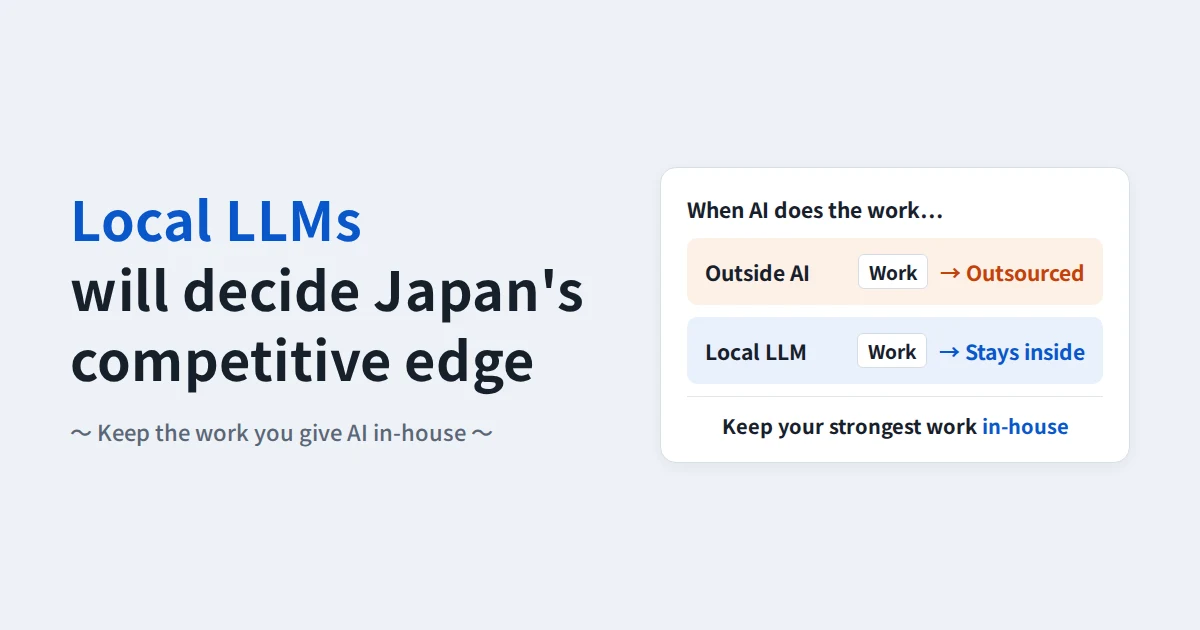
So where does that AI run? If you use an outside AI such as ChatGPT, the work is done on another company's servers. In other words, handing work to an outside AI is the same as outsourcing that work.
Rely too much on outsourcing and the know-how stops staying in your company, and you have to go along with the other side's terms. Japanese companies have already been through this with system development. With AI, what you hand over is not a system but the work itself, so the more you rely on it, the more of your company's strengths move outside.
Keep handing work to an outside AI, and that work ends up unable to run without it. The AI's performance, its price and how long you can keep using it are all decided by the other company. And because other companies can use the same AI, it alone does not set you apart.
If you keep the AI in-house instead, the documents you give it, the way you run it and the records of the work all stay with you. The more you use it, the more it becomes a system of your own that competitors cannot copy.
That is why we believe the work that makes up your strengths should stay in-house, AI and all. The way to do that is a "local LLM", which runs AI in a place your company controls.
This article shows why with numbers and figures, and closes with how to get started. How local LLMs work is explained in "What is a local LLM?".
Using an outside AI means outsourcing the work

Handing work to an outside AI means outsourcing that work to another company.
The documents the AI reads and the answers it gives are processed on servers outside your company.
As with outsourcing to people, the more work you hand over, the less you can protect yourself on your own from price changes, specification changes or the service being shut down.
The more you rely on outsourcing, the more of your strength moves outside

Japanese companies have left much of their system building to outside development companies. Of the people who do IT work, 72.0% work at IT companies in Japan, compared with 34.6% in the United States (2015). In Japan, few people with IT expertise work inside the companies that use the systems.
The Ministry of Economy, Trade and Industry's "DX Report" points out that, after leaving everything to development companies, many companies no longer understood what was inside their systems and could not fix them themselves.
With AI, you hand over not just systems but the work itself. If the same thing happens, what stops staying in your company is the way you work. In its "AI Basic Plan", revised in July 2026, the Japanese government also says the country must avoid excessive dependence on particular countries or companies.
The same AI gives the same answers

Any company can sign up for the same outside AI. Simply adopting AI does not set you apart from competitors.
The difference comes when you let the AI read your own design drawings, quality records and the know-how of your experienced staff.
Japanese companies have not connected their strongest data to AI

According to the Ministry of Internal Affairs and Communications' "White Paper on Information and Communications in Japan 2026", 24.5% of Japanese companies let AI learn from their internal data or make that data searchable by AI. In the United States, Germany and China, the figure is above 50% in every case.
In the same survey, Japanese companies' top concern was "security risks such as leaks of internal information", at 46.4%, the highest of the four countries. We read these two figures as companies being unable to hand their strongest work to AI because that information cannot leave the company.
With a local LLM, the work you give AI stays inside the company
A local LLM is a way of running AI in a place your company controls, such as your own servers. Neither the work nor the data leaves the company, so even work that uses information you cannot share outside can be handed to AI.
The Japanese government calls the state of being able to use AI on its own terms, without relying entirely on other countries or companies, "AI sovereignty" (sovereign AI), and is working toward it. We see local LLMs as the way to achieve this at the level of a single company.
AI you can run yourself is now only months behind the frontier

Some AI models are published openly and can run on your own servers. According to the research organization Epoch AI, the best of these trail the most advanced AI by about four months on average (May 2026).
Models that are strong in Japanese, such as the National Institute of Informatics' "LLM-jp", are also published under terms that allow business use. A gap with the frontier remains, so which work can be handed over is checked task by task.
You do not need to keep everything in-house

As with outsourcing to people, work that is not a strength can be handed to outside providers. Researching public information or writing general text is fine with an outside AI. Only the work that makes up your strengths needs to stay in-house.
In our own project management tool, projectAI, we also split AI features between outside AI and an environment we manage ourselves, feature by feature. For details, see "Our in-house local LLM case study".
You can start with a single task

There is no need to switch the whole company at once. Pick one task that makes up your strengths, compare the results with an outside AI, then expand.
We help at every stage, from choosing the hardware and environment, to building the setup that makes AI usable in your work, to operations. We run a local LLM ourselves, and our proposals draw on that experience.
FAQ
Is it enough to use a Japanese-made AI?
Even a Japanese-made AI, if you use it as an outside service, still means outsourcing the work. What matters is where the AI runs and who manages it.
Outside AI services have settings that keep our input out of training. Isn't that enough?
Even if it is not used for training, the work is still processed on outside servers. For work that is fine to share outside, an outside AI is no problem.
How much does it cost?
It varies widely with the model and the environment, generally from several million yen to several billion yen. If you focus on one task, you can start small.
Do small and mid-sized companies need this too?
If you have work that makes up your strengths, it is worth considering regardless of size.
Summary
- Using an outside AI means outsourcing the work
- The more you rely on outsourcing, the more your way of working and your data move outside, and your competitive edge drops
- With a local LLM, the work you give AI stays inside the company
To stay competitive as AI spreads, we recommend keeping the work you give AI in-house, starting with the work that makes up your strengths.
Which task to start with and what hardware you need are good questions for our free estimate and consultation. Our support is summarized on Local LLM build and implementation.
Related articles and pages
- Local LLM build and implementation: hardware to operations
- What is a local LLM? How it works and when to use one
- Local LLM case study: cloud AI or local, feature by feature
- Local LLM hardware requirements and recommended models
- Muse Glimmer 30B vs Qwen3.8-27B on the same agent evaluation
Sources
- Ministry of Internal Affairs and Communications, "White Paper on Information and Communications in Japan 2026", July 2026: "Figure I-2-1-5: Preparation for business transformation with generative AI" and "Figure I-2-1-8: Risks of concern in using generative AI" (in Japanese)
- Ministry of Internal Affairs and Communications, "White Paper on Information and Communications in Japan 2019", July 2019: "Figure 2-3-1-6: International comparison of where ICT workers are placed" (in Japanese)
- Ministry of Economy, Trade and Industry, "DX Report: Overcoming the 2025 Digital Cliff (summary)", 7 September 2018 (in Japanese)
- Cabinet Office, "AI Basic Plan", adopted by the Cabinet on 14 July 2026 (in Japanese)
- Epoch AI, "Open models lag state-of-the-art closed models by 4 months", 29 May 2026
- National Institute of Informatics, "New Japanese LLM "LLM-jp-4" released under an open-source license", 3 April 2026 (in Japanese)
Reviewed by

Ichiro NagataCEO and Representative Director
A former engineer at Yahoo! JAPAN. For more than 18 years at startups and large companies, he has worked on a wide range of projects, from new consumer and business ventures to the digital transformation of operations. Alongside hands-on development as an engineer, he has built and managed teams, designed businesses and tested hypotheses, gaining broad experience in launching and growing businesses. He has been through three business sales. Convinced that co-creation makes products better and lets ideas be tested in the market, he founded wesionaryTEAM to offer a co-creation platform.