
Case Studies by Field
All Case Studies30
Cloud Services9
Core & Business Systems4
Construction DX2
E-commerce Development3
Inventory & Order Management4
AI Adoption10
DX Promotion8
New Ventures12
CASE STUDY
A System That Runs a Ryokan's Day-Trip Bathing Unstaffed, From LINE Booking to QR Check-In and Payment
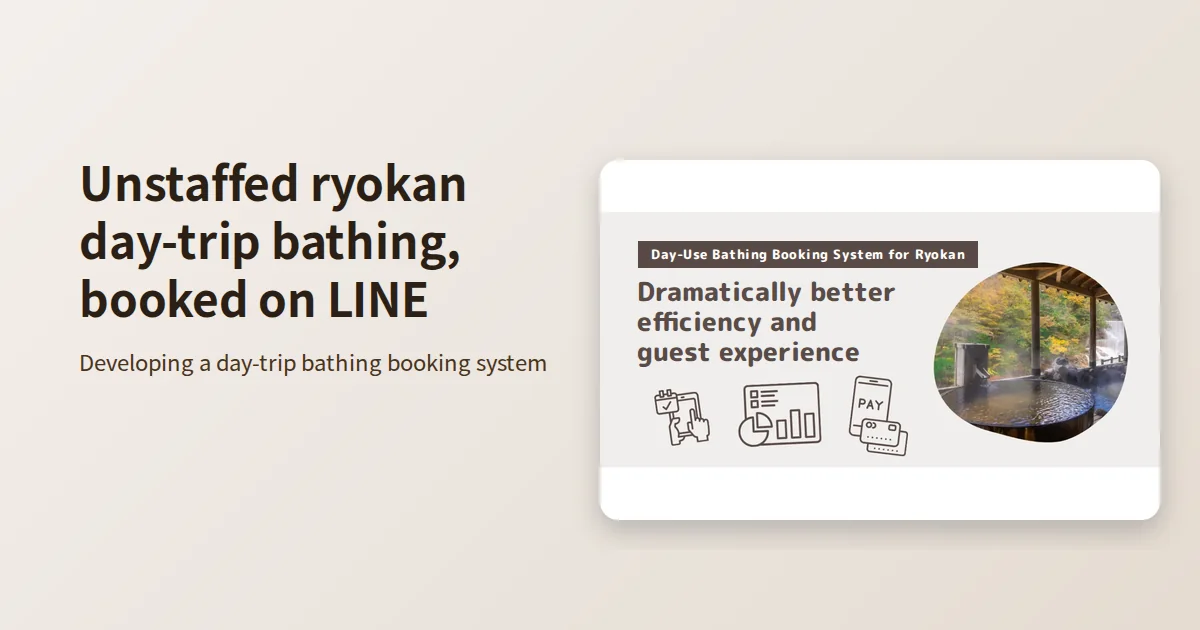
Overview
A ryokan (traditional Japanese inn) was taking bookings for day-trip bathing through LINE chat. Bookings, changes, and cancellations were all one-to-one exchanges between staff and guests. Because staff replied in between cleaning and serving guests, every incoming message interrupted their work, and guests could not confirm a booking outside staffed hours.
We developed a system that lets guests book from LINE 24 hours a day, check themselves in with a QR code on the day, and pay on their own. For staff, we provide an admin dashboard that shows bookings and guest information at a glance. The system is currently in a trial at a real ryokan ahead of full rollout.
Challenges
- Each booking exchange interrupted cleaning and guest service, lowering overall productivity
- Guests could only confirm a booking during the hours when staff were able to reply
- With limited staff, the ryokan wanted to free up time for work only people can do, such as hospitality and attracting guests
What We Did
- A booking screen in LINE where guests can check availability and complete bookings, changes, and cancellations
- Self check-in: guests just hold the QR code issued at booking up to a terminal at the counter
- Advance online payment and self payment at an on-site terminal (including split bills for groups)
- An admin dashboard with a booking calendar, guest list, sales reports, and review list
Results
- Confirmed in a trial at a real ryokan that everything from booking to payment works as designed
- With booking exchanges gone, staff can keep doing their actual work without interruption
- Bookings can be viewed at a glance in the admin dashboard, so phone inquiries can be answered right away
An Approach That Lets You Check Before Building, Even Without IT Knowledge
For the people at the ryokan, building a system was a first-time experience. To address their worries about whether they were communicating the requirements properly and whether anything major was being missed, we started by putting into words, together with everyone involved, "what we are doing this for." Then we made the system concrete step by step: screen wireframes, design, and an interactive prototype. By involving stakeholders from the start, rather than informing them of decisions afterward, we create a situation in which everyone can make decisions as a participant.
By letting people experience "what happens when I do this" with a prototype, we can pick up insights that never came up during requirements definition, before development begins. In this project too, through repeated discussions and site visits, the scope grew from the original "digitizing bookings" to unstaffed operation covering check-in, payment, and collecting reviews after guests leave. The system is designed around the idea that the time freed up by automation goes to hospitality only people can provide, such as greetings and conversation at the counter.
Our Scope of Work
- Clarifying goals and requirements definition
- Screen design, visual design, and prototyping
- System design, development, and testing
- Infrastructure setup
Client Information
Company Name
A ryokan (a lodging facility that offers day-trip bathing)
Business Overview
- Provides overnight stays and day-trip bathing
Frequently Asked Questions
Can we request development even if no one in-house knows much about systems? Yes. This client was also developing a system for the first time. We work through the goals together and make decisions while trying out a prototype, so you can make decisions without specialist knowledge.
Do guests need to install a new app? No. In this project, we made it possible for guests to complete bookings, changes, cancellations, and advance payment inside LINE, which they already use every day.
Won't going unstaffed take the warmth out of hospitality? The goal is to hand routine tasks such as booking and checkout to the system so that staff can spend their time on greetings and conversation. The system is designed on the premise that human touchpoints remain.
Related Information
- Changing work at short-staffed workplaces through systems → DX Promotion Support
- Development of booking and payment systems → System Development
Related news
FREE ESTIMATE
Free Estimates: Learn What to Build and the Cost Range on the First Call
Your requirements do not need to be settled. Tell us in a sentence what you want to build, and your project manager will sort it out with you.