
BLOG
Our Philosophy on AI Adoption, and How We Put It into Practice
"I want to make our company one that leads with AI. How should we go about it?" This is the question we hear most often from business owners.

Before I started writing this article, I ran a small experiment. I posted a single line to Gemini: "Write an article on how to think about AI adoption and the concrete steps for doing it." Thirty seconds later, it returned an impressive 7,000-character article.
In the same 30 seconds, a person can write 30 to 40 characters at most. That is a difference of several hundred times. Faced with that gap, it is tempting to think, "From now on, we should just have AI write every article." But this is exactly where the most important distinction in thinking about AI adoption is hidden.
It is true that the human brain is no match for AI in how fast it can put words out. Conscious output such as speaking and writing runs at 2 to 3 words per second, or only a few tokens when converted into AI units (a token is the unit AI uses to count language; in Japanese it is roughly one character). One study finds that the amount of information people can process as behavior is only about 10 bits per second (Zheng & Meister, Neuron, 2024). Behind the scenes, however, the brain runs computation on a completely different scale, in parallel. Taking a frequently cited estimate (which puts the brain's processing capacity at 10^15 to 10^16 operations per second) and converting it to a large LLM (70B to 100B class), this is equivalent to roughly 5,000 to 50,000 tokens per second. Reading the atmosphere in the room, catching the other person's expression, checking against past experience, moving the hand precisely to form letters. People discard most of that enormous processing and output meaning condensed into a tiny number of words.
For those interested in how the calculation works, here is the basis.
Brain processing capacity (one frequently cited estimate):
  10^15 to 10^16 operations per second (1 to 10 PFLOPS)

Computation a large LLM needs to output one token:
  about 2×10^11 operations (2 × 100 billion parameters)

Conversion:
  10^15 ÷ (2×10^11) = about 5,000 tokens per second
  10^16 ÷ (2×10^11) = about 50,000 tokens per second

Extending the assumptions to the brain's physical limit (upper-bound model):
  10^18 ÷ (2×10^11) = about 5 million tokens per second
An estimate that extends the assumptions to the brain's physical limit even reaches the equivalent of 5 million tokens per second. The human brain quietly runs that much computation while selecting only a few characters per second (note that the brain is an analog, massively parallel structure while AI runs on digital matrix operations, so this conversion is only a rough guide).
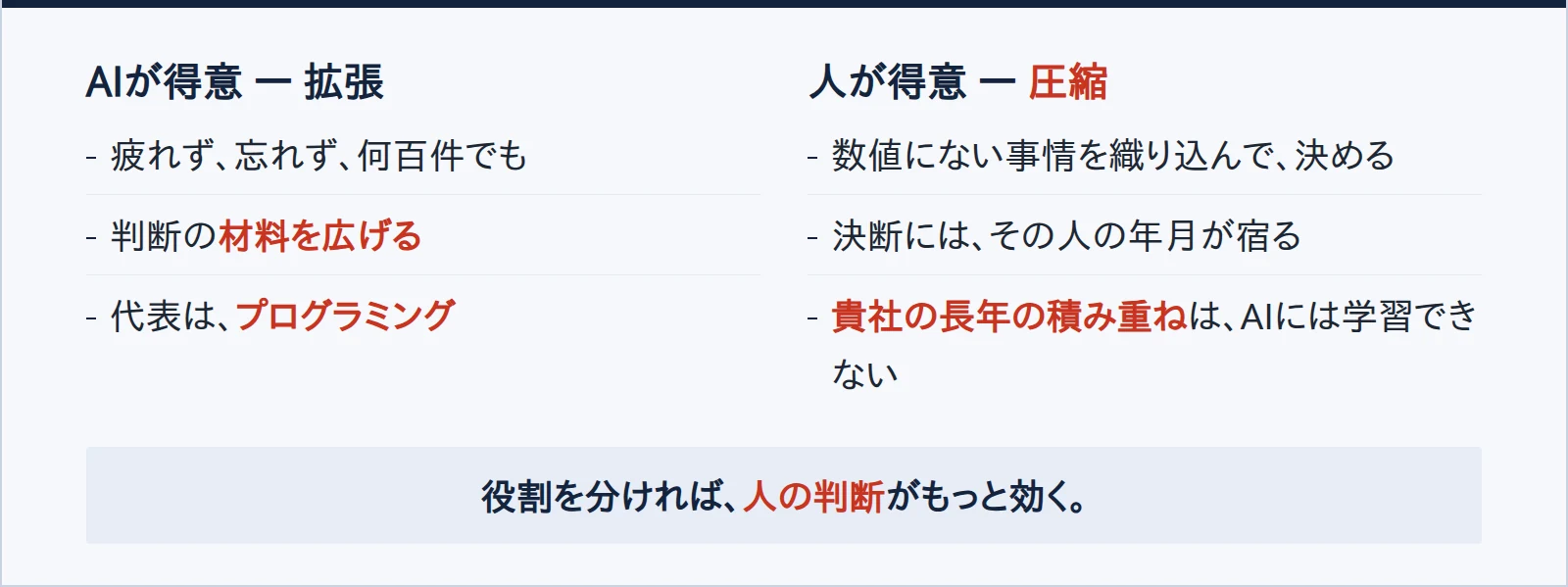
In other words: AI is what expands a 30-character instruction into 7,000 characters. People are what condense processing equivalent to tens of thousands of tokens per second into a judgment of a few dozen characters. AI is in a league of its own as an "expanding machine," and people are in a league of their own as a "compressing machine." It is not a question of which is better; they point in exactly opposite directions.
That is why our philosophy at wesionaryTEAM can be summed up in one line.
AI expands, people compress.
We have seen many workplaces stumble with AI adoption. We have collected common failures and the actual consultations we receive in a separate article, "Common AI Adoption Failures and the Consultations We Actually Receive." In this article, drawing on those failure cases and on our own experience of using AI heavily in our development and operations, we answer the question "So how do you actually go about it?" We cover what the philosophy means, the three principles that follow from it, and the concrete process. Under our standard approach, it takes one week until the first AI agent is running. We also openly share everything you need to make a decision, including our thinking on co-creation, an approach where we take on results and risk together, and where subsidies fit in.
Our Philosophy on AI Adoption: AI Expands, People Compress
Back to the experiment from the introduction. The 7,000 characters Gemini wrote in 30 seconds were certainly impressive. They were well structured, and nothing in them was wrong. So why did we throw those 7,000 characters away and write this article from scratch?
Because no one's judgment went into that text. It is correct. But it belongs to no one. Whichever company posts the same single line gets back nearly the same 7,000 characters. There is no reason for us to write it, and no reason for you to read it. Impressive text and meaningful text are not the same thing.
Expansion alone does not create value. Value only appears once it passes through compression.
AI Is Extraordinarily Good at Expansion
Let us start by acknowledging head-on how remarkable AI is. AI never tires, never forgets, never changes its mood, and keeps processing hundreds of cases at the same quality. It works across more documents than a person could ever read, lays out options, and prepares drafts. It widens the material for judgment into areas that were physically beyond human reach.
Think back. In our work, we have given up on a great many things. We cannot compare case studies from 100 companies. We cannot reread five years of inquiries. We do not have time to draft ten different outlines. How many things we "really wanted to do" have we left behind with the words "there isn't time"? AI picks up those things we gave up on, one by one.
Here is a little of the technical explanation of why it can do so much. At its core, AI is a machine that has learned from an enormous amount of text and keeps predicting "the word most likely to come next in this context." That is why it is unbeatable in worlds where the grammar is strict and there is no ambiguity. Programming is the prime example. Simply ask in plain language, "Aggregate this sales data by month and by product, and pull out the products that are growing," and AI instantly writes the analysis logic in Python (a programming language well suited to data analysis), processing tens of thousands or even millions of rows in a matter of seconds. Work that would take a person a full day of wrestling with a spreadsheet is finished before you even get up from your desk. In our own development work, this is exactly where AI contributes the most: "expanding work" such as drafting code, searching across documents, and listing options is now AI's territory.
There is a gap here that people cannot close no matter how hard they try. This is not something to be frustrated about. It is something to hand over with confidence.
People Are Extraordinarily Good at Compression
On the other hand, remember the numbers from the introduction. The human brain runs processing equivalent to tens of thousands of tokens per second in the background, discards most of it, and selects only a few characters. It is not throwing things away; it is choosing with great care.
To avoid any misunderstanding: AI can detect patterns too. Abnormal machine sounds, something off in a series of numbers: as long as the data is there, AI is actually better at these. The compression that only people can do lies beyond that.
Take the case where a long-standing business partner asks for a steep discount. Looking at the data alone, the answer is "decline." But the person making the decision instantly weighs a vast range of circumstances that have never been turned into numbers (20 years of relationship with that company, the debt of gratitude for help during hard times, reputation in the industry, morale on the front line) and decides, "We'll accept this time, but change the terms." Or, in a hiring interview, they pass on a candidate with an impeccable background because "they won't fit our team." Or, conversely, they see something that does not show on a résumé and take a chance.
On interviews, there is a well-known story: interviewers finish their judgment based on the impression of the first few minutes and spend the rest of the time looking for reasons to justify it. Empirical research shows it is not quite that extreme: about one in four interviewers settle their judgment within five minutes, and about 60% within 15 minutes (Frieder et al., 2016). Still, it is true that many interviewers reach a conclusion by the middle of the interview and spend the rest confirming it. It may sound careless, but the order is reversed. Expression, way of speaking, timing, appearance. The brain processes an enormous amount of information in a few minutes and reaches a conclusion, and the words follow afterward. Compression first, explanation after. That is how fast the human brain decides.
Each of these is work where you answer a question whose correct answer is written nowhere in the data, using your own values, and take responsibility for the outcome.
This is compression. Running processing equivalent to tens of thousands of tokens per second in the background, and in the end condensing it into the single point of "deciding." AI can go as far as detection. But decisions can only be made by people who have values and carry responsibility.
And here is the crucial point. Woven into that decision are the years that person has built up. The nights of failure, the mornings spent bowing in apology, the feel of the days when things went well. AI has learned from text from all over the world, but your company's years of accumulated experience are not written down anywhere, so it has no way to learn them. That is why work that has passed through human judgment carries an originality that only your company has. Gemini's 7,000 characters, or a single remark from someone who knows the front line. It is always the latter that moves customers' hearts.
Failure Happens When Expansion and Compression Are Confused
AI adoption usually fails when these two roles are mixed up.
Putting AI in place of people with the sole aim of cutting labor costs. What is lost then is not expansion but compression. Proposals can now be produced quickly. In exchange, the "feel of this company" has disappeared from every proposal. Inquiry handling has been automated. In exchange, there is no longer anyone saying, "That customer has seemed a bit off lately." Man-hours have certainly gone down. But something that does not show up in the numbers is quietly being lost. And people usually notice only after it is gone.
This is why you must not start from the question "How many people's worth of man-hours can AI cut?" That question cuts first the things in your company that are hardest to measure and most valuable. The man-hours you can cut are easy to measure. The judgment you lose is hard to measure. If you decide based only on what is easy to measure, the answer is a foregone conclusion. We describe real examples of failures that happened this way in a separate article, "Common AI Adoption Failures and the Consultations We Actually Receive."
If you divide the roles correctly, however, the story is entirely the opposite. Leave expansion to AI, and let people focus on compression. The material for judgment then increases by orders of magnitude, and the experience of the person who makes the final choice matters more than ever. In other words, in the age of AI, the years your people have built up do not become cheaper. Rather, for the first time, they can be used to their full potential. Not an asset to be replaced by AI, but an asset unleashed by AI. That is the mechanism we design in AI adoption.
So how does this philosophy translate into an actual process? From the next chapter, we get specific.
Three Principles That Follow from This Philosophy

"AI expands, people compress." Turning this philosophy into criteria for practical decisions gives three principles. These are what we actually use when putting together our proposals.
Principle 1: Not "What Should AI Do?" but "Whose Judgment Should It Strengthen?"
Discussions about AI adoption usually start from the question "What should we have AI do?" We turn this question around. Whose judgment in your company, and which judgment, do you want to strengthen?
Is it the sales manager's judgment in prioritizing deals? The development lead's judgment in finalizing specifications? The executive's judgment in choosing where to invest? Once you settle on one judgment to strengthen, the material AI should gather and the areas it must not be entrusted with fall naturally into place. In the language of the previous chapter, because you decide where compression happens first, the design of expansion becomes clear.
What happens when the order is reversed? An initiative that starts with nothing but the order "Use AI to make operations more efficient" keeps piling up costs without being able to set goals. It heads toward the very failure described in the separate article.
Principle 2: Before Adding Seats, Choose One Task Where It Works
Hand out accounts to the whole company, and the whole company will change. Many adoptions launched with that expectation end up facing the reality that "only 10% keep using it." That is because they handed out tools without deciding what work to entrust.
We do the opposite and boldly narrow the scope. One task where it will have an effect. Deliver results there, confirm them in numbers, and build a template for success. Once the template exists, expand to the neighboring task. It looks like a detour, but it is the fastest route. Because you narrow it down to one, you can measure the effect. Because you can measure the effect, you can decide whether to continue, wind it down, or expand. Because you can decide, you can take the next step with confidence. A company-wide rollout cannot create this cycle.
Principle 3: Do Not Make People Learn Tools; Build AI into Their Current Workflow
An AI tool that looked wonderful in the demo goes unused on the front line. This is not laziness on the part of the front line. Busy teams simply have no room to change their work procedures in order to learn a new tool.
That is why we do not add new screens. We build AI into the business systems you already use and into your daily workflow. Expansion runs where people do not see it, and only the results arrive on the usual screen as material for judgment. There is nothing new for the front line to learn. That is the condition for an adoption that sticks.
Once the principles are set, what remains is execution. In the next chapter, we describe our standard process, which turns these three principles directly into steps. It takes one week until the first AI agent is running.
The Concrete Process: One Week Until Your First AI Agent Is Running

From here on, we talk about execution. Our standard process consists of five steps. It requires no special preparation and no large team.
What Is an AI Agent? From AI That Answers to AI That Works
Before that, a word about terminology. What this article calls an "AI agent" is not a chat-style AI that answers when you ask, but a system that automatically carries out an entire sequence of work you have entrusted to it.
For example: "Aggregate monthly sales data → compare with past trends and identify changes → draft a report → send it to the person in charge for review." You can hand over, all at once, a flow of work that people used to instruct AI on one step at a time. From AI that answers to AI that works. This is where the main battleground of AI use has now moved.
These five steps are not an improvised procedure. They are designed around the division of roles in Chapter 2 (expansion to AI, compression to people) so that each of the failure patterns summarized in the separate article is closed off, one by one, within the process.
Step 1: Choose One Task Where It Works
Before the first week begins, we and your company choose one task together. The criteria are the principles from the previous chapter. Whose judgment are we strengthening? The more a task's working time is taken up by "expansion" (gathering material, drafting, processing), and the clearer the point of "compression," that is, the decision, the better it works.
At the same time, we also decide which tasks not to choose. Assessments and judgments that themselves carry responsibility. Moments that move customers' hearts. As written in Chapter 2, AI can go as far as detection, but deciding is people's work. Drawing this line at the outset is the best prevention against "we rolled it out company-wide, but nobody uses it." At this point, we also measure how many hours the chosen task currently takes, so that we can check the effect in numbers later.
Step 2: One Week Until the First AI Agent Is Running
Once the task is decided, we build a small AI agent dedicated to it. The guideline is one week.
Before we start building, we draw the lines around data. Which data cannot leave the company? Who may see which information? If confidentiality agreements or internal rules prevent sending data to external AI, we choose a configuration that keeps data inside the company. The barrier of "the more important the data, the less we can use it with AI" can be overcome through the choice of configuration.
Clients are sometimes surprised: "We heard it would take several months." The explanation is just as written in Chapter 2. The work AI is best at is programming, and we ourselves develop together with AI. The very speed of development is now in a different league from a few years ago. There is one more reason. Rather than bending an off-the-shelf tool to fit your business, it is actually faster to build something dedicated inside your workflow. You avoid, from the start, the failure where a tool that was wonderful in the demo never takes root on the front line.
Step 3: Measure the Effect over Another Week
We use the agent that is now running in real work and compare the results against the numbers measured in Step 1. Has the time it took gone down? Has the material for judgment increased? Can people now focus on decisions?
We measure more than the effect. We also make costs visible per feature. AI usage fees grow with use, so unless you can see how much each feature costs and how well it works, you cannot decide whether to continue or wind it down. At this stage, we close off the failure of "the invoice only shows a total, so we can't tell where to cut."
And we make an important promise. If it is not working, we wind it down. Since it is still at the small-build stage, there is almost nothing to lose by winding it down. We prevent, through structure rather than willpower, the failure of keeping something that does not work "because we went to the trouble of building it."
Step 4: Build Out Only the Templates That Work for Production
Only the templates whose effect has been confirmed in numbers are built out for production. How will we keep evaluating the accuracy of answers? Who should be able to see which data? How will we keep records of who asked what and what the AI answered? Moving to production with a test-grade build will inevitably stall; this is the stage where we get past the "stuck in testing" barrier.
We also make the configuration independent of any specific AI service. The instructions given to the AI and the data used to check answer quality remain as your company's assets. The AI itself is made replaceable later. This is so that we never create a situation where a single price change by another company brings your business to a halt.
Step 5: Expand Across the Organization While Adding Agents
Templates that work spread to neighboring tasks and to other departments. From the second one onward, it is much faster than the first.
What we keep protecting as we expand is the place where compression happens. We expand while keeping people involved. The moment the output becomes the same no matter who uses it, building may get faster, but the reason to be chosen disappears. Widen the expansion, protect the compression. If you proceed while checking that this design holds, by this point a "sense of working with AI" has begun to grow in the organization, and the front line itself starts asking, "Couldn't we do this for our work too?" Things that never happen with a rollout handed out by decree begin to happen.
Looking only at the steps, it is a simple story. But there is one more thing that matters as much as this process: who you do it with, and in what kind of relationship.
Choosing Co-Creation: Taking On Results and Risk Together

AI use is an area where you cannot predict the effect until you try it. That does not change no matter how much experience you build up. Fit with the work, the state of the data, how the front line uses it. Some things always remain that you only learn by running it and measuring.
Under conventional business practice, however, the client takes on most of the cost and risk before the effect is known. Get an estimate, get internal approval, pay several million yen upfront, and find out months later whether it works. We have seen many executives stop at this point. And we think that hesitation is right. A decision to pay a large sum upfront for something unpredictable should not be taken lightly.
So we decided to change our position. Not the position of supporting from the outside and getting paid for it, but the position of pursuing the same outcome as your company. In projects that use AI to create business growth, we only see results once your company sees results; we call this the co-creation model.
This structure changes how we behave. We have no choice but to be serious about choosing the tasks that will work. If something is not working, we will be the ones to say, "Let's wind it down." If we judge that you should not adopt it, we will tell you so. This is not idealism; since our results can only come from your results, there is no other way. That is what it means to take on results and risk together.
For projects where sharing results is hard to structure, such as internal operational efficiency, we proceed as conventional contract development, step by step from a small verification, within the range where a return on investment can be foreseen. Details of the process are on our AI implementation support page.
Where Subsidies Fit In: An Accelerator, Not a Prerequisite

Government subsidies may be available for AI adoption. From fiscal 2026, the former IT Implementation Subsidy (IT導入補助金) has become the Digitalization and AI Implementation Subsidy (デジタル化・AI導入補助金), and tools with AI features and tools that support generative AI are now explicitly eligible. The subsidy cap for the standard track is up to ¥4.5 million (the subsidy rate is in principle one half, or two thirds depending on conditions). We work with partners that support subsidy applications, so we can offer a seamless proposal from judging eligibility through implementation and operations after approval.
But it is important not to get the order wrong. A plan to adopt AI if the subsidy comes through leaves your business decision to the subsidy. Our process is the opposite. Choose one task where it works and run something small to confirm it; with this way of starting, you can take the first step even without a subsidy. A subsidy is an accelerator for growing something you already know works. We believe that is the healthy order.
Frequently Asked Questions

Where should we start?
By choosing one task. For the selection criteria, see the three principles in this article: whose judgment to strengthen, whether expansion takes up most of the task, and whether it can be built into your current workflow. If you cannot narrow down the candidates, we will look through your list of tasks with you and suggest, "This one looks like it will work."
Will it really be running in one week?
Yes. As a guideline for getting the first AI agent running, we actually do it in one week. The reasons are that we ourselves develop together with AI, and that we build something dedicated to your workflow rather than adapting an off-the-shelf tool. It may take more or less time when requirements are complex, but the aim is to "run something small and confirm it," so we never build big from the start.
Is it OK if we have no IT staff in-house?
Yes. Our principle is to design it so that the front line has nothing new to learn. What is needed is not IT knowledge but people who know the work. Telling us "this is how this work actually runs" is the most valuable help you can give.
What if we don't want our data to leave the company?
You can choose a configuration that keeps data inside the company (running AI within an environment you manage yourselves). Even with confidentiality agreements or internal rules, you can split the work by feature: features that touch confidential information run in a self-managed environment, and general work uses ordinary cloud AI. We actually run this configuration in our own products.
Summary: The First Step Toward Becoming a Company That Leads with AI

Back to the question at the start. How do you make your company one that leads with AI?
Our answer is this. A company that leads with AI is not the company with the most subscriptions to the latest AI tools. It is a company that has designed the division of roles between expansion and compression within its own work. Any company can buy tools. But the years and judgment your people have built up are not for sale anywhere. Use AI to widen the material for judgment by orders of magnitude, and let people make the judgment. Once this design is in place, your company's originality begins to expand at the speed of AI.
And the first step is surprisingly small. Choose one task where it works, and get your first AI agent running in one week. That is where it begins.
If you want to know the common failures first, see the separate article "Common AI Adoption Failures and the Consultations We Actually Receive." Details of the process and the co-creation model are on our AI implementation support page. Feel free to contact us, even if it is just to figure out which part of your work could be "the one that works."