
BLOG
Common AI Adoption Failures and the Consultations We Actually Receive
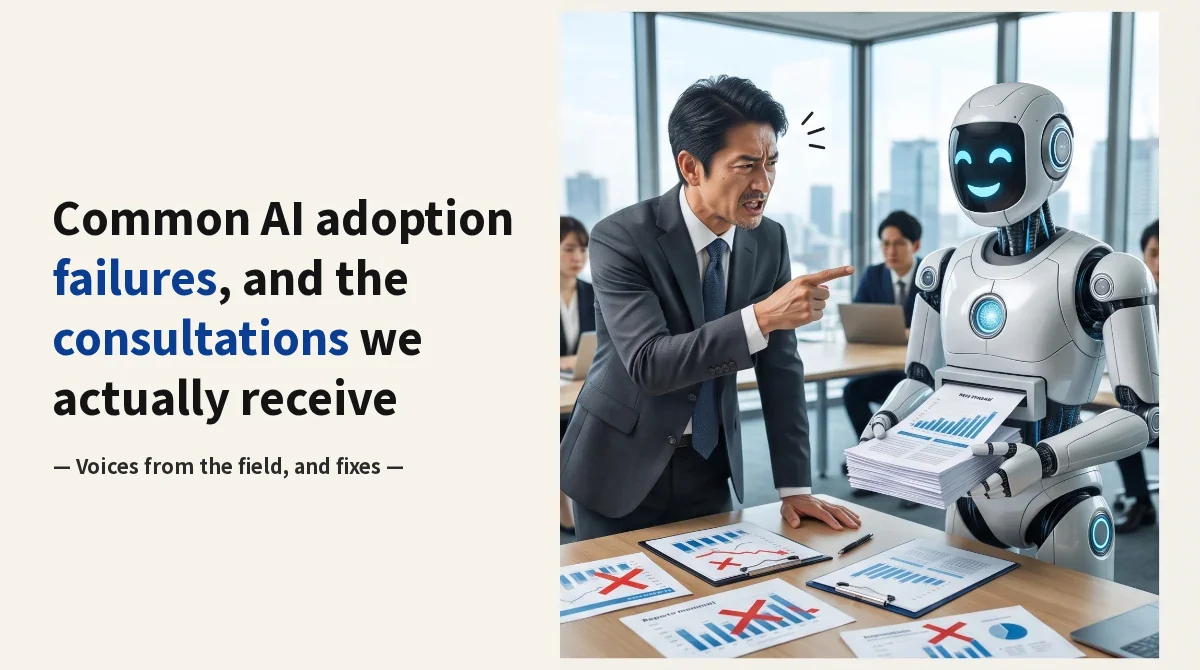
"We gave ChatGPT, Claude, and Gemini accounts to the whole company, but only about 10% of people keep using them. People on the front line tell us they don't know what to use them for."
"Fact-checking and fixing the AI's answers takes so long that it's faster to write everything myself from scratch."
"Management told us to 'use AI to make operations more efficient.' But management doesn't really understand AI either, and keeps paying large sums to consulting firms and development companies with no visible results."
It is not unusual for an AI adoption consultation to begin with comments like these.
Surveys show the same trend. In PwC Japan's 2025 survey (Generative AI Survey, Spring 2025), only 13% of Japanese companies already using generative AI said the results "far exceeded expectations." In the Japan Users Association of Information Systems (JUAS) Corporate IT Trends Survey 2025, 26.8% of companies that had adopted it answered that they "have not yet achieved the expected results, or don't know," and about 60% (59.8%) do not measure the results at all. Failure is not the exception; it is a path many companies adopting AI today go down.
Having handled many consultations, we see a common pattern in where things get stuck. Neither management nor the front line really understands how AI works, how the models differ and where each is strong, or what AI is good and bad at. Yet they "just start with AI for now," because the media is talking about it, because it is the trend, because competitors have started. AI is meant to be a means, not an end. And the most unfortunate part is that when a start like this fails to produce results, people conclude that "AI is the problem" and go back to the old way without looking back at what happened. What is lost there is not the monthly tool fee, but a big opportunity that could have transformed the business.
When I worked at a large company, I saw many employees criticize Excel. They used it with no method for sharing and no rules for managing data, and when things got confusing on the ground, they blamed the tool. Excel, an extremely useful tool, did nothing wrong. I feel that what is happening with AI now is the same thing.
Imagine this. Tomorrow, an extraordinarily capable new subordinate who holds the intelligence of all humanity joins your company. You make no effort to learn what they are good and bad at, and you don't give them the data or information they need for the job. In that state, how could this subordinate possibly deliver results? We believe this question is really all there is to think about in AI adoption.
In this article, based on consultations we (wesionaryTEAM) have actually received, we describe concretely, from the perspective of the side providing support, where failures happen and why. We also share, as they are, the approaches we propose for each consultation.
We hope this gives useful material for decisions both to those considering AI adoption and to those who have already adopted it and hit a wall.
What AI Is Good At and Bad At — Before Welcoming Your Extraordinarily Capable New Subordinate
Before you welcome this extraordinarily capable subordinate, there is one thing we would like you to stop and think about. It is not about AI. It is about people.
Only People Can Move People's Hearts
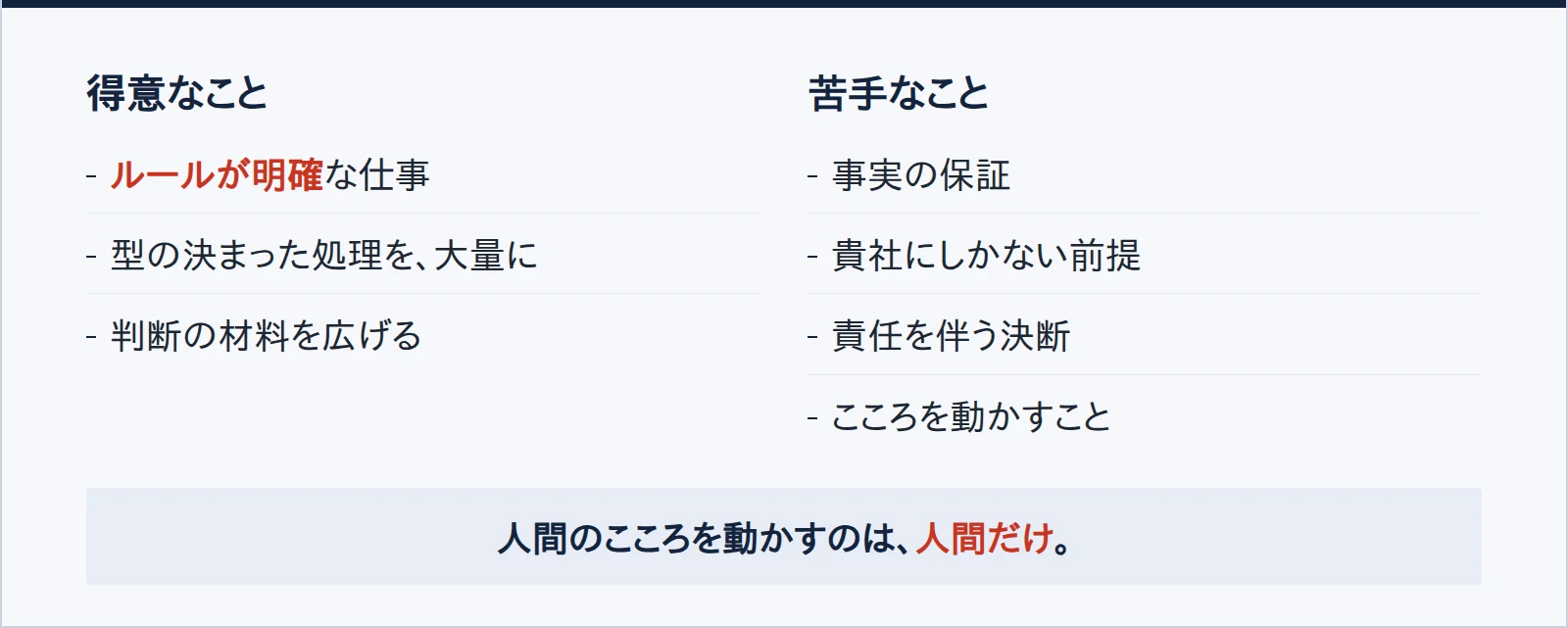
When your company's product was chosen, what was the deciding factor in the end? The enthusiasm of the person in charge, trust built up over years of working together, the feeling of "I want to buy from this person." Beyond any comparison of price or features, there must have been a moment when someone's heart was moved.
Only people can move people's hearts. We believe this one sentence is the starting point of all AI adoption.
That is why you must not let AI write your messages to customers. The wording may be polished, but the warmth that should have been there is missing. The person receiving it senses this keenly. Work you handed over for the sake of efficiency becomes the reason customers leave. This is actually happening.
What AI Really Is: A Probability Machine
So what is AI? Inside ChatGPT, Claude, and Gemini is a mechanism called an LLM (large language model). The name sounds difficult, but it does only one thing. It learns from an enormous amount of text, then keeps predicting and choosing "the word most likely to come next in this context." That alone produces text as natural as a human's.
Once you understand what it really is, the reasons behind AI's puzzling behavior become clear.
AI pretends to know about your company even though it knows nothing about it, because it is simply returning "the usual continuation" drawn from the vast body of text in the world. Being plausibly wrong (hallucination) is not a malfunction or a defect either. It is a distortion that inevitably arises from piling up enormous numbers of probability calculations, a natural by-product, so to speak.
In other words, the more you expect AI to behave like a human, the more disappointed you will be. If you ask AI for answers in frontline work that has no single right answer, what comes back is "the most common, very generic answer in the world," not the answer for your company's front line. The mismatch many people feel after adoption, "this isn't what I expected," comes from here.
What AI Is Truly Good At
So where does a probability machine truly shine? The answer is a world without ambiguity. The prime example is coding, the work of writing programs.
Programming languages have strict structure and clear grammar. For example, the logic that decides shipping fees for an online store can be written like this.
if (memberRank == "Gold" && orderTotal >= 10000 yen) {
  shippingFee = 0 yen
  points = orderTotal × 2%
} else if (firstPurchase == true) {
  applyCoupon("First-Time Discount")
  shippingFee = 500 yen
} else {
  shippingFee = 800 yen
}
"If the customer is a Gold member and the total is ¥10,000 or more, shipping is free and points are doubled. First-time customers get a coupon and ¥500 shipping. Everyone else pays ¥800 shipping." Even with conditions this intricate, once the rules are fixed, programmers all over the world will write it in almost the same way. In a world with no ambiguity, where the next word is determined with high probability, a "machine that guesses the continuation by probability" is unrivaled. In fact, this is the area where AI contributes the most in our own development work.
By the same logic, AI is strong at work that follows a fixed pattern. Picking out set items from large volumes of documents, arranging content into a set document format, listing every option without leaving any out. For work like this, it keeps going through hundreds of items without tiring, without forgetting, at the same quality.
Work that moves people's hearts goes to people. Work with clear rules goes to AI. What happens when you hand over work without knowing where this line is? In the next chapter, we look at real failures based on consultations we have received.
Failure Patterns and the Consultations We Actually Receive

From here, we look at real failures based on consultations we have received. Some details have been changed so that the companies cannot be identified. Each one is written in the order "The actual consultation," "Why it happens," and "Our approach," so feel free to start with whichever is closest to your situation.
Adoption and Uptake Failures
We Rolled It Out Company-Wide, but Nobody Uses It
The actual consultation: "We gave every employee a paid AI tool account. When we checked usage a few months later, only about 10% were still using it. Staff say they 'don't know what to use it for,' and all that keeps happening is the monthly bill."
Why it happens: A rollout that starts by handing out accounts begins without identifying "the work where using it will make a difference." It is like assigning an extraordinarily capable subordinate to every department while nobody decides what work to give them. They have no way to act. Leave it longer, and some employees start using outside AI services through personal accounts the company doesn't know about, which adds risk to information management on top of the wasted spending.
Our approach: Before adding more seats, we choose one area of work where AI will make a difference and build AI into it. We include a way to measure usage from the start, and design on the assumption that unused parts can be shut down.
A Promising Tool That Never Makes It Into the Workflow
The actual consultation: "We signed up for an AI service marketed as sales support. The demo looked great, but in the end the team kept working the way they always had. All that was left was the monthly fee."
Why it happens: Off-the-shelf AI tools may work beautifully in a demo, but they are not part of your company's actual workflow or the systems you already use. People on the ground will not change their work procedures just to learn a new tool. This isn't laziness on their part; it is natural human behavior. The cause lies in an adoption plan that underestimated the cost of changing procedures.
Our approach: Rather than asking you to learn a new tool, we build AI into the business systems and workflows you already use. We design on the premise that frontline procedures do not change.
The Trial Worked, but We Can't Move to Production
The actual consultation: "The AI system we built as a trial worked well. But as soon as full-scale rollout came up, security and operational issues surfaced one after another, and it has been stuck for a year."
Why it happens: A trial is a place to confirm that something "works." But production requires more: how to guarantee the accuracy of answers, who should be able to see which data, how to keep records that can be checked later when something goes wrong, and what to do when it doesn't work properly. If you try to go to production with something built only for validation, you stop at this wall. In the JUAS survey, the share of companies in trial or preparing for adoption (20.2%) is almost the same as the share that have adopted (21.0%). Many of them are stuck in front of this wall.
Our approach: We design for production use from the start. At the trial stage, we identify the requirements that will be needed later and build in evaluation of answer accuracy, access permission management, and record keeping. Then we support you all the way through setting up the structure for production operations.
Data and Security Failures
The More Important the Data, the Less You Can Send It to Outside AI
The actual consultation: "We have source code we've developed over many years, along with design and calculation data. We want to use them with AI, but because of confidentiality agreements with business partners and our internal rules, we can't send them to outside AI services. As a result, we haven't been able to start anything in the area where AI would probably help the most."
Why it happens: The concern that "the data we enter will be used to train the AI" is well known, and it can now be avoided with paid business plans or by changing settings. But the practical wall lies beyond that. Before the question of training even comes up, the mere fact of sending data to servers outside the company can violate confidentiality agreements or internal rules. In 2023, it was widely reported that employees at a major Korean electronics manufacturer entered semiconductor-related source code into an outside AI, after which the company temporarily banned all internal use of generative AI. The more the data embodies a company's competitiveness, the higher this wall becomes.
Our approach: From the start, we include a configuration that keeps data inside the company among the options. This means placing the AI inside an environment your company controls, with a network configuration in which data does not leave. The important point is that not everything has to use that configuration. Decide which data needs protecting, then split by feature: features that touch confidential information run in the self-managed environment, and general work uses ordinary cloud AI. We actually run this configuration in our own products.
What You Feed Into AI Can Be Drawn Out, Depending on How You Ask
The actual consultation: "We want to build an AI chat loaded with internal documents and make it available company-wide. But the documents include HR information and business terms. When we tried it, we found that with cleverly worded questions, it would answer with information we never meant to show."
Why it happens: AI is a machine that answers with the most probable continuation. It does not decide on its own that "this information must not be shown to this person." Data you load into it can come out to anyone, depending on how they ask. It is like a new shop clerk who has only just learned the store's rules being smooth-talked by a customer into revealing what goes on behind the scenes. This is a new leakage path unique to AI that did not exist in traditional systems.
Our approach: We control who can access which data, including through the AI's answers: viewing permissions by department and role, control over what the AI is allowed to reference, and records that let you check afterward who asked what and what the AI answered. We include these in the design from the very first stage of building. Because they are hard to add later, the order matters.
Cost and Investment Decision Failures
Started on Orders From the Top, With Only Costs Piling Up
The actual consultation: "Management gave the order: 'Use AI to make operations more efficient.' We signed an advisory contract with a consulting firm and placed an order with a development company too. Monthly report meetings and documents keep increasing, but nothing about the actual work has changed. We've been paying for more than a year now."
Why it happens: Neither those who gave the order nor those who received it decided "which work to change with AI, and by how much," and only the ordering moved ahead. Without a numerical target, results cannot be measured, in principle. The only reports that come out are impressions like "it feels more convenient," and payments continue with nothing to base a decision on whether to continue or wind down. In the JUAS survey as well, about 60% of companies that adopted generative AI do not measure the results. AI consulting fees are generally around ¥100,000 to ¥1 million per month, and development for the trial stage alone runs ¥1 million to ¥5 million. Those are large sums to keep paying without a yardstick for judging them.
Our approach: First, we set one numerical target. "How many hours per month to cut from this task," or "how much to grow the sales of this process." Then we measure the situation before adoption and start. Once results are visible as numbers, decisions to expand, fix, or wind down can be made based on facts, not impressions.
Costs That Grow the More You Use It, With No Way to See Inside
The actual consultation: "After we started using a system with built-in AI, the monthly usage fees kept growing beyond what we expected. The invoice shows only the total, so we can't tell how much each feature costs. We can't decide where to cut."
Why it happens: Most AI usage fees are pay-as-you-go. What's more, the longer the AI's answers, the higher the charge. The more convenient it is and the more it is used, the more the costs rise, yet all you see on the invoice is the total. Because you can't tell which features are earning their cost and which are simply eating up budget, you keep paying even for features with little effect.
Our approach: We build a way to measure AI costs per feature into the system itself. We also use different AI models for different purposes: high-performance AI for work that requires difficult judgment, inexpensive AI for simple work. It is the same as not asking your highest-paid expert to do simple tasks. And we keep features that are not producing results in a state where they can be stopped at any time.
Asked for a Large Upfront Investment Before the Effect Is Clear
The actual consultation: "When we consulted a development company, we received an estimate of several million yen just for trial-stage development. We can't commit to that amount when we don't know whether it will work."
Why it happens: Using AI is a field where you cannot predict the effect until you try. Yet traditional business practice tends to have the ordering side take on most of the cost and risk before the effect can be confirmed. When asked to pay a large sum up front for something that may not work, it is natural for many executives to hesitate.
Our approach: We offer a "co-creation" approach in which we share both the results and the risk. For projects that use AI to create business growth and revenue, we charge nothing from the initial consultation through production implementation. Once operations begin, we are paid through a monthly usage fee and a scheme that shares the results according to the scale of the business (revenue share). In other words, we earn income only after you see results. Rather than supporting from the outside, we are in a position of pursuing the same outcome as you. With this structure, the ordering side does not have to carry the worry of "what if it doesn't work" alone. For projects where sharing results is hard to make work, such as internal operational efficiency, we propose conventional contract development that starts with small validations and proceeds step by step, within a range where the payback outlook is clear.
National subsidies can also sometimes be used for AI adoption costs. From fiscal 2026, the former IT Implementation Subsidy (IT導入補助金) has become the Digitalization and AI Implementation Subsidy (デジタル化・AI導入補助金), and tools with AI features and tools that support generative AI are now explicitly eligible. The maximum subsidy under the standard category is ¥4.5 million (the subsidy rate is 1/2 in principle, or 2/3 depending on conditions). Checking eligibility and applying takes preparation, but we work with businesses that support subsidy applications, so we can offer one continuous proposal, from judging whether you can apply through implementation and operations after approval. For details, see our AI implementation support page.
Results and Dependency Failures
We Produce Faster, but It Doesn't Win Orders
The actual consultation: "Since adopting AI, creating documents and proposals has clearly gotten faster. But lately we feel everything looks similar to what other companies produce. In fact, it isn't leading to orders."
Why it happens: As described earlier, AI's answers are "the most common, very generic answer in the world." If you leave proposals to AI without any ingenuity, your competitors are using the same AI to produce similar proposals. In exchange for speed, you lose the reason to be chosen. You gain speed and lose what makes you distinctive, a bad trade. What moves customers' hearts is your track record, the experience built up on the ground, and the enthusiasm of the person in charge; in other words, things on the human side.
Our approach: We maximize human involvement so that the AI output is distinctive. AI handles gathering material and drafting, and people weave in your company's track record, frontline knowledge, and the judgment of the person in charge. We design with "does it lead to orders?" as the criterion, not "can we make it fast?"
Unable to Move Away From a Particular AI Service
The actual consultation: "The AI service we use revised its pricing, and our monthly costs went up significantly. Only when we considered switching did we realize our system was built around that AI and we couldn't move."
Why it happens: The AI world changes fast, and price changes, specification changes, and service shutdowns are not unusual. And dependency does not occur only in the AI itself. The instructions you have built up for the AI, the way data is stored, the mechanisms for checking answer quality: the more these are tailored to a specific service, the more dependency grows, all at once and quietly. By the time you notice, the cost of switching has grown too large, and part of your business is at the mercy of another company's pricing.
Our approach: We design a configuration in which the AI component can be swapped out later. We prepare the instructions for the AI and the data used to check quality in a form that is not locked into a particular service and remains your company's asset. Even if a specific AI's specifications or pricing change, the business does not stop. The one you delegate to may change, but the way the work is done stays with your company.
How to Recover When AI Has Been Adopted but Has Stalled
Already adopted, and stalled. We receive many consultations like this. In fact, most of the consultations we receive come after adoption.
The first step to recovery is to identify which of the failure patterns above applies, before concluding that "AI is the problem." But this assessment is hard to make internally. The people who know how the adoption came about are the ones most caught up in it, which makes it harder for them to judge.
So before lining up the options, please consult us first. Once we hear about your current situation, we will diagnose which pattern applies and tell you whether you should wind it down, shrink it to the part that works and continue, or rebuild it by fixing only the missing parts of the design. Quite often, you do not need to redo everything.
Cases Where You Should Not Adopt AI
Coming from a company whose work is supporting AI adoption, this may sound odd. Even so, there are cases in consultations where we answer, "Let's not do that." These three follow naturally from the principles described so far.
Cases Where You Want AI to Make Assessments or Judgments
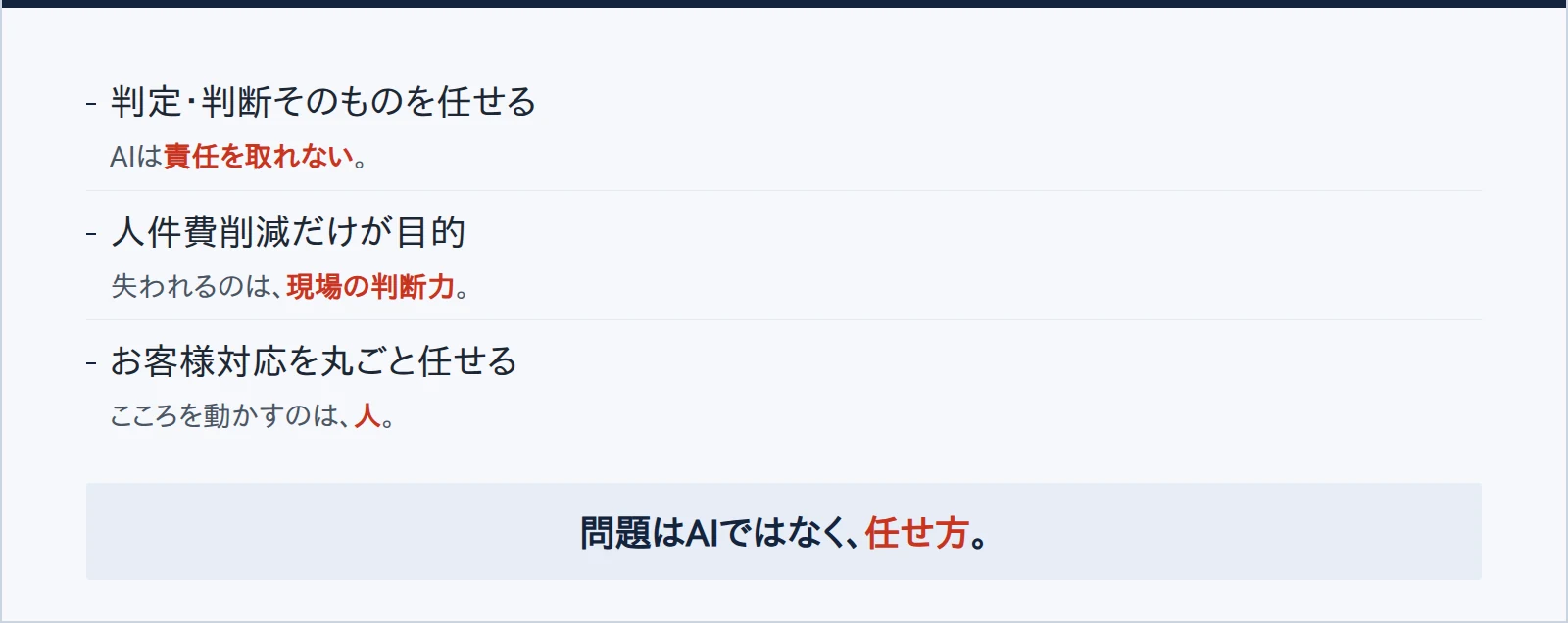
Hiring decisions, personnel evaluations, choosing whom to lend to or do business with. When a consultation asks to hand over the assessment or judgment itself, which carries responsibility, to AI, we ask the client to reconsider the design. AI is a machine that answers with the most probable continuation; it can neither truly explain the reasons for a judgment nor take responsibility for the outcome. And when a judgment turns out to be wrong, no customer or employee will accept the explanation "the AI decided." What you can leave to AI stops at gathering the material for a judgment. The real start comes after you change the design so that the judgment itself stays with people.
Cases Where Cutting Labor Costs Is the Only Goal
We also don't recommend adoption that starts from the question "how many people can AI let us cut?" The reason is that the math doesn't add up. The labor costs you can cut are easy to measure. But the frontline judgment and the unrecorded know-how lost along with those people are hard to measure. You trade an easy-to-measure gain for a hard-to-measure loss. Moreover, no employee willingly cooperates with an AI brought in to replace them. Without the front line's cooperation, it doesn't take hold, produces no results, and ends with "AI is the problem." The same ending as with Excel. AI delivers its greatest results when it is brought in not as a tool to reduce headcount, but as a device that strengthens people's judgment.
Cases Where You Want to Hand Customer Interactions to AI as They Are
Replies to inquiries, apologies, the final push in a proposal. When a consultation asks to hand the moments of facing customers over to AI entirely, we draw a line there as well. Because only people can move people's hearts. The more polished the wording, the less warmth comes through, and customers quietly drift away. What AI handles is behind-the-scenes work: organizing past exchanges, searching for the information needed, drafting replies. Beyond that, the final words that reach the customer are written by a person. If you cannot keep to this line, AI adoption for that work should wait.
What these three have in common is that the problem is not AI itself but how work is handed to it. Even if one of them applies to you, you don't need to give up on adoption. Redesign the work you hand over, and AI will deliver.
How to Adopt AI Without Failing — Four Steps for Small and Medium-Sized Businesses

Turn the failure patterns and principles above inside out, and the approach can be organized into these four steps. You need neither special talent nor a big budget.
Step 1: Choose One Task to Delegate, Based on What AI Is Good and Bad At
Start not with a company-wide rollout, but by choosing one task. The criterion for choosing is the nature of AI described in the first half of this article. Tasks with clear rules and patterns, where people can check for mistakes, suit AI. Do not choose moments that move customers' hearts, or assessments and judgments that carry responsibility. It means reading your extraordinarily capable subordinate's résumé before deciding on their first assignment.
Step 2: Draw the Lines for Data That Can't Leave and for Where People Take Over
Before you start building, draw two lines. One is the data line: which data cannot leave the company, and who may see which information. The other is the work line: how much to hand to AI, and where people take over. The final words that reach the customer always stay on the human side. These lines are hard to redraw later, which is exactly why you decide them first.
Step 3: Try It Small, Inside Your Current Workflow
Rather than having frontline staff learn a new tool, build AI into the systems and workflows already in use. Not changing frontline procedures is the condition for it to take hold. In our case, the guideline for getting the first system working is one week. Not spending large sums at this stage protects your freedom to make decisions later.
Step 4: Check the Numbers, and Expand Only What Works
Compare against the numbers you measured before adoption, and look at how much each feature costs and how well it works. Wind down what isn't working. Also check whether human involvement is keeping the output distinctive. Then expand only the patterns whose effect has been confirmed, to neighboring tasks and to other departments. Expansion comes last. Many failures happen when this order is reversed and companies start by expanding.
Finally, here is a pre-adoption checklist. Please look it over before consulting us.
- Have you narrowed the work you want to delegate down to one task?
- Have you measured the time and cost that task currently takes?
- Have you decided on a yardstick for measuring results?
- Are the documents and data you can give the AI organized?
- Have you decided which data cannot leave the company?
- Have you decided who may see which information?
- Have you decided to wind it down if it doesn't produce results?
- Is there a setup in which the final words that reach customers are written by people?
It's fine if not everything is in place. The items that aren't are exactly what we decide together in the first consultation.
Frequently Asked Questions
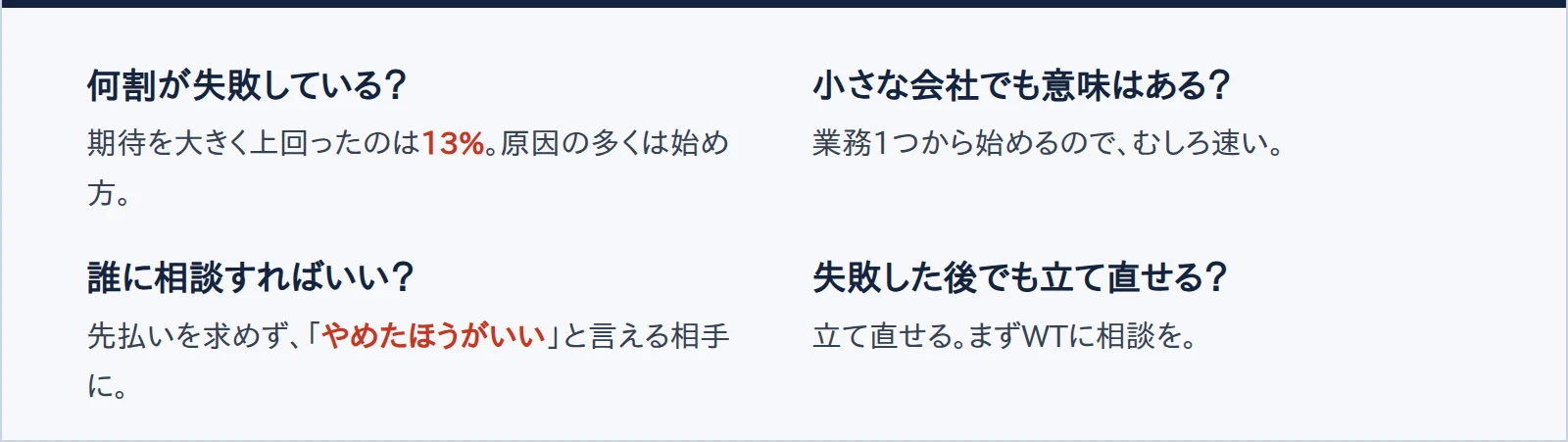
How many companies fail at AI adoption?
In Japanese surveys, only 13% of companies already using generative AI said the results "far exceeded expectations" (PwC, 2025), and 26.8% of adopting companies answered that they "have not yet achieved the expected results, or don't know" (JUAS, 2025). However, as described in this article, most failures come from starting by handing over work without knowing what AI is good and bad at. Change how you start, and they can be avoided.
Does AI adoption make sense for a small company?
Yes. The approach in this article (narrow it down to one task, build it into your current workflow, check the numbers before expanding) does not assume a large company-wide investment. Small companies, with fast approvals and little distance between management and the front line, can actually run this cycle faster.
Whom should we consult?
There are tool vendors, consulting firms, development companies, and others. Whoever you consult, there are two things we would like you to check. Whether large costs arise before the effect can be confirmed. And whether they will tell you when it is better not to adopt. Many of the failures described in this article happen when companies start without checking these two things.
We've already failed. Can we recover?
Yes, you can. In fact, most of the consultations we receive come after adoption. Don't end it with "AI is the problem"; please consult us first. We will hear about your current situation, diagnose which failure pattern in this article applies, and propose the best way to recover.
Summary — Most Failures Are Decided by How You Start
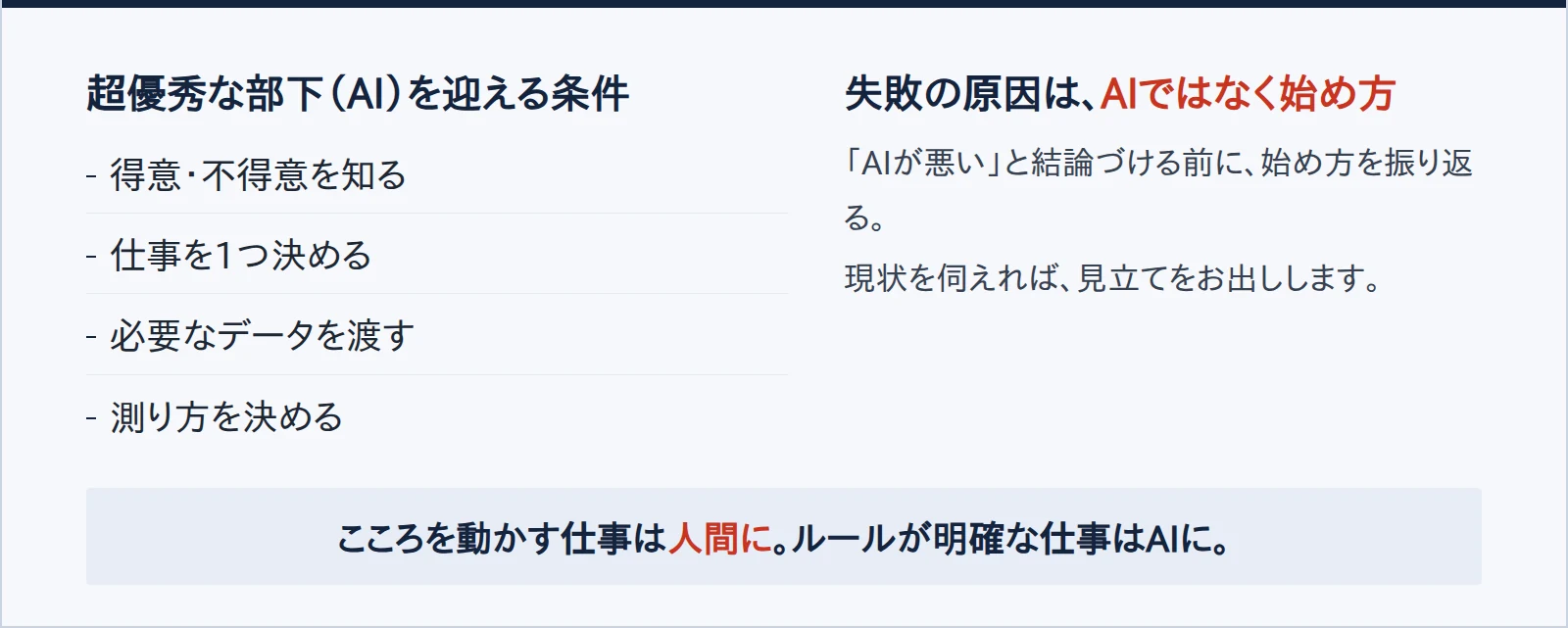
In this article, based on consultations we have actually received, we have looked at where AI adoption fails and why.
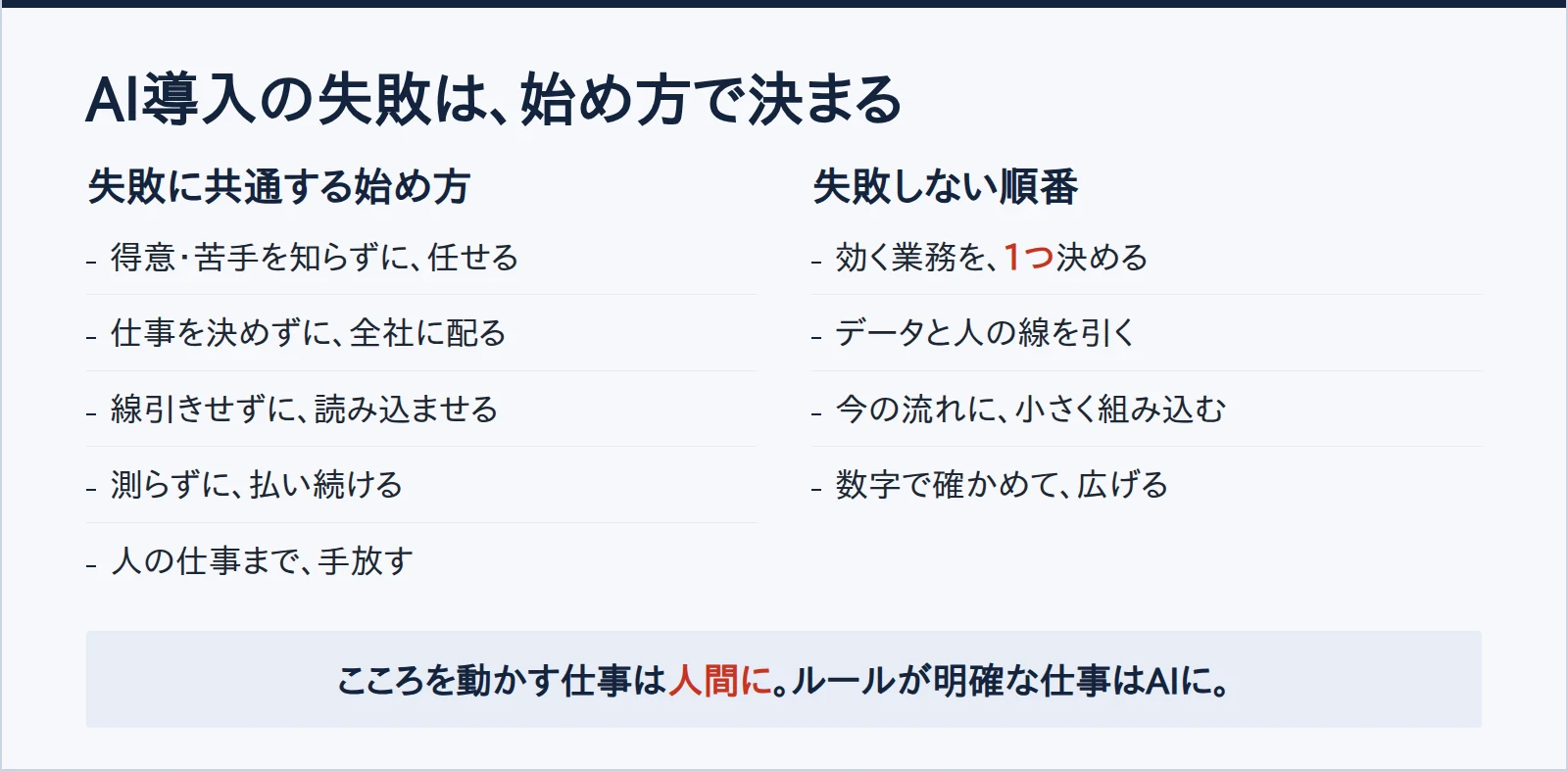
Looking back, the cause of failure was not AI itself. Handing over work without knowing its strengths and weaknesses. Handing out accounts without deciding what work to delegate. Loading in data without drawing lines. Paying continuously without a yardstick. Giving away even the work only people can do. All of these are problems of how you start and how you delegate.
Tomorrow, an extraordinarily capable new subordinate who holds the intelligence of all humanity joins your company. If you welcome them knowing their strengths and weaknesses, choosing one task to delegate, giving them the information they need, and deciding how to measure results, this subordinate will deliver results on a completely different scale. If instead you welcome them without deciding anything, all that remains is the conclusion that "AI is the problem," and a big opportunity that could have transformed the business is lost. Just as with Excel, years ago.
Whether you are just starting or have already hit a wall, once we hear about your current situation, we can give you our assessment. Including the co-creation approach, in which we charge nothing from consultation through production implementation, we will propose the form that fits your company. Our thinking and concrete approach are described in detail in a separate article, "Our Approach to AI Adoption and How We Put It Into Practice." For service details, see our AI implementation support page.