
Case Studies by Field
All Case Studies31
Cloud Services9
Core & Business Systems4
Construction DX2
E-commerce Development3
Inventory & Order Management4
AI Adoption11
DX Promotion8
New Ventures12
CASE STUDY
TeamPlace®: Developing a Workplace Subscription Platform for Finding the Places, People, and Activities That Suit You
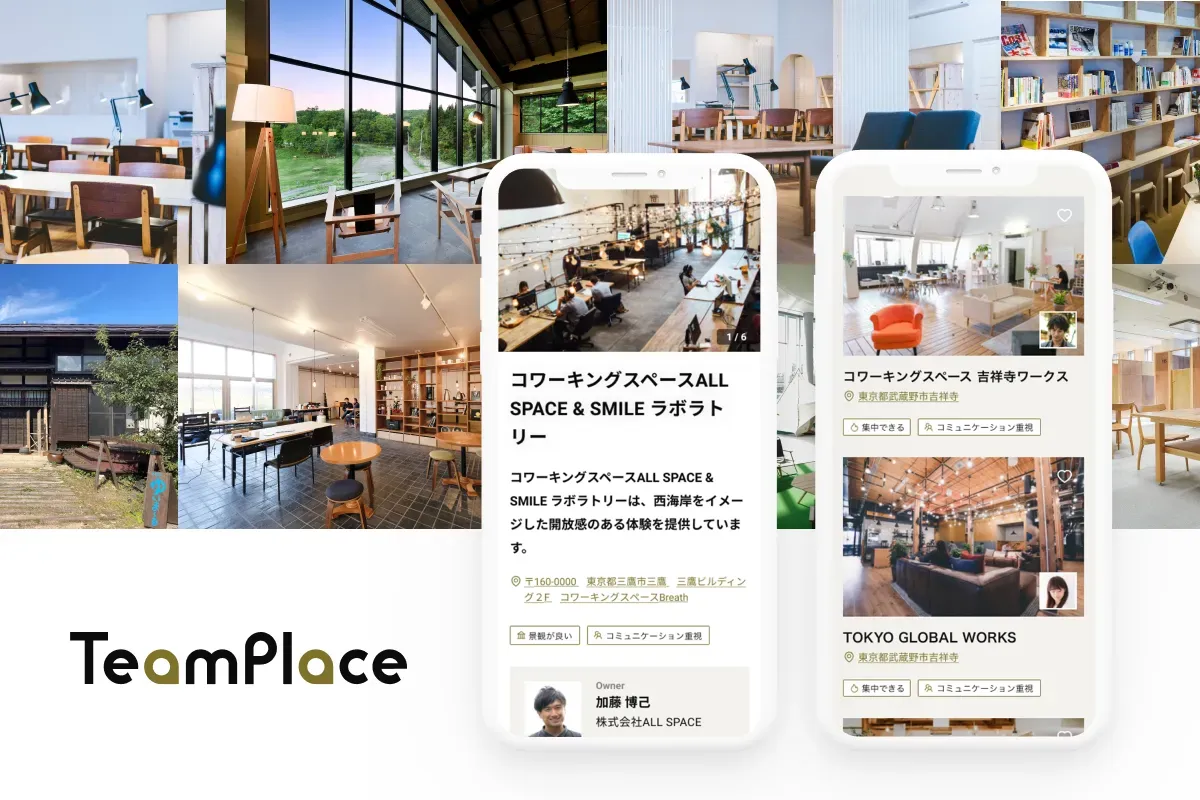
Overview
There are many websites introducing coworking spaces and Wi-Fi-equipped cafes across Japan. But for users to find places and people that "suit them," the conventional information about a place's facilities and features was not enough. What was missing was a picture of who you would meet there and what you could do there, based on the backgrounds of the people who gather in each place and the character of its community.
So TeamPlace was designed around the motto "a social network for finding the places, people, and activities that suit you," making it easy for operators to convey their vision, background, and strengths.
Development of the platform started small, and the value and experience it offers have grown through improvements and expansions based on user feedback and usage data. Along the way, the number of partner workplaces has passed 50, and the number of workplace users continues to grow.
Challenges
-
Users can't find a place where they want to work
-
Users can't meet a community that shares their values
-
Users want fresh inspiration from conversations with other people
What We Did
-
Started developing the platform small
-
Released an MVP, then improved and expanded the platform based on user feedback and usage data. This work is still ongoing
Results
-
Partnerships with more than 750 staffed workplaces across Japan
-
Launched the AnyWhere Pass, which gives access to more than 140 workplace locations across Japan
-
Certified as an eligible tool under the IT Implementation Subsidy 2024 (IT導入補助金2024)
Our Scope of Work
-
Requirements definition
-
Design
-
Development
-
Testing
-
Operations
Client Information
Company Name
AnyWhere Inc.https://anywhere.co.jp/
Vision
A society where anyone in the world can work and live richly, anywhere
Mission
To provide the environment and mechanisms that connect places, people, and activities, and to pursue and realize work styles that fit the times
Business Overview
• Operating "TeamPlace," a workplace platform connected by people and a passport to places to work • Communication support using the online 2D metaverse "SpatialChat" • "WORK AnyWhere," hands-on support for business initiatives at companies and local governments
Product Information
Name
TeamPlacehttps://team-place.com/
Mission
Providing places to work, connections, and activities to companies and individuals
Service Overview
TeamPlace® is a subscription platform for places to work, connected through people. It connects more than 750 attractive workplaces across Japan with people and activities, making it possible to visualize information, turn it into an asset, and put it to use. With the "AnyWhere Pass," you can use more than 160 workplaces on a one-time or subscription basis. "TeamPlace.CRM," a customer relationship management system that connects places, people, and activities, makes it possible to visualize what happens every day, starting from places and people, and turn it into an asset.
-
Introducing and providing workplaces to companies and individuals
-
Easy check-in and check-out using on-site QR codes
-
One-time and subscription pass features
-
Support for workplaces and owners (launch and operation)
-
"TeamPlace.CRM," a customer relationship management system that connects places, people, and activities
Feature List
-
Content management (CMS)
-
Booking
-
One-time payments
-
Subscriptions
-
Job postings
-
Matching
-
Recommendations
-
Browsing history
-
Map search
-
Events
-
Email delivery
-
Usage analytics
-
Social login
-
QR code scanning
-
Check-in and check-out
A Project That Began With a Shared Vision
Haruhisa Saito, CEO, AnyWhere Inc.
Ichiro Nagata, CEO, wesionaryTEAM
Saito: I founded the company around 2020, and when I could see what I wanted to do, I was convinced I absolutely needed core development members. That's when I happened to have the chance to meet you, Mr. Nagata. You had a wide range of development experience and you identified with the business, so I really wanted to work with you. That was how it started. What did you think when you first heard about TeamPlace?
Nagata: I had many opportunities to hear about startups and new businesses, but when I met you, I strongly identified with the vision of TeamPlace: not just places, but building communities and creating connections between people.
Saito: I'm really glad to hear that. Because we connected on the core of it, we're still working together today. After that we moved development forward for a little over six months, and the first version of TeamPlace was released in 2021. We've worked hand in hand ever since. At first it only had information about places, but as we kept adding features to visualize all kinds of information around each place, such as people's profiles and announcements of events and openings, I think a good cycle formed in which the business side was building those connections too.
Project Challenges
AnyWhere Inc. had been connecting workplaces across Japan with their users, and it set out to offer a new service around the theme of "finding the places, people, and activities that suit you." In the process, several challenges came to light.
First, for users to find places and people that "suit them," it was not enough to provide information about physical workplaces as before. Precise matching based on users' needs and values was required. This meant taking into account, as fully as possible, not only the facilities and features of each place but also the backgrounds of the people who gather there and the character of its community.
Second, TeamPlace aimed to deliver new value that had never existed before, but how much real demand there was for it was unknown. The vision was grand, and everyone recognized that developing everything at once would take enormous time and cost. If time and money were not invested carefully, it would be impossible to change course when a mismatch with actual needs appeared.
How the Project Was Run
At the start of the project, to realize the platform's grand vision, we first listed every feature of the product. The whole team discussed it many times, evaluated each feature in terms of development effort, certainty of demand, and impact, and defined the MVP (Minimum Viable Product). Defining the MVP was an important step for using limited resources as effectively as possible and validating demand in the market early.
Next, we used Figma to create wireframes for every screen. Visualizing the product this way clarified the service's concept and ideas, and through interviews and discussions across the team, it sharpened our picture of the product. The direction and features of the service gradually took concrete shape, laying the foundation for the next phase.
We then moved on to UI design, also in Figma. Aiming to deliver an excellent user experience (UX), we optimized every detail of the UI, considering whether each element was needed, how elements related to one another, and how users would feel and act. We pursued a design that users could operate intuitively, so they could easily find "the places, people, and activities that suit them."
Since releasing the first version in 2021, we have continuously tested hypotheses based on user feedback and usage data and evolved the product. By repeatedly removing, improving, and expanding features to match needs, we have raised the value of the service.
For the development team, to keep this long-term project stable, we regularly rotated members' roles. This minimized the risk of depending on any particular member and encouraged knowledge sharing across the whole team.
To keep communication smooth, we also made it a policy for all stakeholders to join Slack and communicate openly. This made information sharing smooth, narrowed information gaps between teams, and dramatically increased the speed of communication.
Although TeamPlace was a project with high uncertainty, these approaches kept it moving steadily forward. Today it has grown into a service used by more than 750 workplaces across Japan and several thousand users.
It is still evolving. While improving and expanding features, we are also working internally on faster page loading and on addressing technical debt.
We will continue to work together as one team to provide an even better service.
Technical Features
-
Backend development: Go & Gin: The backend is implemented in Go, using Gin, a fast HTTP web framework. This enables high performance and efficient request handling.
-
Frontend development: React & Next.js: The frontend is built on React, using Next.js, which supports server-side rendering and static site generation. This achieves faster initial page loads and optimized SEO.
-
Code maintainability and safety: TypeScript: TypeScript is used for type-safe programming, improving code readability and maintainability. SonarQube: SonarQube is used to analyze code quality and security, catching bugs and vulnerabilities early and keeping the codebase healthy.
-
Cloud infrastructure and scalability: GCP/Firebase (serverless): A serverless architecture on Google Cloud Platform and Firebase provides automatic scaling and high availability. It reduces the burden of infrastructure management and optimizes resource use.
-
Design methods: Atomic Design: UI components are built on Atomic Design principles, providing a reusable and consistent user interface. Figma: Figma is used as the design tool, enabling real-time collaboration and prototyping across teams.
-
Usage monitoring and fast problem detection: Sentry: Sentry is used for real-time error tracking and performance monitoring, enabling early detection of and fast response to problems. Google Analytics: Google Analytics is used to analyze user behavior and usage, helping improve and optimize the service.
-
Operational productivity and fast delivery: GitHub Actions: Continuous integration and continuous deployment are automated with GitHub Actions, ensuring code quality and a fast release cycle.
FREE ESTIMATE
Free Estimates: Learn What to Build and the Cost Range on the First Call
Your requirements do not need to be settled. Tell us in a sentence what you want to build, and your project manager will sort it out with you.