
Case Studies by Field
All Case Studies30
Cloud Services9
Core & Business Systems4
Construction DX2
E-commerce Development3
Inventory & Order Management4
AI Adoption10
DX Promotion8
New Ventures12
CASE STUDY
Case Study: An Analytics Platform That Automatically Collects and Visualizes View Data for YouTube Videos Using Provided Music
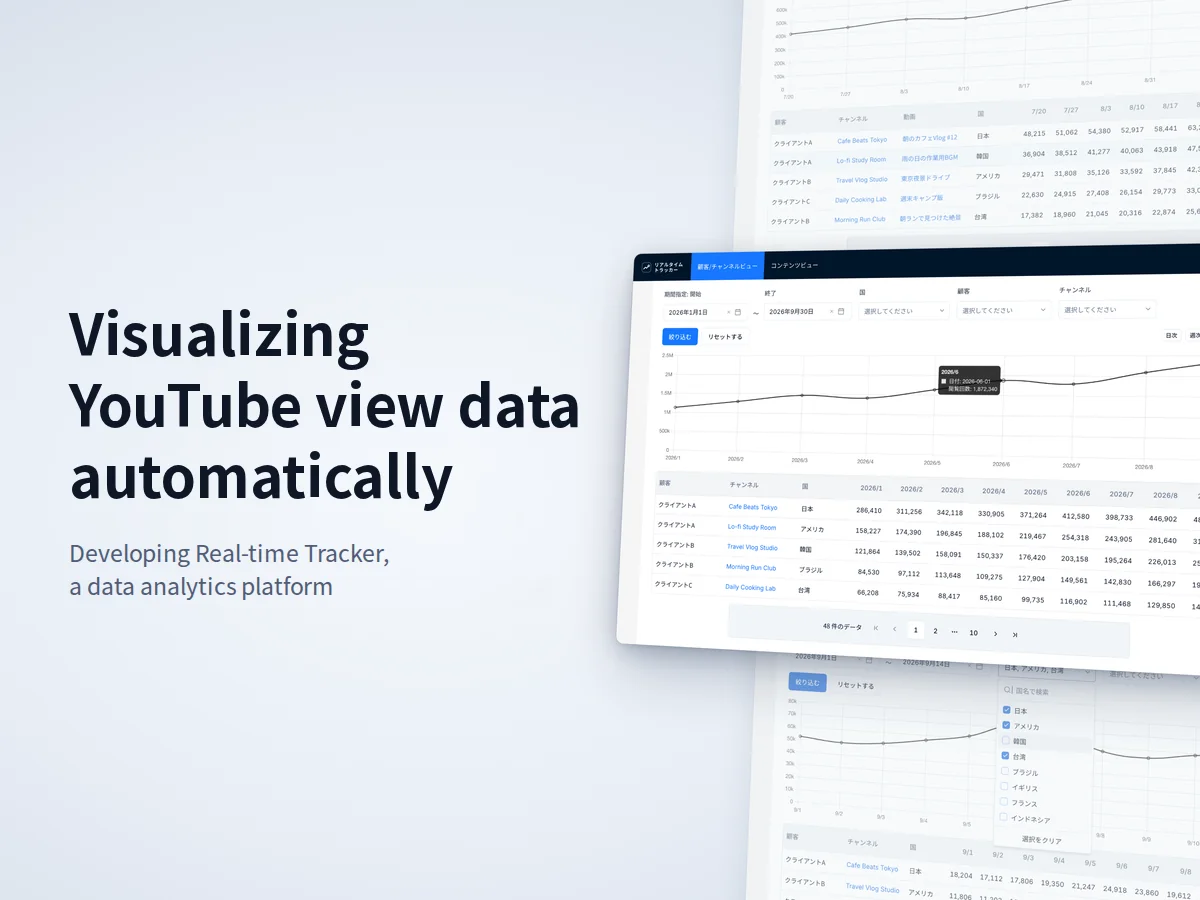
Overview
Our client, a music company, provides music to artists and businesses. The music it provides is used in many YouTube videos, but there was no way to see in one place which videos were using it, how many times they had been played, and in which countries they were watched, which made it difficult to evaluate the results of providing music in numbers.
We developed "Real-time tracker," an analytics platform that automatically retrieves playback data from YouTube, aggregates it by recipient, channel, and country, and visualizes it. The project came to us through an introduction from a sales company, and we were selected after a competition among several companies. We handled everything from requirements definition through design, development, and infrastructure setup, and delivered the platform.
Challenges
- There was no way to get an overall picture of the view counts of videos using the provided music, or the countries in which they were watched
- The results of providing music could not be evaluated in numbers and used for business decisions
- Because the system depended on retrieving data from YouTube, it was necessary to determine before development how much could actually be achieved
What We Did
- At the proposal stage, researched and actually tested the data retrieval mechanisms YouTube offers to outside parties, and presented what could and could not be done, along with measures to address the risks
- Laid out every screen, displayed item, and chart in a design tool before development, and confirmed the finished picture with the client
- A mechanism that automatically retrieves data such as video view counts and aggregates it daily, weekly, and monthly at three levels: video, channel, and recipient
- Lists that can be filtered by recipient, channel, country, and period, and charts showing trends in view counts
- Display in multiple languages, including Japanese
Results
- Delivered a system that lets the client check, in numbers, how the music it provides is being used, by recipient, channel, and country
- There was almost no rework once development began, and development was completed without any unexpected problems
- Set up a structure that assumes ever-growing daily playback data, so trends can still be followed by switching periods as data accumulates
The More a System Relies on External Services, the More It Must Be Assessed at the Proposal Stage
With a system that uses data from an external service, if you discover after development has begun that "that data can't be retrieved," the plan itself falls apart. At the proposal stage, we researched and tested YouTube's data retrieval mechanisms, and set out in concrete terms in our proposal what could be achieved and how we would deal with the constraints. That concreteness was also why we were selected in the competition. The client told us, "Your technical skills and your attitude toward product development were the deciding factors."
In this project, the data to collect, how to store it, and how to present it were clear from the start. We therefore chose to finalize all requirements before moving into development. We sorted out the client's requests in online meetings once or twice a week, then laid out the screens and their contents and reached agreement before development began. Communication took place where all stakeholders could see it, so information never stayed locked up with particular individuals. By confirming feasibility at the proposal stage and agreeing on the finished picture before development, rework after development begins can be kept to a minimum.
Our Scope of Work
- Technical research at the proposal stage
- Requirements definition
- Screen design
- Design, development, and testing
- Infrastructure setup
Client Information
Company Name
A music company
Business Overview
- Providing music to artists and businesses
Frequently Asked Questions
Can you build systems that use data from external services such as YouTube? Yes. In this project, at the proposal stage we researched and actually tested the data that could be retrieved and its constraints, presented what could be achieved and how we would address the risks, and then developed the system.
Can we specify which cloud to use? Yes. In this project, using Google Cloud was one of the client's prerequisites. Within that, we chose and designed around a data analytics service suited to aggregating the ever-growing daily playback data.
Can we see what the finished product will look like before placing an order? Yes. We lay out the screens, displayed items, and charts in a design tool and confirm them with you before development begins. In this project, this confirmation meant that almost no rework occurred during development.
Related Information
- Development of analytics tools and business systems that integrate with external services → System development
- Building systems that gather scattered data into a form you can use for decisions → DX promotion support
FREE ESTIMATE
Free Estimates: Learn What to Build and the Cost Range on the First Call
Your requirements do not need to be settled. Tell us in a sentence what you want to build, and your project manager will sort it out with you.