
Case Studies by Field
All Case Studies31
Cloud Services9
Core & Business Systems4
Construction DX2
E-commerce Development3
Inventory & Order Management4
AI Adoption11
DX Promotion8
New Ventures12
CASE STUDY
Case Study: MVP Development of MELD, a Concert Companion Matching Service and a Music Label's First In-House Service
Overview
meld Inc. is a company whose core business is an independent music label. Through its long involvement in live music, it had repeatedly heard people say, "I can't go to concerts or festivals because I'd be going alone." Finding companions mostly happened on social media, where ticket fraud and problems involving personal information had occurred.
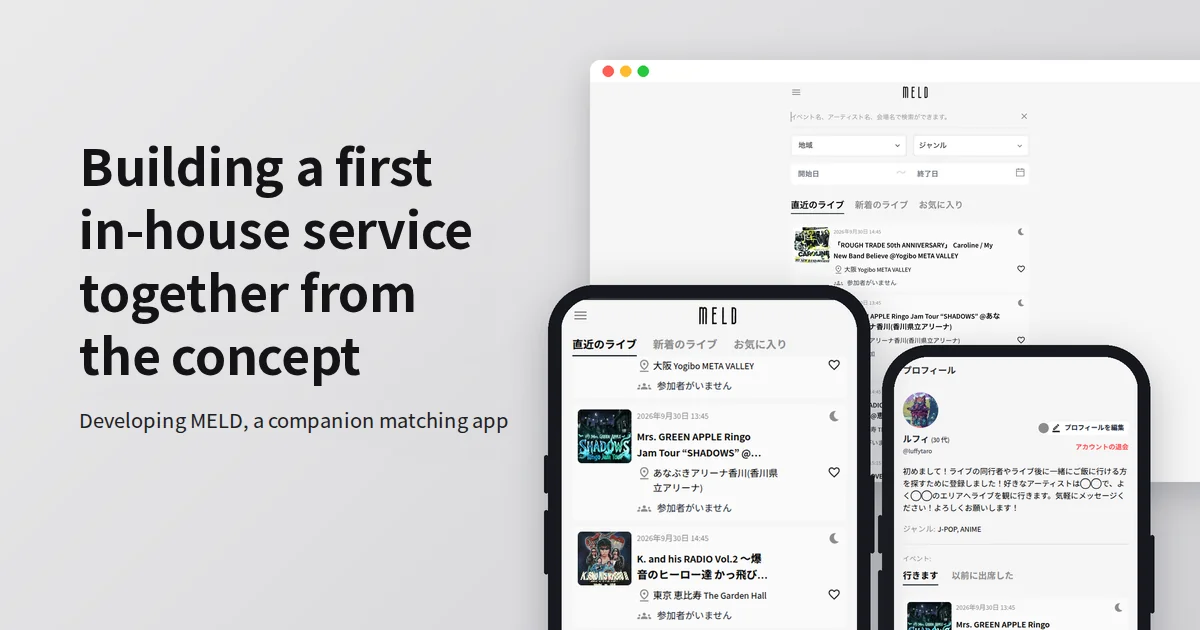
We worked with the company from the very first step of putting its concept into words to launch its first in-house service. We developed MELD, a companion matching service that lets people go to music events with others who share their tastes, as a web service for smartphones, and launched it with only the essential features.
Challenges
- As this was the company's first business development project, it had no established process for turning an idea into a service
- Because the service involves meeting in person with people first met online, safety measures were essential
- With the business still at the validation stage, initial and running costs had to be kept down
What We Did
- Put into words what the service is for and what it does, and shared the screens and user flows using wireframes
- Matching that connects people who want to go to the same event, and ticket matching that lets people pass on spare tickets at face value
- Safety measures built in from the requirements definition stage: paid membership, a reporting function, one-on-one messaging only, and payments that do not require the company to hold card information
- Focused development on the smartphone experience, since more than 90% of users access the service from smartphones
Results
- Passed 300 registered members within a month and a half of launch, and has since grown to more than 7,000
- Users signed up without any large-scale promotion, confirming the hypothesis that "I can't go alone" is a real problem
- Users have said things like, "I had a spare ticket, and I'm glad I could go with someone"
Turning a Problem Found in the Field into a First In-House Service
Clients who know the front lines of their industry understand their users' problems better than anyone. At the same time, when it is their first time turning that understanding into a service, it is natural to be unsure how to proceed. In this case, we divided the work into stages (putting the concept into words, wireframes, design, and development) and set up time for discussion at each stage. The client told us they were able to move forward without confusion, and that the wireframes in particular were very helpful because they made the shape of the service concrete.
We work alongside you from the very first step: shaping a problem found in the field into a service that can be tested at minimum cost. What led the client to choose us was our co-creation approach and our empathy for users' problems.
Our Scope of Work
- Putting the business concept into words
- Wireframes and UI design
- Requirements definition, design, development, and testing
- Infrastructure setup
Client Information
Company Name
meld Inc.
Business Overview
- Core business is an independent music label; also involved in live music events
Frequently Asked Questions
Can we consult you about our first new business even if we don't know what to decide first? Yes. As in this case, we start together by putting into words what the service is for and what it will do, and move forward while checking its shape with wireframes.
How do you approach safety for a matching service where people actually meet in person? We identify risks at the requirements definition stage and build countermeasures into the design. In this case, we adopted paid membership, a reporting function, one-on-one messaging, and payments that do not hold card information.
Is it okay to start with a web service rather than an app? We decide based on how users will use the service. In this case, more than 90% of users access it from smartphones, so we kept costs down by starting with a web service that works comfortably on smartphones.
Related Information
- Launching a new business or matching service → PoC/MVP Development
- Developing membership and subscription web services → System Development
Related news
FREE ESTIMATE
Free Estimates: Learn What to Build and the Cost Range on the First Call
Your requirements do not need to be settled. Tell us in a sentence what you want to build, and your project manager will sort it out with you.