
BLOG
What Is the Feynman Technique? How to Use It in 4 Steps, With a Worked Example
- Principles of Learning
- 1. Active Engagement
- 2. Motivation
- 3. Understanding the Fundamentals
- 4. Existing Knowledge
- 5. Feedback
- 6. Repetition and Connection
- The Feynman Technique
- 1. Choose a Topic and Start by Learning the Basics
- 2. Teach It to Someone
- 3. Identify the Gaps
- 4. Simplify and Repeat
- Let's Look at an Example
"I read the textbook and thought I understood it, but when I try to solve problems, I get stuck." "Things I thought I had memorized don't come back to me on exam day." These are walls many people run into when studying for certification exams or entrance exams. The cause is not your memory. It is the lack of a procedure for checking whether you really understand.
The Feynman Technique is a study method in which you try explaining what you have learned to someone in your own words, find the places where your explanation gets stuck, and relearn those parts. It is named after the way physicist Richard Feynman learned. It needs no special tools; with paper and a pen, you can try it today.
In this article, before getting into the technique's four steps and a concrete example, we lay out the learning principles it is built on. Knowing the principles shows you why the method works, and makes it easier to adapt to your own situation, whether you are studying for a certification exam or relearning skills for work.
Principles of Learning
Let's start with some important principles of learning — simple ideas that make a big difference to how we approach learning and how we experience it:
1. Active Engagement
No one can plant the seeds of knowledge directly into our brains. Unless we actively engage, learning doesn't happen. This means extra effort: taking notes, getting hands-on experience, listening actively, and asking deep questions. Learning is not just absorbing; it is doing. And naturally, learning through practice feels more enjoyable than simply listening.
2. Motivation
Motivation — especially intrinsic motivation — is essential to learning. Having a strong personal reason to learn something is a must, and it makes learning exciting, especially in the moments that test your patience and your limits.
Think of motivation as the fuel that keeps your learning journey going even when the road gets rough.
3. Understanding the Fundamentals
Many people want to learn fast, but trying to skip the fundamentals is like heading into battle without a weapon. Taking the time to understand the basic concepts makes learning faster and more effective.
4. Existing Knowledge
Some familiarity with related concepts greatly improves the learning curve. It is like building a house — you can't start with the roof; first you need a solid foundation. Look back at what you already know and use it as a stepping stone to new knowledge.
5. Feedback
Even when you think you have mastered a skill or concept, you need feedback to improve. It may be a small adjustment or a major change of direction, but without proper feedback, learning remains incomplete. Feedback helps you refine and perfect what you have learned.
6. Repetition and Connection
Our brains are good at connecting new knowledge to existing knowledge. Developing the ability to link new knowledge with what you already know lets you grasp the bigger picture, which is deeply fulfilling. This is how long-term mental models are formed. But our brains are also very efficient at forgetting knowledge we don't use.
That is why repetition matters. Practice what you have learned regularly so that it sticks.
The principles above apply equally to conceptual learning and skill-based learning, but today we will focus specifically on conceptual learning using the Feynman Technique.
The Feynman Technique
If you can't reduce it to a freshman level, you don't really understand it.
— Richard Feynman
There are many learning techniques available, but the Feynman Technique is one of the most effective ways to learn concepts.
Let's take a closer look at this simple yet powerful learning method.
1. Choose a Topic and Start by Learning the Basics
Choose something you want to learn or understand better. It can be anything: a physics concept, a new programming language, the theory of evolution. The important thing is to focus on one concept at a time.
2. Teach It to Someone
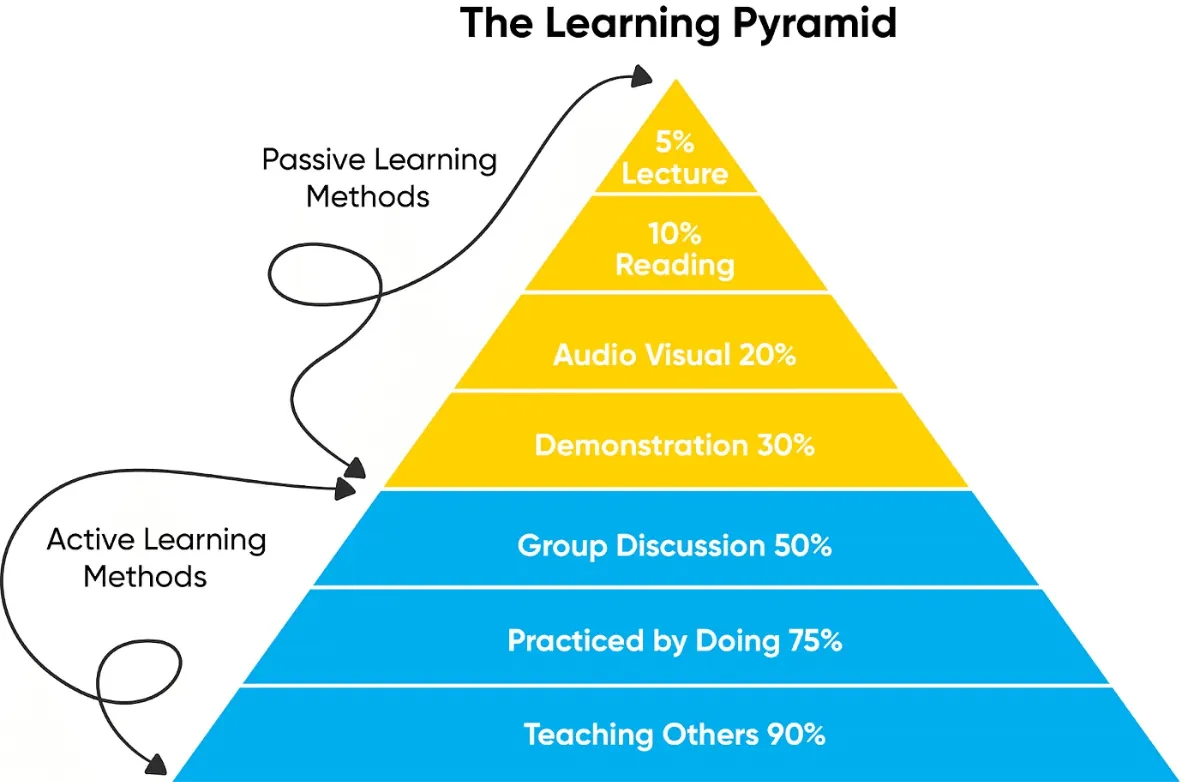
Explain it as if you were teaching a child, or someone with no prior knowledge of the topic. Use simple words, avoid jargon, and try to break it down into small, easy-to-understand parts. The simpler your explanation, the deeper your understanding.
Teaching helps you organize your thoughts and distinguish between what you truly understand and what you have merely memorized.
3. Identify the Gaps
As you explain, you will notice parts where your understanding is incomplete, or parts that are hard to simplify. These gaps show the areas that need more attention. Write down these gaps and questions — they are like a treasure map showing you where to dig deeper.
4. Simplify and Repeat
Go back and review the gaps you identified. Dig deeper into those areas, learn, and fill in the missing pieces. Then try teaching it again, this time simplifying even further. The goal is to refine your explanation until it is completely clear, not only to others but to yourself. Repeat this process until you can confidently explain the topic in the simplest terms.
Let's Look at an Example
Say, for example, that you want to learn about closures in JavaScript.
1. Read and understand the basics from books, tutorials, and online resources. Get familiar with the syntax and basic use cases.
Here is an example:
"A closure is a function that has access to its own scope, the scope of the outer function, and the global scope."
function outerFunction(outerVariable) { return function innerFunction(innerVariable) { console.log(`Outer Variable: ${outerVariable}`); console.log(`Inner Variable: ${innerVariable}`); }; } const newFunction = outerFunction("outside"); newFunction("inside");
2. Teach it to someone
Explain it as if you were teaching someone with no programming background. Imagine you are explaining it to a child or to a friend who has never written code. Avoid jargon like "lexical environment" and explain it in simple words.
Example: "Imagine a box. There is a message inside the outer box, and you can put another box inside it. The inner box can see both its own message and the outer box's message. A closure in JavaScript is like that — it lets a function inside a function access the outer function's variables."
3. Identify the gaps
As you teach, you will run into parts that are hard to explain, or parts where you don't fully understand why it works.
For example:
-
Why does the inner function remember outerVariable even after outerFunction has finished running?
-
How does this behavior differ from other programming languages?
Write down these questions and explore the topic again to deepen your understanding.
4. Simplify and repeat
After identifying the gaps, research them and fill in the missing pieces. Then simplify your explanation further and try teaching it again.
Your revised explanation might look like this — imagine you are setting off on an adventure. Before you leave, your parent (the outer function) prepares a special backpack (the closure) for you. Inside this backpack, they put important items (the variables from the outer function). And even after you have left home (after the outer function has finished running), you can open the backpack and use the items your parent packed for you.
And here is the magical part: no matter how far you go, and no matter how much time passes after you leave home, the items in the backpack are always there for you to use. The backpack is private — only you can access it, and it belongs to you alone.
In JavaScript terms:
-
The parent (the outer function) runs and prepares the backpack (the closure).
-
The child (the inner function) carries the backpack, along with the parent's variables, even after the parent has finished running.
The Feynman Technique forces you to engage actively, connect ideas, and understand a subject in a way that sticks. It is not just about learning; it is about aiming for mastery.
So the next time you set out to learn something new, think of it as an adventure. With the right approach, the journey can be just as valuable as the destination.
Happy learning!
This article was originally written in English by our engineer Surendra Sedai in January 2025 and translated into Japanese.
The original English version is available here:
https://articles.wesionary.team/learning-about-learning-with-feynman-ec715ca40f0f
Careers
We are working to turn product co-creation into a repeatable system. We are looking for product managers to lead product co-creation, and sales team members to bring our vision to the market!
https://wesionary.team/career/product-manager
https://wesionary.team/career/sales
For Companies Looking for a Development Partner
By making the most of global development, we deliver both high cost-effectiveness and high quality. Our experienced and diverse team understands your challenges correctly and delivers the right systems and an excellent experience. If you need help with business system development, new business development, operational efficiency, or digital transformation (DX), please contact us.